Dark-charged primordial black holes proposed as source of KM3NeT and IceCube neutrinos in theory paper
A theoretical model in which primordial black holes carry a dark charge reconciles the KM3NeT and IceCube neutrino data and leaves room for them to make up all dark matter.
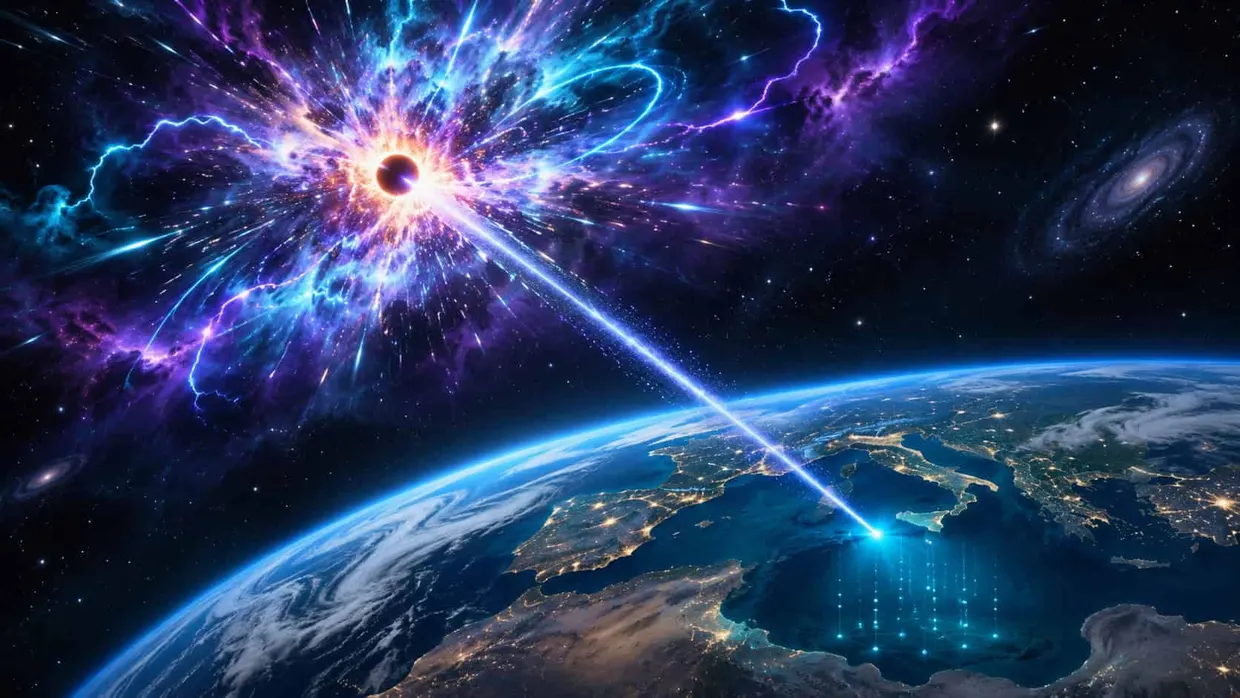
Physicists at the University of Massachusetts Amherst have proposed that exploding primordial black holes with a dark charge could explain the highest-energy neutrinos seen so far. The model was published in Physical Review Letters. The KM3NeT experiment recently observed a neutrino with an energy around 100 PeV, and IceCube has detected five neutrinos with energies above 1 PeV aps.org
Physical Review Lettersaps.orgOpen source ↗. There are no known astrophysical sources for them. The work is theoretical: no such black hole has been observed.
Why standard black holes do not fit
Primordial black holes formed in the early universe could emit particles through Hawking radiation. The lighter a black hole is, the hotter it is and the more it emits, so evaporation accelerates until the black hole explodes, as co-author Andrea Thamm describes it.
For ordinary Schwarzschild black holes, this interpretation runs into three problems. The burst rates inferred from KM3NeT and IceCube disagree with each other. They also conflict with indirect constraints from the extragalactic gamma-ray background. Finally, an associated gamma-ray signal was not observed at LHAASO.
A dark u(1) charge and a quasi-extremal state
The authors consider a population of primordial black holes charged under a new dark u(1) symmetry. Such black holes would spend most of their time in a quasi-extremal state aps.org
Physical Review Lettersaps.orgOpen source ↗. According to the authors, evaporation nearly stops in this state. The black hole later discharges through the dark Schwinger effect, producing pairs of dark electrons, and then explodes.
In this scenario the neutrino emission at 1 PeV may be more suppressed than at 100 PeV. The burst rates implied by the KM3NeT and IceCube observations and the indirect constraints can then all be consistent at 1σ. No associated gamma-ray signal was expected at LHAASO. The authors report that the agreement depends on the dark charge and the mass of the dark electron.
The paper also states that such black holes could constitute all of the observed dark matter in the universe. Because they spend most of their lifetime in a dormant state, they would not produce the background gamma-ray glow that rules out standard primordial black holes as dark matter, according to the authors.