Comet 3I/ATLAS dust dominated by ~100 μm grains, Nordic Optical Telescope data show
Observations in July–September 2025 link the delayed dust tail of interstellar comet 3I/ATLAS to large, slowly ejected grains; dust output was about 180 kg/s at 2 au.
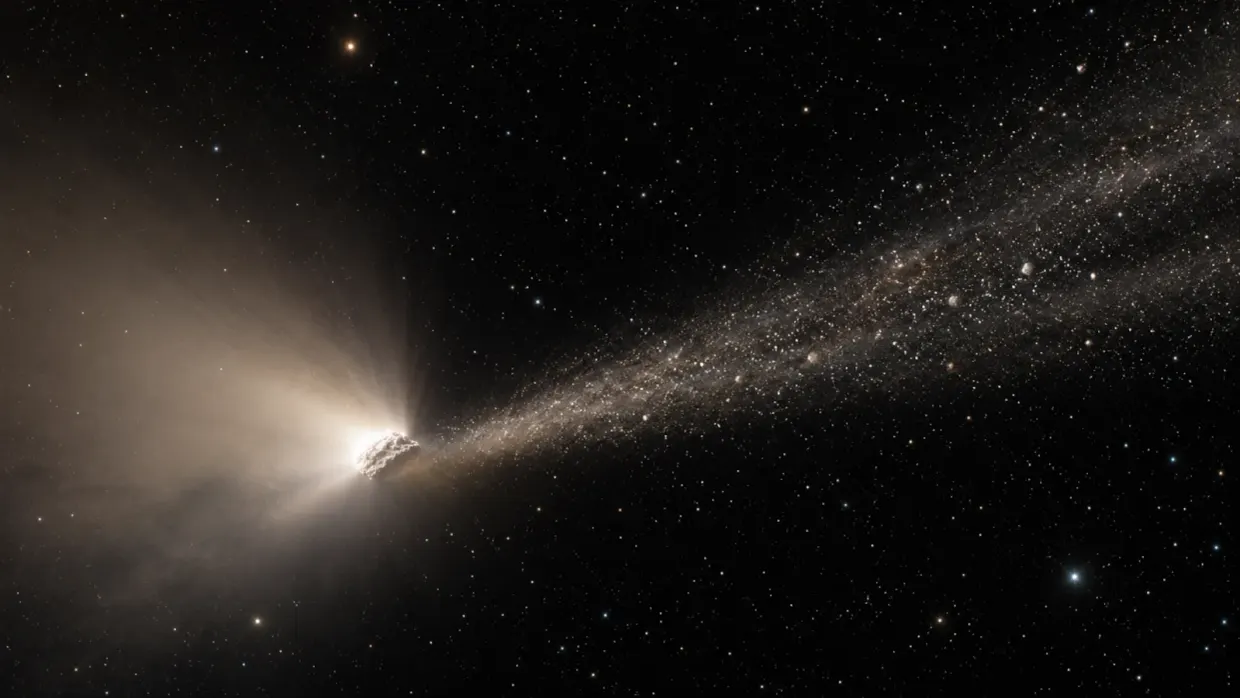
Interstellar comet 3I/ATLAS first showed a dust fan directed toward the Sun, and a tail pointing away from the Sun became dominant only later. A team led by David Jewitt at the University of California, Los Angeles observed the comet before perihelion with the Nordic Optical Telescope (2.5 m mirror, La Palma) in July–September 2025. The results are published in The Astrophysical Journal Letters iop.org
The Astrophysical Journal Lettersiop.orgOpen source ↗.
Dust size and the delayed tail
In the early July observations the comet showed a Sun-facing dust fan. At later dates the morphology was dominated by an antisolar dust tail. The authors attribute the delayed emergence of the tail to the large size of the optically dominant particles, with an effective radius of 100 μm, and to their slow ejection at about 5 m/s. Such particles respond sluggishly to solar radiation pressure.
Micron-sized particles may be present, but not in numbers sufficient to dominate the scattering cross section. The authors suggest that their relative depletion may reflect interparticle cohesion, which binds small particles more effectively than large ones. The particle size was inferred from the observed dust distribution, not measured on individual grains. If release began before the first images, the dominant grains could be larger than 100 μm.
Brightening and dust production
Fixed-aperture photometry over heliocentric distances of 4.6–1.8 au follows a power law with index n = 3.8 ± 0.3, assuming a phase function of 0.04 ± 0.02 mag per degree iop.org
The Astrophysical Journal Lettersiop.orgOpen source ↗. This corresponds to dust production varying as r_H^−1.8±0.3. A dependence close to r_H^−2 is expected for a strongly volatile material and agrees with independent spectroscopy showing that carbon dioxide is the primary driver of activity.
The index is unremarkable among solar system comets, where n is widely dispersed. It therefore gives no basis for calling 3I either dynamically old (thermally processed) or new (pristine).
The authors estimate dust production in 3I at about 180 kg/s at 2 au. For 2I/Borisov at the same distance the figure is about 70 kg/s. A similar preponderance of 100 μm grains was reported in 2I/Borisov, but its heliocentric index was much smaller, n = 1.9 ± 0.1, which is asteroid-like. The dust quantities are approximate, since they depend on assumptions about grain size, density, reflectivity and residence time of the dust.
Sources · 2
Found a mistake?Read also