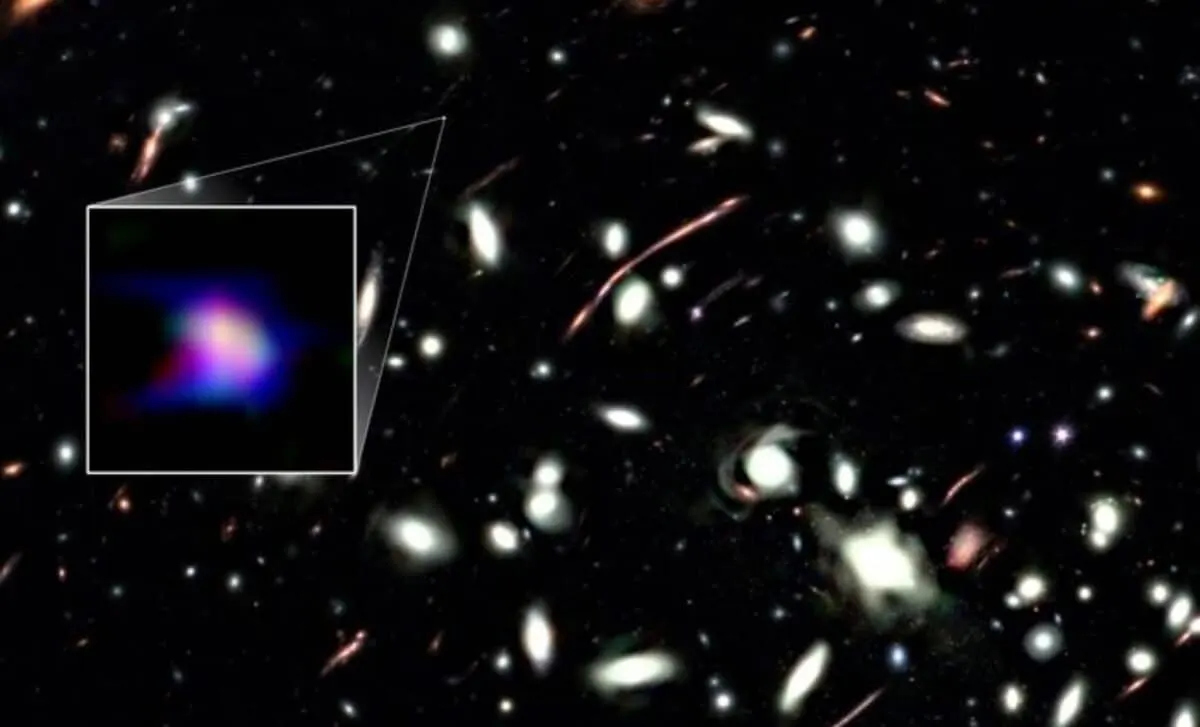
Chandra and JWST reanalysis lowers UHZ1 X-ray excess to 2.0–2.9σ, weakening black hole claim
A reanalysis of 2.2 Ms of Chandra data and new JWST/MIRI images finds no compelling evidence of a luminous obscured black hole in galaxy UHZ1 at z = 10.054.
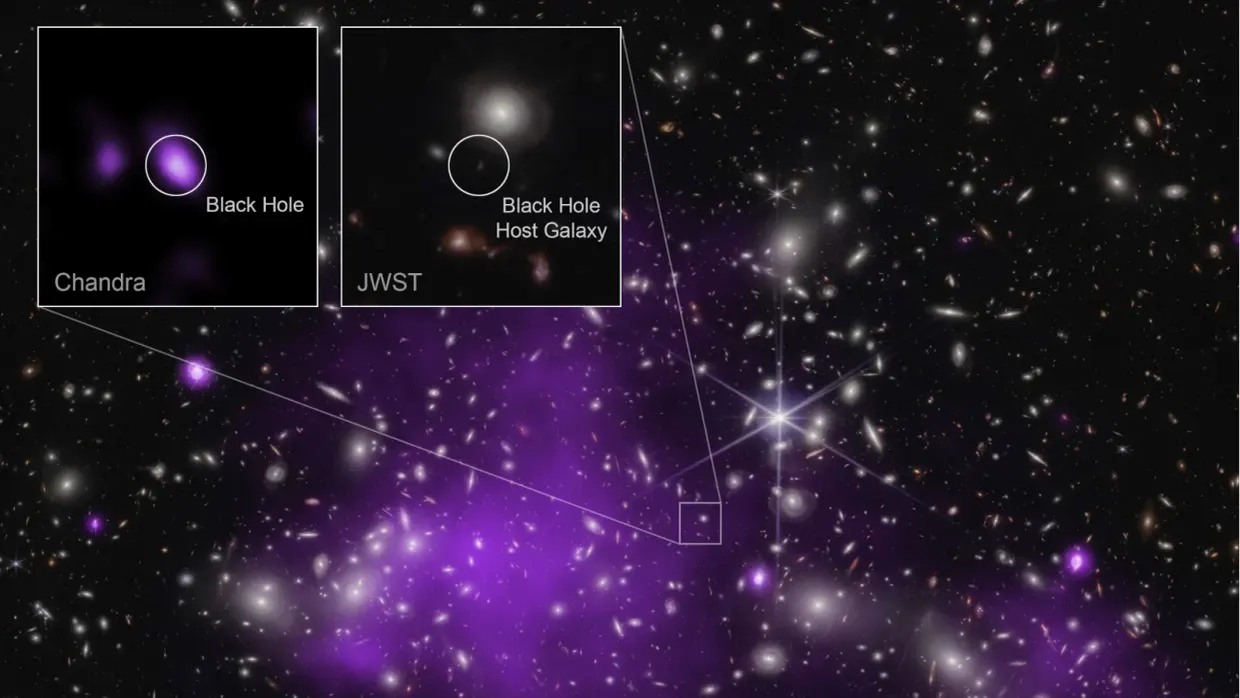
A team at the University of Michigan led by Fan Zou has reanalysed X-ray and infrared observations of UHZ1, a gravitationally lensed galaxy at spectroscopic redshift z = 10.054, seen about 480 million years after the Big Bang. According to a paper in The Astrophysical Journal, the hard X-ray excess once read as a sign of a direct collapse black hole reaches a significance of only 2.0–2.9σ, against the 4.2–4.4σ originally reported iop.org
The Astrophysical Journaliop.orgOpen source ↗. The authors used the full 2.2 Ms of Chandra imaging, including 0.95 Ms of previously unpublished observations.
What the earlier interpretation rested on
The earlier interpretation (Á. Bogdán et al., 2024) relied on a 2–7 keV excess detected with Chandra. It was attributed to a Compton-thick active galactic nucleus (AGN) with an inferred 2–10 keV luminosity of about 10^46 erg/s. The resulting extreme ratio of X-ray to rest-frame optical–infrared emission was taken as the signature of an “outsize black hole galaxy”. The black hole mass was estimated at 10 to 100 million solar masses.
In the new analysis the significance depends on how the Chandra images are aligned astrometrically, and the original detection is not robustly reproducible, the authors report. In 100,000 randomly varied alignments, only 0.1% reached the significance of the earlier publication. The hard X-ray signal also does not grow with the added exposure, contrary to what a steady source would show, so any excess is not persistent.
Infrared limits and spectra
UHZ1 is undetected in all nine JWST/MIRI imaging bands at wavelengths above 5 μm, which span 5.6–25.5 μm iop.org
The Astrophysical Journaliop.orgOpen source ↗. The authors fitted red and obscured AGN templates to the tightest MIRI upper limit. For any buried AGN this gives a bolometric luminosity below 1.3 × 10^45 erg/s.
Independent JWST spectroscopy shows no AGN signatures in the rest-frame ultraviolet or optical. The authors describe UHZ1 as a low-mass, metal-poor, star-forming galaxy whose stars total about 170 million solar masses. They conclude that the multiwavelength data show no compelling evidence for a luminous obscured AGN, regardless of its proposed formation channel.
Sources · 2
Found a mistake?Read also