Webb images Sagittarius B2: 10% of galactic-center gas, about half of its star formation
Webb's NIRCam and MIRI imaged the stellar nursery Sagittarius B2 near the Milky Way's center; many young stars seen by ALMA stay hidden even in infrared.
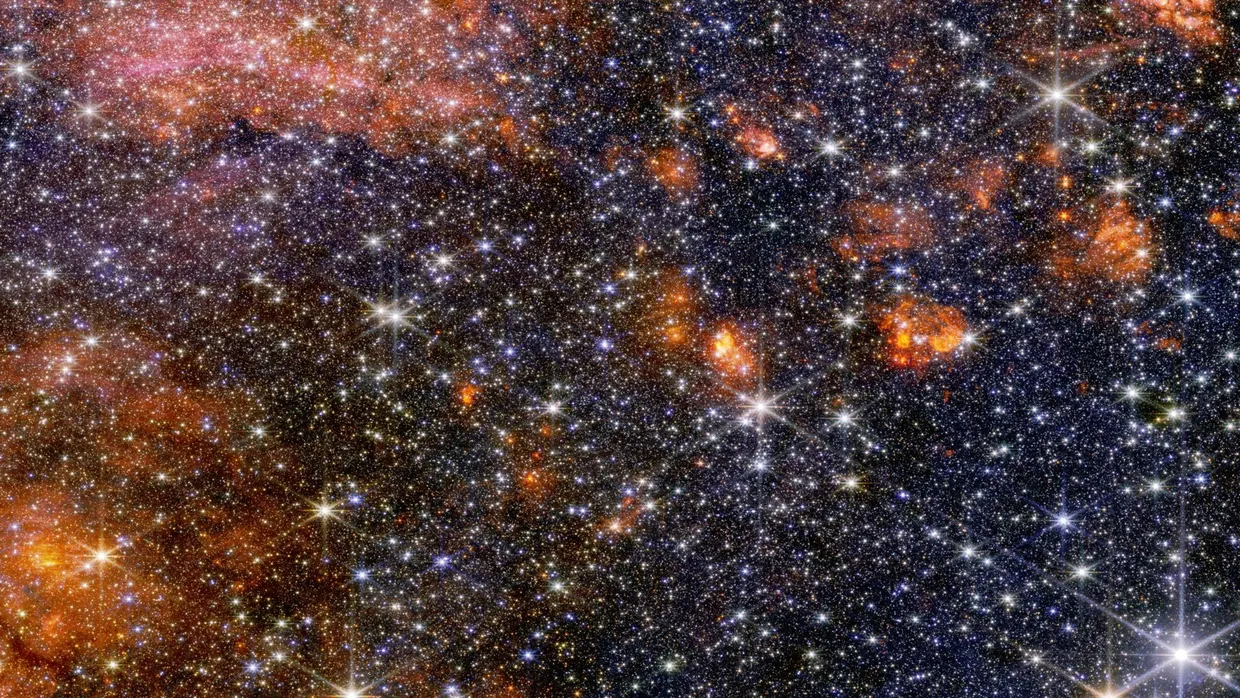
The James Webb Space Telescope imaged Sagittarius B2, a stellar nursery near the center of the Milky Way, with its Near-Infrared Camera (NIRCam). The image was released on September 24, 2025, Earth.com reports earth.com
Earth.comearth.comOpen source ↗. The observing program was led by Adam Ginsburg and Nazar Budaiev of the University of Florida.
Why this cloud stands out
Sagittarius B2 lies a few hundred light-years from Sagittarius A*, the supermassive black hole at the Milky Way's center. According to NASA's release, it holds about 10 percent of the gas in the galactic center but accounts for roughly half of its star formation. The team used Webb to examine how massive stars form in this dense environment.
Stars begin in cold molecular clouds, where gas gathers into denser clumps. As a clump gains mass, its gravity can start a collapse that heats the material and produces a protostar. If the core becomes hot and compressed enough, hydrogen nuclei begin to fuse into helium.
What infrared shows and what it misses
Near-infrared light passes through part of the dust, so the NIRCam image shows crowded star fields, luminous clouds and dark structures earth.com
Earth.comearth.comOpen source ↗. A companion image from the Mid-Infrared Instrument (MIRI) emphasizes warm dust, and far fewer stars are visible in it, because only the brightest stars emit strongly at these longer wavelengths.
The observations used 14 filters covering wavelengths from 1.5 to 25 micrometers. They revealed a layered cloud containing both exposed massive stars and deeply obscured populations. The researchers also identified candidate regions of gas energized by massive stars that earlier radio observations had missed.
MIRI detected radiation escaping from the embedded cluster Sagittarius B2 North along cavities associated with outflows. However, many young stellar objects previously detected with the ALMA radio telescope remained invisible to Webb. In the infrared images, part of the star formation in the cloud stays hidden behind gas and dust.