ESA's Hera probe reaches Didymos and Dimorphos and begins early characterisation
Hera flies around the asteroid pair at 12 cm/s, about as fast as a crawling insect, to study the effects of NASA's DART impact on Dimorphos in 2022.
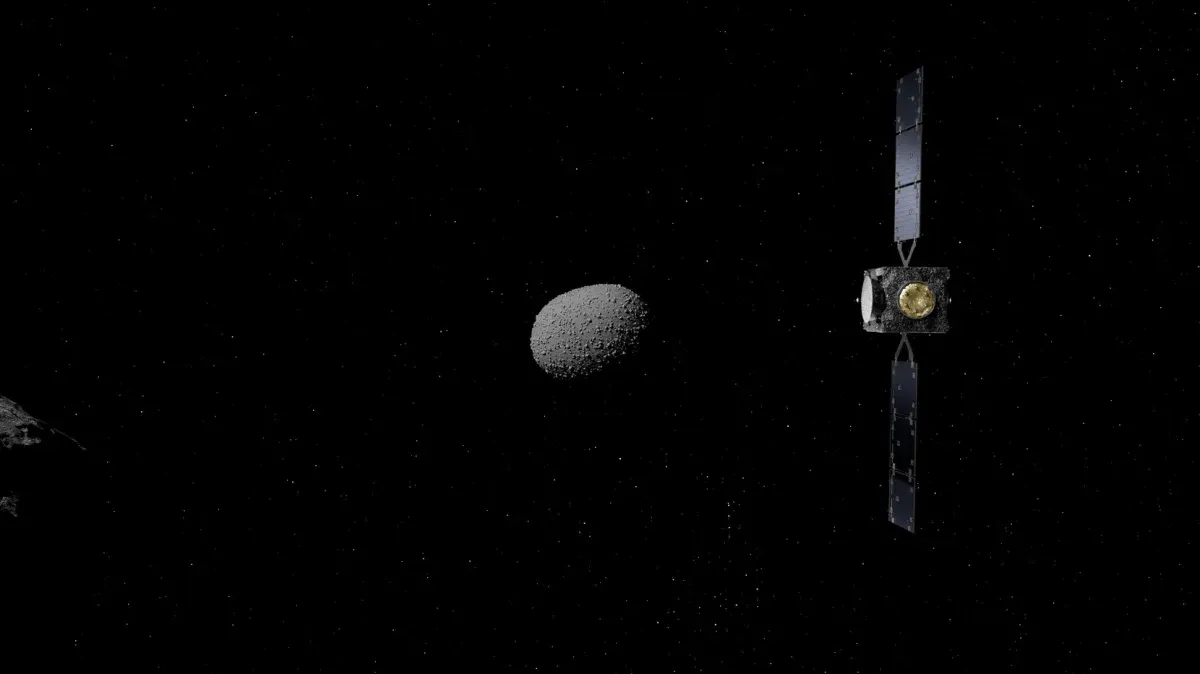
The European Space Agency's Hera planetary defence spacecraft has reached the binary asteroid system Didymos, according to esa.int. The probe, about the size of a small car, is now 25–30 km from the pair and has begun its early characterisation phase esa.int
esa.intesa.intOpen source ↗. It is 196.5 million km from Earth.
"Our aim right now is to gather the big-picture findings of relevance to supporting the mission's planetary defence goals," said mission scientist Michael Kueppers. Hera's images will show for the first time what a small asteroid looks like globally after a hypervelocity impact. Earlier impact models suggested many different reactions of the asteroid, and Hera should show which forecast was correct, if any.
Flight around two low-gravity bodies
The main body, Didymos, is 780 m in diameter and has gravity about 40 000 times weaker than Earth's. The moonlet Dimorphos, 151 m in diameter, has gravity about 200 000 times weaker. A traditional circular orbit is impractical in such conditions.
Instead, Hera moves around the common centre of gravity of the two bodies at a typical velocity of 12 cm/s. It travels in nearly straight lines and, on a cycle of three days followed by four days, fires its thrusters to change course by 90 degrees. The result is a series of "rectangular orbits" that keep the distance at about 25–30 km esa.int
esa.intesa.intOpen source ↗.
The scheme draws on the experience of ESA's Rosetta comet mission. If a thruster firing fails, the spacecraft simply drifts away from the asteroids instead of risking a collision, and each manoeuvre uses little propellant. Next month Hera is scheduled to move to around 20 km for the detailed characterisation phase, flying bowtie-shaped hyperbolic arcs.
The spacecraft is controlled from ESA's ESOC centre in Darmstadt, Germany. The team connects with it for about eight hours a day through four 35-m Deep Space Antennas in Argentina, Spain and Australia. The Flight Dynamics team uses telemetry to determine Hera's position relative to the asteroids and to prepare the telecommands for its next location.
What Hera has to find out
On 26 September 2022, NASA's 580-kg DART spacecraft hit Dimorphos at 6.1 km/s. The collision sent a plume of debris across 10 000 km and shortened the asteroid's orbit by around 33 minutes esa.int
esa.intesa.intOpen source ↗.
Open questions remain. It is not known whether the impact left a crater or reshaped the asteroid entirely, or what the exact makeup, structure and mass of Dimorphos are. These properties should explain why the deflection was much greater than simulations predicted.
Over the coming months Hera will carry out a close-up investigation of the impact site with several instruments. It will also deploy two shoebox-sized CubeSats for a still closer survey, eventually progressing to landing.