ExoMars TGO detects HCl in the Alba Mons region in aphelion season; possible sign of active magma
Hydrogen chloride found in Mars's cold season only in the Alba Mons region, next to fresh narrow fissures, is best explained by ongoing igneous processes, the authors report.
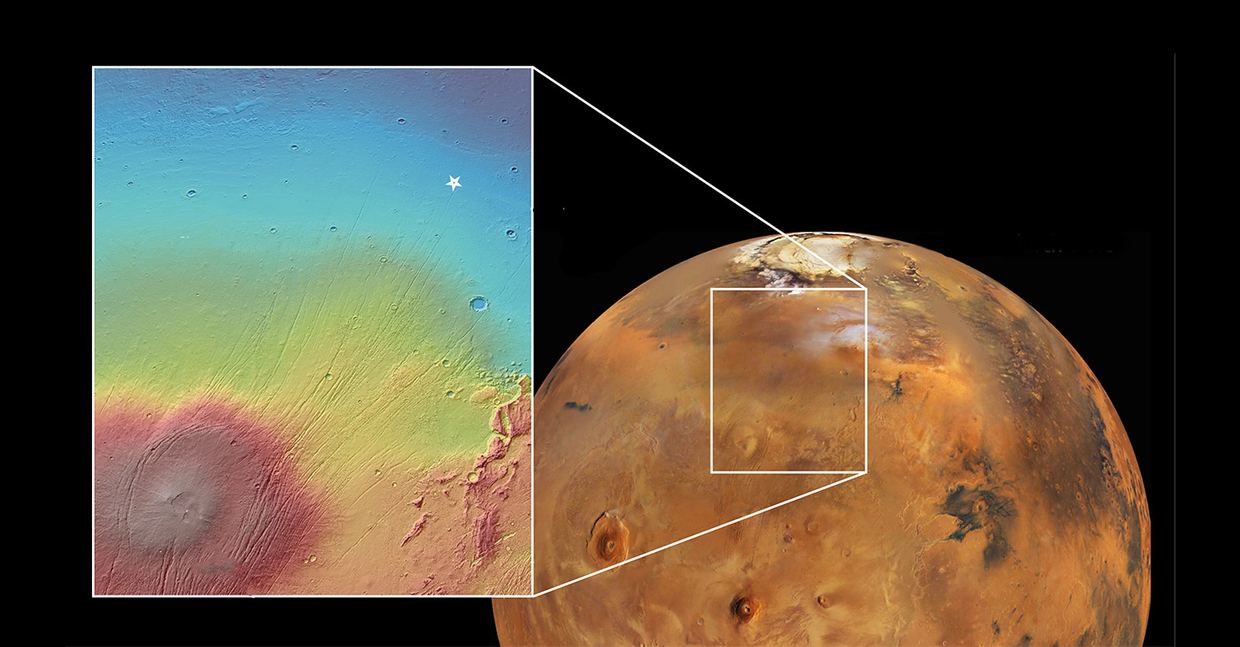
An international team led by Alexander Trokhimovskiy of the University of Bern reported in Science Advances detections of hydrogen chloride (HCl) in the Martian atmosphere during the cold aphelion season. The detections are isolated in the Alba Mons region doi.org
Science Advancesdoi.orgOpen source ↗. The data come from the Atmospheric Chemistry Suite on the ESA ExoMars Trace Gas Orbiter, which analyzes absorption spectra of sunlight passing through the atmosphere. In the same area the authors identified fresh fissures narrower than 1 meter
doi.org
Science Advancesdoi.orgOpen source ↗.
Why hydrogen chloride is a marker
Mars has long been considered geologically dead, because its most prominent volcanic formations, including Olympus Mons, are billions of years old. Evidence of ongoing activity has been accumulating, however. NASA's InSight lander recorded marsquakes from 2018, many originating in the Cerberus Fossae region. Volcanic deposits there are only a few tens of thousands of years old. Clues to volcanism younger than tens of millions of years have also been reported doi.org
Science Advancesdoi.orgOpen source ↗.
Sulfur dioxide, which could testify to eruptive activity, has so far not been detected. The authors note that active magma chambers may be better identified by seepage of halogen gases such as HCl. On Earth this gas is often released from fissures and gas vents in volcanic areas. It is broken down quickly by chemical processes, so any HCl detected must have been formed or released relatively recently.
Perihelion background and the new signal
Since 2021 the orbiter has detected HCl at part-per-billion levels across the Martian atmosphere during the warm perihelion period. That widespread signal was attributed to aerosol-atmospheric sources doi.org
Science Advancesdoi.orgOpen source ↗. Planetary scientists link at least part of it to perchlorate-bearing dust. In southern summer, dust storms lift this dust and higher temperatures make the perchlorate evaporate.
The new detections differ in timing and location. They were made in the cold aphelion season and are confined to the Alba Mons region doi.org
Science Advancesdoi.orgOpen source ↗. The authors interpret the narrow fissures there as potential pathways for HCl rooted into magmatic bodies at depth. According to them, the results are best explained by ongoing igneous processes in the Martian interior
doi.org
Science Advancesdoi.orgOpen source ↗.