Drosophila erecta males court only amid food odour and group motion, experiments show
In groups of Drosophila erecta flies on a food patch, food volatiles raise male arousal and visual motion amplifies it; the related D. melanogaster does not depend on these cues.
Researchers report in Nature that mating in the fly Drosophila erecta is strictly contingent on the ecological and social environment created when flies aggregate densely on a food patch doi.org
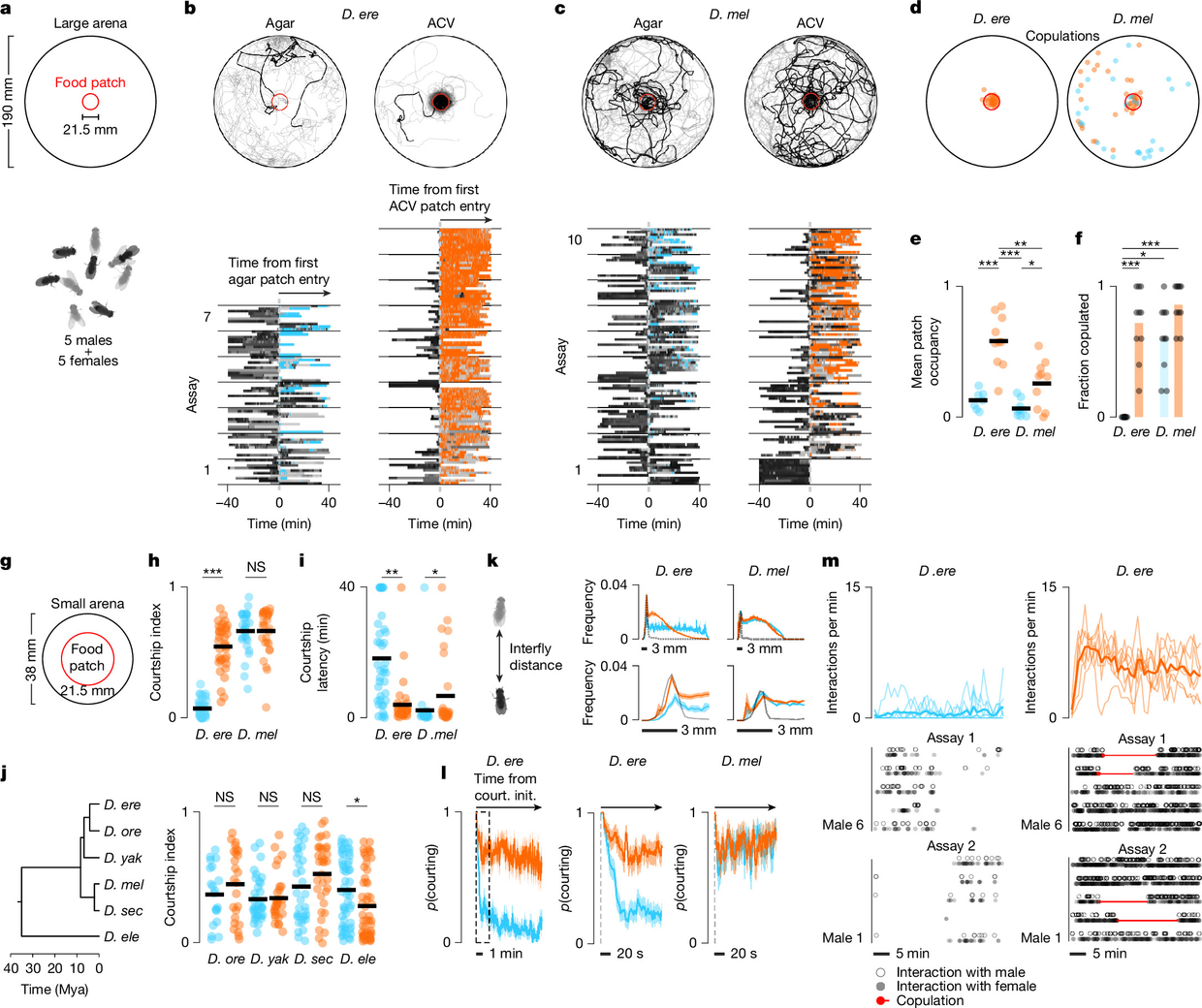
Naturedoi.orgOpen source ↗. In the experiments, groups of five males and five females were placed in a 190 mm arena with a central 21.5 mm agar patch, either plain or scented with apple cider vinegar (ACV) as a generic host odour
doi.org
Naturedoi.orgOpen source ↗. The same design was used for the close relative Drosophila melanogaster, so that the two species could be compared
doi.org
Naturedoi.orgOpen source ↗.
Flies were fed and kept as virgins, which minimised their motivation to approach the odour for metabolic needs or in search of an egg-laying site doi.org
Naturedoi.orgOpen source ↗. Both species feed on yeast that metabolise decaying fruit and are attracted to fermentation volatiles, which is why ACV was chosen
doi.org
Naturedoi.orgOpen source ↗.
Food odour and a visual feedback loop
The authors found that food volatiles directly promote male sexual arousal in D. erecta. They trigger males to sample and pursue potential mates, which produces dynamic interactions across the group doi.org
Naturedoi.orgOpen source ↗. The resulting visual motion transforms each male's visual field and further amplifies his arousal. The authors describe this as a multisensory feedback loop that promotes courtship across individuals
doi.org
Naturedoi.orgOpen source ↗. D. erecta males are highly sensitive to the increase in visual motion, in contrast to D. melanogaster, they report
doi.org
Naturedoi.orgOpen source ↗.
The authors link this dependence to the species' ecology. Reproduction and population density in D. erecta are tightly tied to the seasonal availability of its host fruit, the screwpine Pandanus, which leaves a narrow window for individuals to meet and mate doi.org
Naturedoi.orgOpen source ↗.
Species-specific thresholds in the circuit
In D. melanogaster, food odour can promote arousal but is dispensable for vigorous courtship doi.org
Naturedoi.orgOpen source ↗. Comparative circuit analyses show that species-specific arousal thresholds reflect variation in how olfactory input modulates conserved nodes controlling courtship drive. As a result, food volatiles act as a strict sensory gate only in D. erecta
doi.org
Naturedoi.orgOpen source ↗.
The authors conclude that environmental cues not directly tied to sexual signalling can strongly influence reproductive behaviour. According to them, such cues also reorganise the social landscape, so that mating occurs where reproductive opportunities are abundant doi.org
Naturedoi.orgOpen source ↗.
Sources · 1
Found a mistake?Read also