Rubin Observatory preview data reveal two new Milky Way satellites: Aquarius IV and Rubin-GC1
Two studies based on preview data from the Simonyi Survey Telescope describe the ultra-faint galaxy Aquarius IV and the star cluster Rubin-GC1, which lies behind the Milky Way's dust.
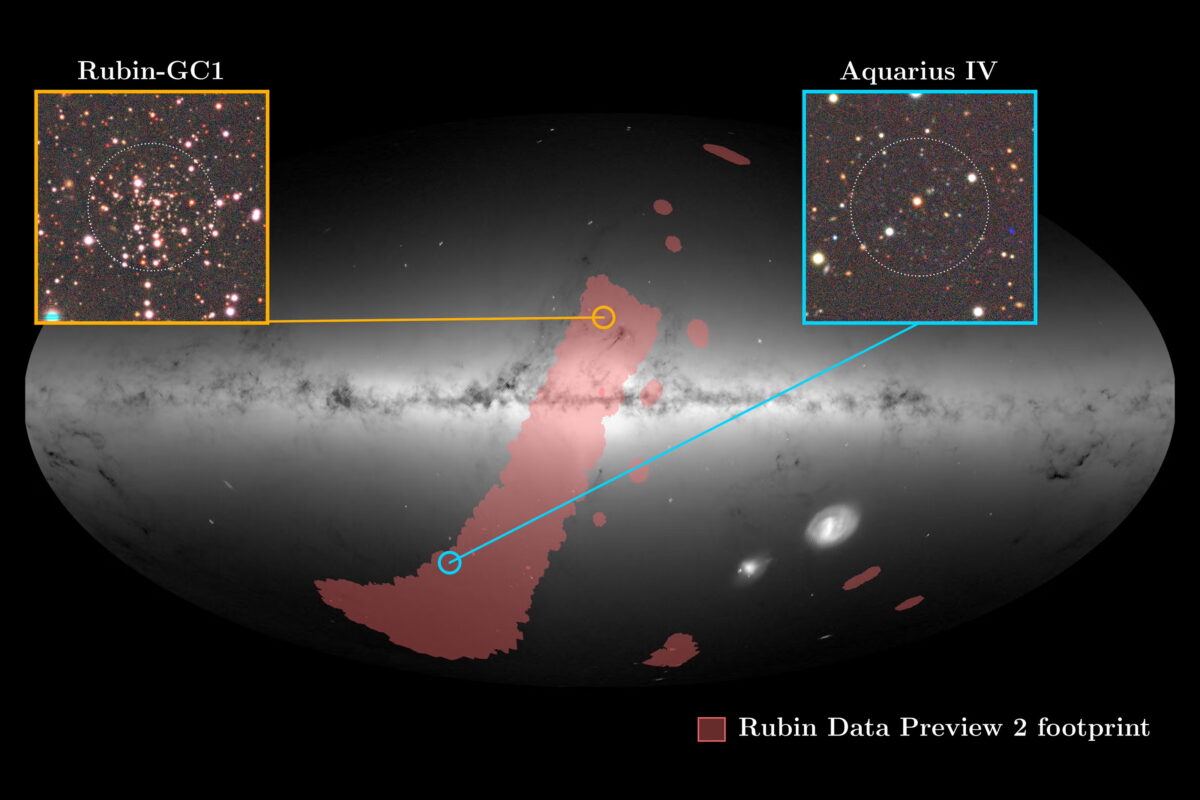
Astronomers using preview data from the Simonyi Survey Telescope at the NSF-DOE Vera C. Rubin Observatory have identified two previously unknown satellites of the Milky Way, according to miragenews.com. miragenews.com
miragenews.commiragenews.comOpen source ↗ The data were taken between April 2025 and January 2026.
miragenews.com
miragenews.commiragenews.comOpen source ↗ One study, published in Research Notes of the AAS, describes the ultra-faint galaxy Aquarius IV in the Milky Way's distant outskirts.
miragenews.com
miragenews.commiragenews.comOpen source ↗ The other, published Oct. 28 in The Astrophysical Journal Letters, describes the star cluster Rubin-GC1.
miragenews.com
miragenews.commiragenews.comOpen source ↗
Two new objects
Rubin-GC1 is located on the far side of the Milky Way, inside a murky region shrouded by cosmic dust. miragenews.com
miragenews.commiragenews.comOpen source ↗ Both objects came out of test data covering just 15% of the full LSST footprint, said Peter Ferguson, a University of Washington (UW) postdoctoral scholar and co-author of both studies.
miragenews.com
miragenews.commiragenews.comOpen source ↗
Ultra-faint galaxies such as Aquarius IV have a fraction of the stars of a larger galaxy and, according to the researchers, are almost entirely composed of dark matter. miragenews.com
miragenews.commiragenews.comOpen source ↗ William Cerny of Yale University, lead author of the Aquarius IV study, said such satellites give new opportunities to test models of galaxy formation, trace the assembly history of the Milky Way and investigate the nature of dark matter.
miragenews.com
miragenews.commiragenews.comOpen source ↗
Catalog quality and the survey
Large galaxies are often orbited by small galaxies or star clusters, but many are extremely faint. The telescope's 3.2 gigapixel sensor is the largest digital camera ever built. miragenews.com
miragenews.commiragenews.comOpen source ↗ More than 20 UW researchers worked on in-focus images, data validation before releases and an accurate catalog of known stars, galaxies and other phenomena.
miragenews.com
miragenews.commiragenews.comOpen source ↗ According to Ferguson, a handful of misclassified galaxies or spurious detections can wash out the signal of an object as faint as Aquarius IV.
miragenews.com
miragenews.commiragenews.comOpen source ↗
The Rubin Observatory began its 10-year Legacy Survey of Space and Time (LSST) in June. miragenews.com
miragenews.commiragenews.comOpen source ↗ One of its main tasks is to map the Milky Way's halo, the cloudlike sphere of gas, stars and dark matter around the main part of the galaxy, and to find hidden satellites and other substructures.
miragenews.com
miragenews.commiragenews.comOpen source ↗ About 65 satellites of the Milky Way are known, and there is speculation that hundreds more remain undetected.
miragenews.com
miragenews.commiragenews.comOpen source ↗ Marla Geha, a professor at Yale University and co-author of both studies, said continued discoveries will allow astronomers to complete the census of the Milky Way's satellite galaxies.
miragenews.com
miragenews.commiragenews.comOpen source ↗