LOFAR maps the ELAIS-N1 field 20 times sharper than before, in an image of 8 billion pixels
A Leiden-led team turned 200 hours of LOFAR data, 400 terabytes, into one image. The data are public for comparison with other wavelengths.
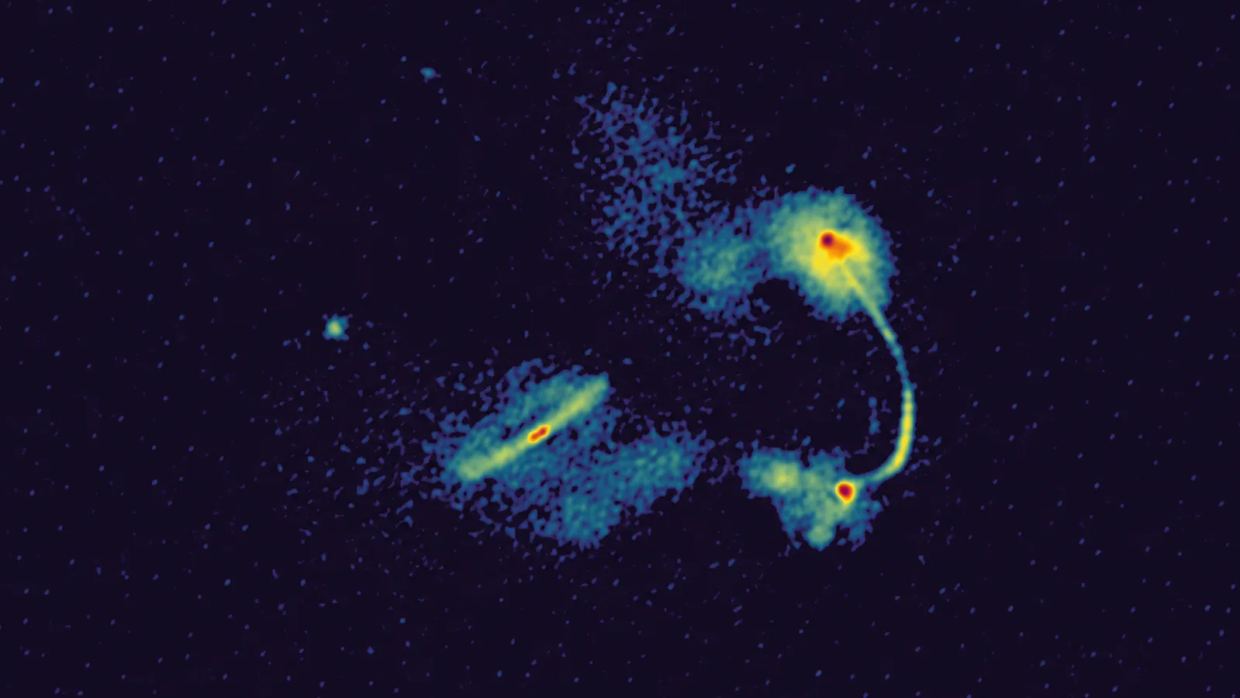
A team led by Jurjen de Jong, a postdoc at Leiden Observatory and ASTRON, has produced a new low-frequency radio image of ELAIS-N1, according to astronomie.nl astronomie.nl
astronomie.nlastronomie.nlOpen source ↗. This part of the northern sky has been studied many times and contains many faint, distant galaxies. The image is 20 times sharper than the previous most sensitive LOFAR image of the region
astronomie.nl
astronomie.nlastronomie.nlOpen source ↗.
The resolution is high enough to distinguish a coin at a distance of about ten kilometres. At this resolution the full LOFAR image contains 8 billion pixels astronomie.nl
astronomie.nlastronomie.nlOpen source ↗.
Data processing and open access
The data were collected over 200 hours and total 400 terabytes astronomie.nl
astronomie.nlastronomie.nlOpen source ↗. For years it was impossible to process such a volume of high-resolution radio-telescope data into a single image. Improved calibration and processing methods, developed by the team and its partners, have cut the computing cost by more than a factor of ten in recent years
astronomie.nl
astronomie.nlastronomie.nlOpen source ↗. "The full dataset could be processed in just a few months on Spider, the powerful data processing platform of SURF in the Netherlands," said De Jong, who led the study
astronomie.nl
astronomie.nlastronomie.nlOpen source ↗.
The data have been made publicly available to the astronomical community. Much of their scientific value lies in combining them with images of the same sky region from other telescopes, for example in the optical, infrared or X-ray range. This allows astronomers to derive properties such as the distance and mass of each radio source astronomie.nl
astronomie.nlastronomie.nlOpen source ↗.
Jets and star formation
Among the most common objects in the image are active galactic nuclei. These compact, bright regions are powered by matter spiralling into a supermassive black hole, and they can launch powerful jets. LOFAR is well suited to detecting them because of its sensitivity to extended, faint radio emission astronomie.nl
astronomie.nlastronomie.nlOpen source ↗.
In low-resolution images, distant galaxies and radio jets look like shapeless blobs. It is then hard to tell whether a source consists of several galaxies, or whether the radio emission comes from a jet or from star formation. At the new resolution, many jets are visible in detail astronomie.nl
astronomie.nlastronomie.nlOpen source ↗. Reinout van Weeren, associate professor at Leiden Observatory and a co-author, said the image offers a way to study how radio jets interact with their surroundings and how this develops over cosmic history
astronomie.nl
astronomie.nlastronomie.nlOpen source ↗.
Other sources are small galaxies forming stars. Radio waves pass through the dust that hides star formation from optical and infrared telescopes astronomie.nl
astronomie.nlastronomie.nlOpen source ↗.
According to the scientists, the work shows the potential of LOFAR2.0, the upgrade being carried out by ASTRON and its European partners. It is expected to enable more sensitive and wider high-resolution images astronomie.nl
astronomie.nlastronomie.nlOpen source ↗.
Sources · 2
Found a mistake?Read also