MIT and UCSB theorists find non-Gaussian momentum kicks for heavy quarks in quark-gluon plasma
A calculation for weakly coupled plasma shows that momentum transfer to a relativistic heavy quark has asymmetric exponential tails, unlike the Brownian bell curve.
Jean Du Plessis of MIT and Bruno Scheihing-Hitschfeld of the Kavli Institute for Theoretical Physics at the University of California, Santa Barbara (UCSB) calculated how a heavy quark moving at close to the speed of light is pushed by a weakly coupled plasma of quarks and gluons. In Physical Review Letters they report that heavy quark transport beyond leading logarithm at weak coupling is intrinsically non-Gaussian doi.org
Physical Review Lettersdoi.orgOpen source ↗. This is a theoretical result, not a measurement.
Beyond Brownian motion
In 1905 Einstein related the motion of a particle in a fluid to the fluid's microscopic structure: drag slows the particle, random kicks from the fluid's atoms and molecules keep it moving. The kicks are described by a bell-shaped probability distribution, with extreme kicks equally rare in both directions. According to Du Plessis, for relativistic particles this relationship breaks down, and it has been known for 20 years that something is missing.
The authors computed the leading-order momentum transfer kernel for relativistic heavy quarks in weakly coupled non-Abelian plasmas. They matched perturbative momentum transfer at the thermal scale to hard-thermal-loop-resummed soft physics doi.org
Physical Review Lettersdoi.orgOpen source ↗. The resulting distribution is bell-shaped for small kicks, but the longitudinal momentum transfer has asymmetric exponential tails, which the authors find crucial for equilibration dynamics
doi.org
Physical Review Lettersdoi.orgOpen source ↗. Du Plessis says large kicks are more common than the bell curve predicts. A large kick that slows the quark more than drag alone would is more likely than an equally large kick that leaves it faster than expected.
What it means for quark-gluon plasma
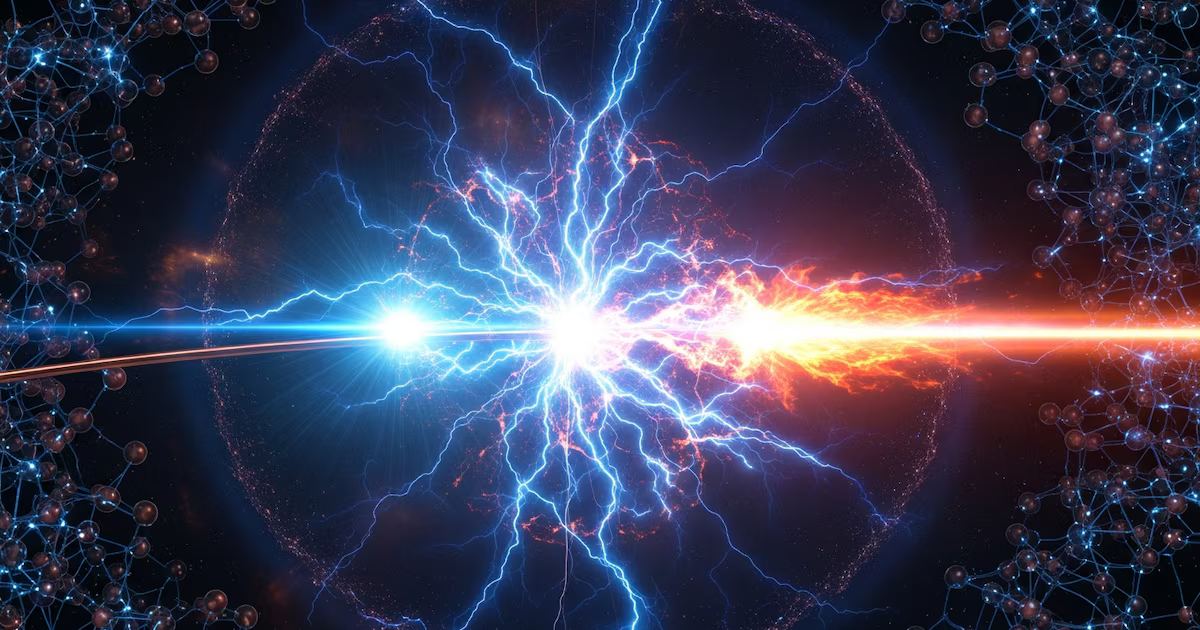
In the first microseconds after the Big Bang, matter was a trillion-degree plasma of quarks and gluons. Accelerators recreate it by colliding ions at close to the speed of light, producing droplets about the size of an atomic nucleus that last tens of septillionths of a second. Heavy quarks passing through the droplets serve as probes of its structure.
The team repeated the calculation for plasmas of different composition and found the same tilted distribution. They also found that the same structure was already present in an earlier calculation for strongly coupled holographic plasmas doi.org
Physical Review Lettersdoi.orgOpen source ↗. The authors conclude that it is not peculiar to weak or strong coupling, conformality, or supersymmetry, and they expect physical quark-gluon plasma to show it as well
doi.org
Physical Review Lettersdoi.orgOpen source ↗.
The researchers say such predictions could be compared with experiments to characterize the plasma. Du Plessis adds that the primordial plasma is likely more strongly interacting than the Brownian picture suggests: more like a liquid and less like a gas.