Chinese team tests precision laser cutting on the outside of the Tiangong space station
A laser unit on a Tiangong robotic arm cut a large object with millimetre accuracy. The technology is intended for repairing external structures of orbital stations.

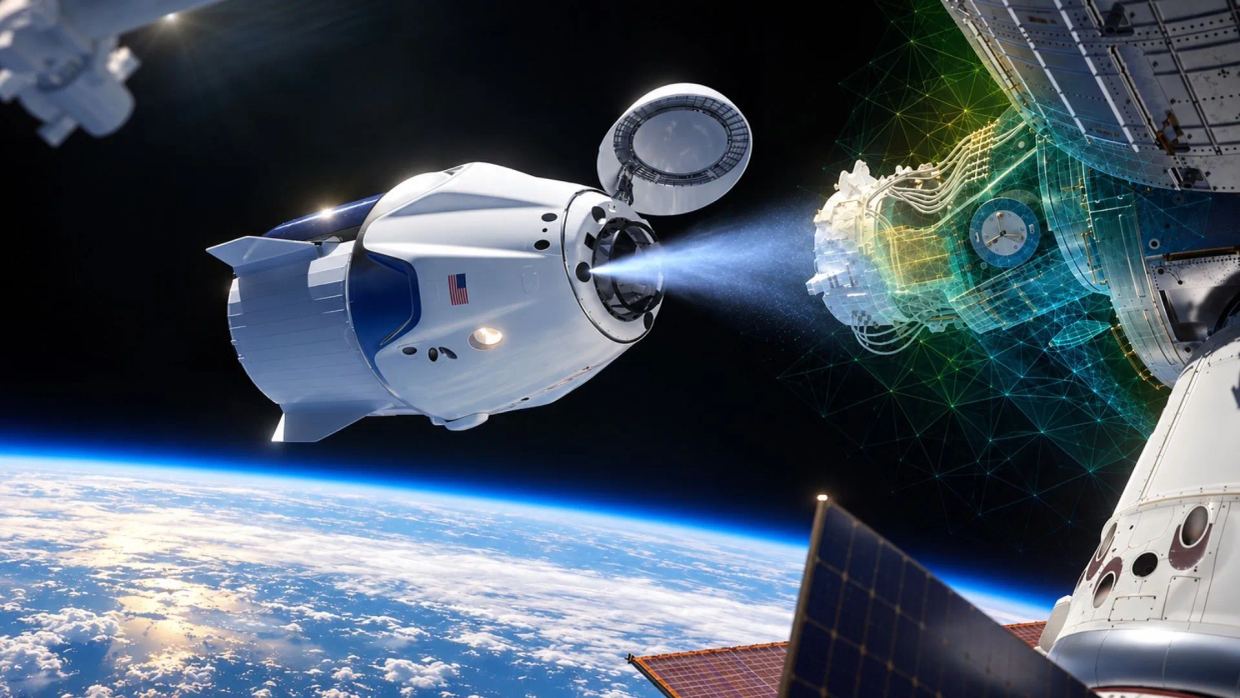
Chinese researchers have for the first time demonstrated precision laser cutting directly in orbit, 3DNews reports. The experiment took place on 30 July 2026 using equipment mounted on the outside of China's Tiangong orbital station. A laser unit fixed to a robotic arm cut a large object with millimetre accuracy. 3dnews.ru
3DNews3dnews.ruOpen source ↗
The equipment was operated remotely from a distance of several hundred kilometres. The university announced the results only recently. 3dnews.ru
3DNews3dnews.ruOpen source ↗
Developers and the positioning system
The unit was developed by a joint team from Huazhong University of Science and Technology and the Shanghai Institute of Space Power-Sources. Work began in July 2025: within a year the team went from design and prototypes to a flight unit and tests in orbit. 3dnews.ru
3DNews3dnews.ruOpen source ↗
The key feature is the positioning system. It includes a fine-adjustment mechanism with many degrees of freedom (8+2), a three-level target capture mechanism and a multi-level visual tracking system. Together they allow the unit to detect, recognise and track the workpiece when the equipment is in a complex relative position. 3dnews.ru
3DNews3dnews.ruOpen source ↗
The developers achieved millimetre positioning accuracy at a distance of hundreds of kilometres and micrometre-level control of the laser's thermal effect on the material. 3dnews.ru
3DNews3dnews.ruOpen source ↗
Test procedure and plans
During the experiment the repair module was delivered to the work area by the station's space manipulator. After aiming and target identification, the system automatically cut the object and collected the resulting debris. 3dnews.ru
3DNews3dnews.ruOpen source ↗
The design had to account for deep vacuum, intense cosmic radiation and large temperature swings. To meet these conditions the researchers adapted industrial laser equipment for space operation, tested it under vacuum and modified individual components. 3dnews.ru
3DNews3dnews.ruOpen source ↗
According to the developers, the test confirmed that the integrated technology works for automated repair of the station's external equipment without taikonauts working in open space. They plan to use such systems for regular maintenance and repair of external structures of orbital stations and other large spacecraft. 3dnews.ru
3DNews3dnews.ruOpen source ↗
NASA has comparable developments that are still waiting for tests on the ISS. The agency also expects to use lasers widely in building large orbital structures and a lunar base. 3dnews.ru
3DNews3dnews.ruOpen source ↗