Finger millet + cowpea–mung bean system beat millet–fallow by 40.2% in yield in a two-year Karnataka trial
On one farm in Karnataka, a two-year trial of twelve cropping systems found that cereal–legume intercrops followed by mung bean raised yield and net returns over finger millet–fallow.
A two-year randomized complete block experiment on one farm in the eastern dry zone of Karnataka, India, compared twelve cropping systems with three replicates per treatment, according to the Journal of Agriculture and Food Research sciencedirect.com
Journal of Agriculture and Food Researchsciencedirect.comOpen source ↗. Rainy-season sole crops and intercrops were followed by mung bean, and the finger millet–fallow system served as the benchmark. The authors assessed productivity, profitability, soil health and topsoil organic carbon (SOC) stock change, and estimated greenhouse gas (GHG) emissions with IPCC Tier 1 methods.
Yield and returns
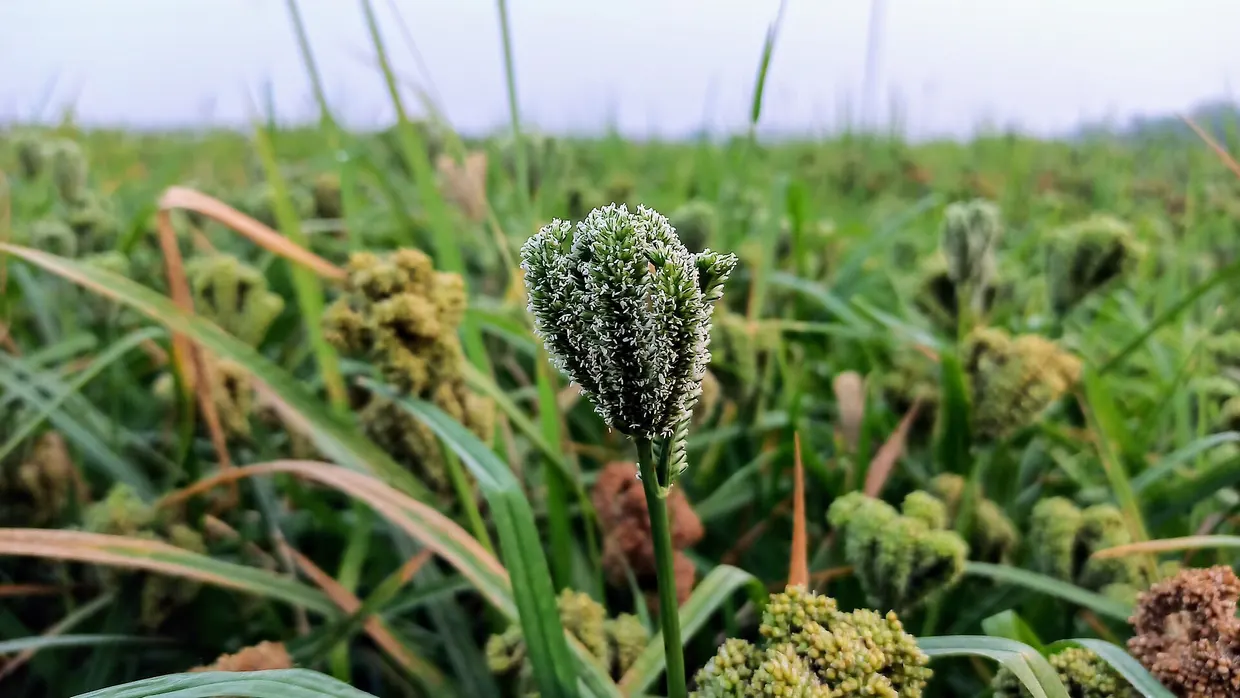
Finger millet + cowpea–mung bean gave the highest system finger millet-equivalent yield (SFEY), 4,271 ± 66 kg ha-1 yr-1, and the highest net returns, 128,562 ± 3,024 INR ha-1 yr-1. This exceeds finger millet–fallow by 40.2% and 33.5%, respectively. The effect was not limited to the rainy season: intercropping raised the mean yield of the succeeding mung bean by 9–19% and its net returns by 26–62% relative to the corresponding sole-cereal sequences.
Soil carbon and emissions
Estimated net GHG emissions were 9.2–15.3% lower in maize-based intercrops than in the maize–mung bean sequence. The maize–mung bean sequence itself had the largest mean SOC-stock gain, 0.36 Mg C ha-1. Finger millet + cowpea–mung bean had the lowest carbon intensity, 0.382 kg CO2-eq per kg SFEY.
Maize + field bean–mung bean recorded the highest mean Soil Health Index (SHI), 77.75 ± 1.8 sciencedirect.com
Journal of Agriculture and Food Researchsciencedirect.comOpen source ↗. The SHI was derived by principal component analysis (PCA) and combined with the other indicators through entropy-weighted TOPSIS ranking. Finger millet + cowpea–mung bean had the highest numerical TOPSIS score, 0.652, and the score of maize + field bean–mung bean was close to it under equal weighting.
The authors conclude that combining spatial and temporal crop diversification improved the balance among productivity, profitability, soil health and environmental performance. The data come from a single farm, and the emissions are model estimates rather than direct measurements.