Thea Energy and MIT to test full-scale superconducting coil for Eos stellarator
The partners will test a planar encircling coil at full magnetic field and full mechanical force at MIT's Plasma Science and Fusion Center, as Thea Energy targets commercial fusion by 2035.
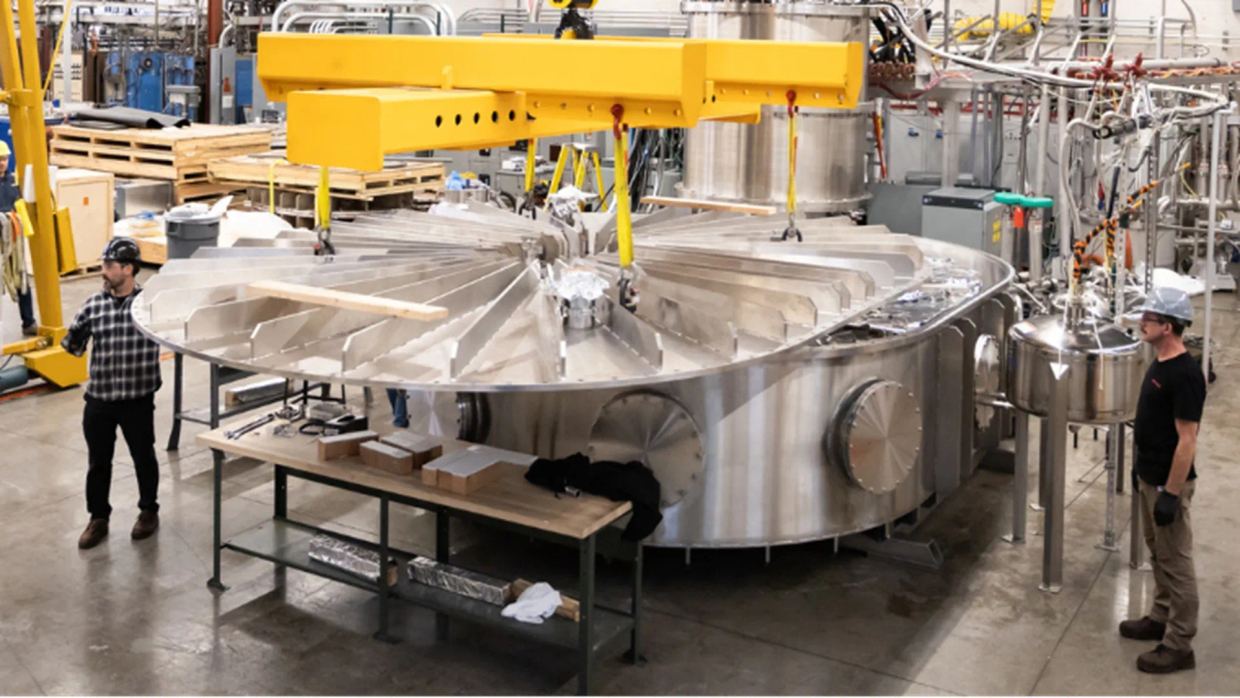
Thea Energy has partnered with the Massachusetts Institute of Technology (MIT) to test a full-scale superconducting magnet for its Eos stellarator, Interesting Engineering reports. The company aims to commercialize its stellarator technology by 2035. interestingengineering.com
Interesting Engineeringinterestingengineering.comOpen source ↗
Thea Energy and MIT's Plasma Science and Fusion Center (PSFC) will test a full-field, full-force planar encircling coil. The tests are meant to show whether the magnet can withstand the magnetic fields and mechanical forces expected during power-plant operation. interestingengineering.com
Interesting Engineeringinterestingengineering.comOpen source ↗
Planar-coil architecture of Eos
Stellarators use magnetic fields to confine superheated plasma, the electrically charged gas in which fusion reactions take place. Their magnets must maintain precise field configurations while withstanding substantial mechanical stresses. Traditional stellarator magnets have complex three-dimensional shapes, which makes them difficult and expensive to manufacture. interestingengineering.com
Interesting Engineeringinterestingengineering.comOpen source ↗
Thea Energy uses a planar-coil architecture intended to simplify magnet production, construction and maintenance. The Eos design has 12 encircling coils and approximately 300 programmable shaping magnets. The encircling coils generate the field that confines the plasma, while the smaller shaping magnets fine-tune its configuration. interestingengineering.com
Interesting Engineeringinterestingengineering.comOpen source ↗
The shaping magnets are modular: their strength can be adjusted, and they can be replaced individually to account for variations during assembly and for wear during operation. Thea Energy says it has already built and validated these shaping coils at full scale. interestingengineering.com
Interesting Engineeringinterestingengineering.comOpen source ↗
What the MIT tests cover
The work will use MIT's cryogenic testing facilities and its expertise in high-temperature superconducting (HTS) magnets. The partners will also examine the coil's efficiency under power-plant-relevant conditions and develop predictive models of its performance. interestingengineering.com
Interesting Engineeringinterestingengineering.comOpen source ↗
They will also test the magnet's resilience to help determine its reliability and support high plant availability. Thea Energy says the collaboration will help de-risk key engineering milestones on the path to commercial fusion by 2035. interestingengineering.com
Interesting Engineeringinterestingengineering.comOpen source ↗
The company's next power-plant design, Helios, will use the same planar-coil approach with both encircling and shaping magnets. Thea Energy previously announced a collaboration with NVIDIA, Synopsys, Argonne National Laboratory and Princeton Plasma Physics Laboratory on a digital twin of Helios. The MIT work, by contrast, is physical testing of the encircling magnet. Thea Energy was spun out of Princeton University and Princeton Plasma Physics Laboratory in 2022. interestingengineering.com
Interesting Engineeringinterestingengineering.comOpen source ↗