Genome study of 28,279 people names BACH2 as a fetal haemoglobin regulator in cell experiments
A multi-ancestry association study found 91 independent signals for fetal haemoglobin levels across 12 regions. Lowering BACH2 activity raised HbF in cultured human cells.
A paper on nature.com reports a genome-wide association study (GWAS) of fetal haemoglobin (HbF) levels in 28,279 individuals. Researchers from the University of São Paulo and Harvard-affiliated scientists took part in the work. The authors identified BACH2 as a regulator of HbF and described how it acts on the γ-globin genes nature.com
nature.comnature.comOpen source ↗.
HbF contains γ-globin, encoded by HBG1 and HBG2. Shortly after birth it is replaced by adult haemoglobin with β-globin, encoded by HBB. Persistently raised HbF after infancy can ameliorate symptoms of sickle cell disease and β-thalassaemia, which arise from HBB mutations nature.com
nature.comnature.comOpen source ↗.
Association study across three ancestries
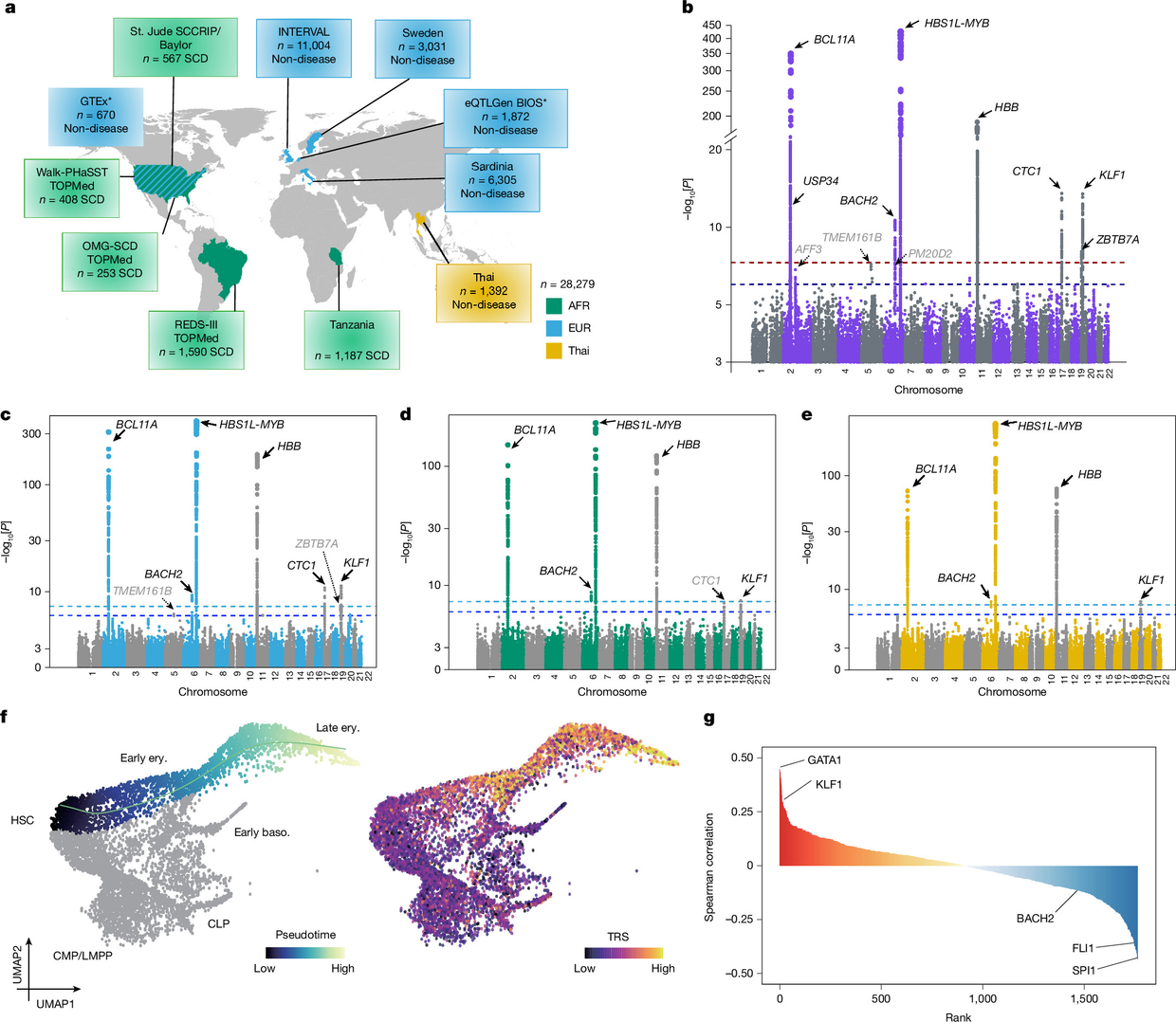
The meta-analysis combined 11 cohorts: European (n = 22,882, seven cohorts), African (n = 4,005, three cohorts) and Asian, Thai (n = 1,392, one cohort). Test statistics showed no inflation (genomic inflation factor 0.99) nature.com
nature.comnature.comOpen source ↗.
The authors found 91 conditionally independent associations in 12 genomic windows of 1 Mb. Eight windows reached genome-wide significance (P < 5 × 10⁻⁸) and four reached the suggestive threshold (P < 1 × 10⁻⁶). Besides the known HBB, HBS1L-MYB and BCL11A loci, the study found regions near the known regulators ZBTB7A and KLF1, and near CTC1, USP34 and BACH2, which had not been linked to HbF before nature.com
nature.comnature.comOpen source ↗.
BACH2 and NRF2 at the γ-globin genes
In one of the new regions, the causal variant rs1010474-C was linked to lower BACH2 expression and higher HbF levels. Direct perturbation or inhibition of BACH2 also increased HbF expression, according to the authors. In the retelling of the work, the experiments used human cells cultured in the laboratory nature.com
nature.comnature.comOpen source ↗.
Mechanistically, BACH2 restrains activation of the γ-globin genes. When BACH2 is lost, NRF2 occupies more chromatin and activation foci form at these genes. The BACH2 and NRF2 binding motifs in the γ-globin promoters overlap, but they can be edited selectively: the edits activate or repress γ-globin, respectively nature.com
nature.comnature.comOpen source ↗.
This effect did not depend on BCL11A, the repressor already targeted by genome-editing and gene-therapy approaches. The authors describe a BACH2–NRF2 axis in HbF regulation. The data come from genetic analysis and cell experiments, not from patient treatment nature.com
nature.comnature.comOpen source ↗.