Helium medium preserves Meissner signal in Bi-2212 crystals up to 20 GPa; NaCl and oil suppress it
Researchers measured Bi2Sr2CaCu2O8+δ single crystals under pressure with different media. Poor hydrostaticity masks the diamagnetic response, while resistance still shows superconductivity.
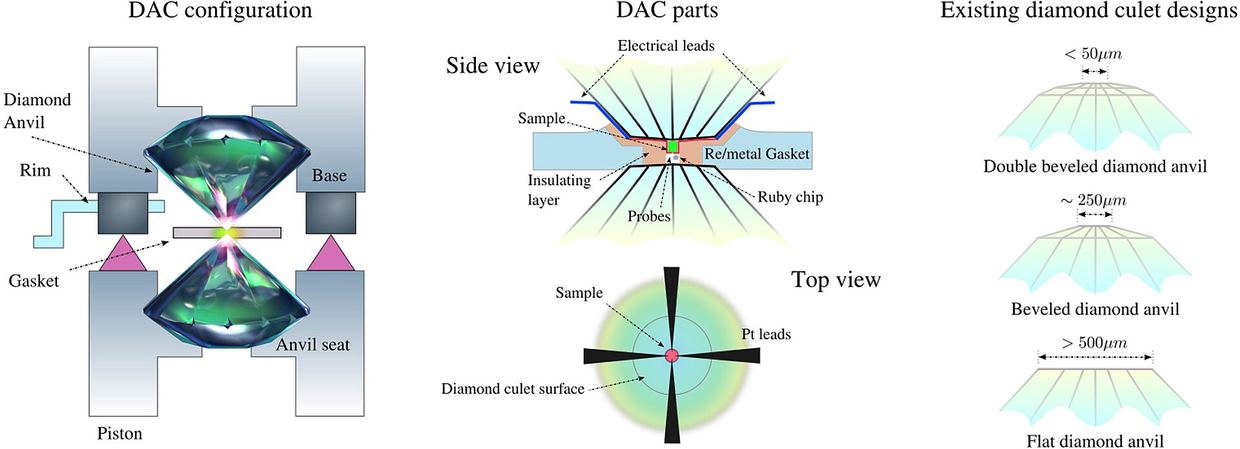
A team from Jilin University, the Center for High Pressure Science and Technology Advanced Research, Shanghai Advanced Research in Physical Sciences, Brookhaven National Laboratory and other institutes studied how hydrostaticity affects the magnetic response of superconducting crystals under pressure. The work was published on 1 October 2026 in Matter and Radiation at Extremes (vol. 11, issue 6, 067801). The authors used optimally doped Bi2Sr2CaCu2O8+δ (Bi-2212) single crystals as a model system doi.org
Matter and Radiation at Extremesdoi.orgOpen source ↗.
Superconductivity requires both zero resistance and magnetic flux expulsion, the Meissner effect. In emerging pressure-induced superconductors, including hydrides and nickelates, a clear Meissner signal in DC magnetic susceptibility under high pressure remains hard to obtain. This raises questions about the bulk nature of superconductivity in these materials doi.org
Matter and Radiation at Extremesdoi.orgOpen source ↗.
Pressure media and the magnetic response
The researchers compared DC magnetization, electrical transport and single-crystal structure with several pressure-transmitting media: solid NaCl, liquid silicone oil, helium, and a control without a medium. With NaCl and silicone oil, which give non- or quasi-hydrostatic conditions, the diamagnetic signal was strongly suppressed. With NaCl the magnetic signal was suppressed at lower pressures than with silicone oil, while electrical signatures of the transition remained detectable doi.org
Matter and Radiation at Extremesdoi.orgOpen source ↗.
With helium, the nearly ideal hydrostatic medium, the Meissner diamagnetic transitions remained observable up to 20 GPa. Diffraction spots stayed nearly sharp and round up to 20.5 GPa doi.org
Matter and Radiation at Extremesdoi.orgOpen source ↗.
Lattice distortion and transport
Single-crystal X-ray diffraction showed that the loss of the magnetic response was associated with pressure-induced lattice distortion. Under less hydrostatic conditions the authors found lattice strain and incipient polycrystallization. According to the authors, these changes may create flux-pinning centers that impede flux expulsion and weaken the Meissner response doi.org
Matter and Radiation at Extremesdoi.orgOpen source ↗.
Transport and magnetic data gave different pressure ranges. With silicone oil, zero resistance persisted to 26.0 GPa, while the Meissner signal was observable up to 17.1 GPa. The authors suggest that conduction needs only a minimal percolative pathway, whereas susceptibility depends on the superconducting volume fraction exceeding the instrument's detection threshold doi.org
Matter and Radiation at Extremesdoi.orgOpen source ↗.
The authors conclude that an absent or weak diamagnetic signal under pressure does not by itself show that bulk superconductivity has vanished. They also note that the pressure-transmitting medium and its ability to limit deviatoric stress are critical for interpreting susceptibility data, including for nickelates and hydrides doi.org
Matter and Radiation at Extremesdoi.orgOpen source ↗.