Harbin team turns rice husks into biochar that adsorbs 6.01 mmol/g CO₂ at 0 °C in lab tests
Laboratory-stage biochar from rice husks adsorbed 6.01 mmol of CO₂ per gram at 0 °C and kept 92.05% of its capacity after 20 cycles, a candidate for adsorption-compressed CO₂ energy storage.
Researchers at Harbin Institute of Technology have made a porous biochar from rice husks that adsorbs CO₂ at ambient pressure and releases it over repeated cycles, according to a study in The Innovation Energy (2026, vol. 3, issue 1, article 100131) doi.org
The Innovation Energydoi.orgOpen source ↗. The material, named UHTCK, adsorbed 6.01 mmol of CO₂ per gram at 0 °C and retained 92.05% of its capacity after 20 adsorption-desorption cycles, the authors report
doi.org
The Innovation Energydoi.orgOpen source ↗.
The work addresses adsorption-compressed CO₂ energy storage, one option for smoothing the intermittency of wind and solar power. Conventional compressed-gas storage depends on high-pressure equipment, which is costly and safety-sensitive. The adsorption variant instead uses materials that bind CO₂ at ambient pressure and release it on demand, so the adsorbent must hold a lot of gas, take it up quickly and give it back easily doi.org
The Innovation Energydoi.orgOpen source ↗.
Pore structure and synthesis
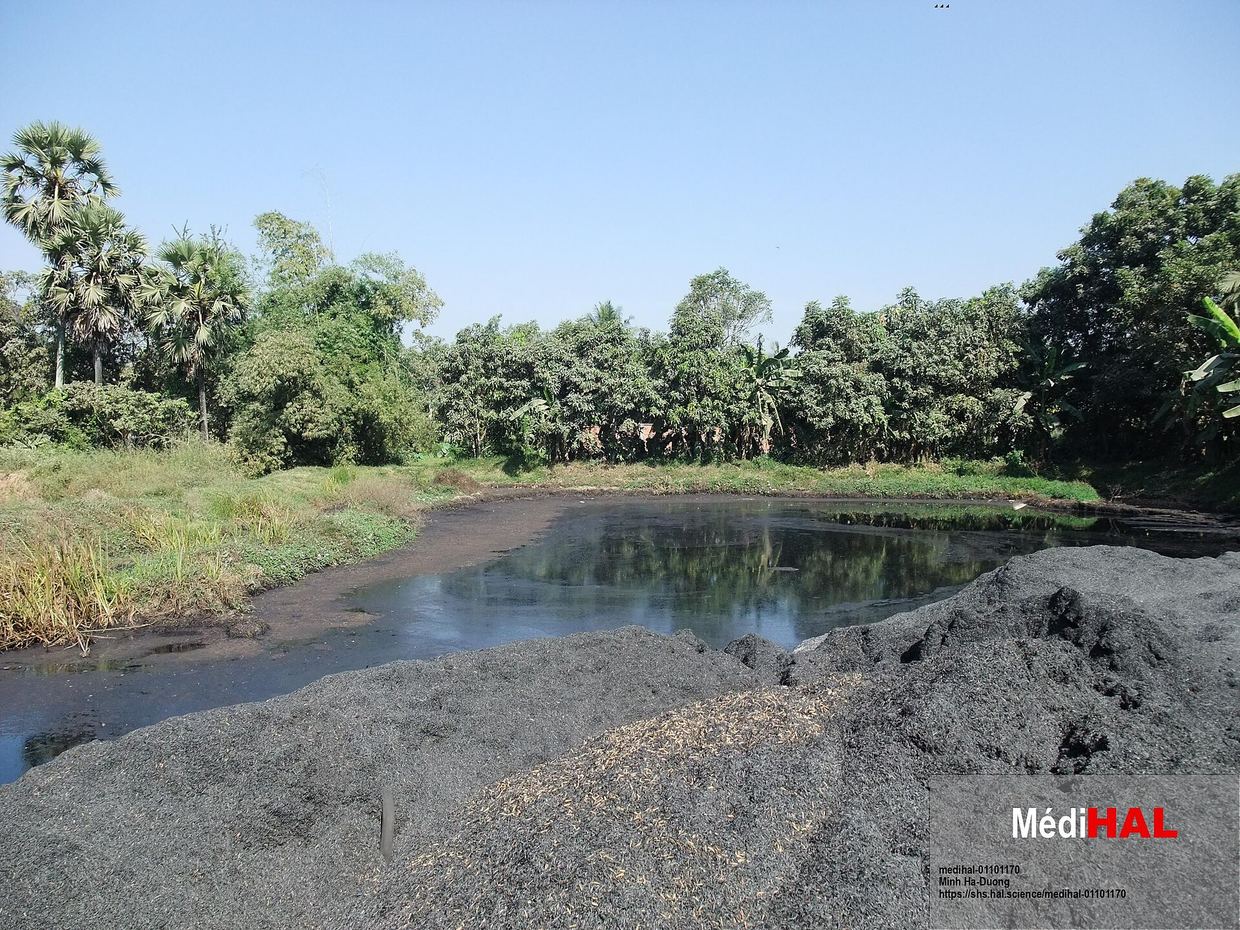
The biochar was produced in two steps: hydrothermal treatment of rice husks, an agricultural waste, followed by chemical activation with potassium hydroxide doi.org
The Innovation Energydoi.orgOpen source ↗. The result is a hierarchical pore system. Narrowly distributed micropores centered at about 0.7 nm serve as storage volume, and a developed network of mesopores works as transport channels. Nitrogen-containing functional groups are deliberately introduced onto the pore surfaces
doi.org
The Innovation Energydoi.orgOpen source ↗.
Diffusion modeling showed that the connected pores speed up gas transport during uptake and release doi.org
The Innovation Energydoi.orgOpen source ↗. Nitrogen-doped mesopores were found to optimize diffusion kinetics
doi.org
The Innovation Energydoi.orgOpen source ↗.
Mechanism from simulations
The team combined adsorption measurements with molecular dynamics simulations and density functional theory calculations to relate pore structure to adsorption-desorption equilibrium doi.org
The Innovation Energydoi.orgOpen source ↗. The simulations showed CO₂ confined as a monolayer in micropores and accumulating near the walls of mesopores
doi.org
The Innovation Energydoi.orgOpen source ↗.
Functional groups at the pore edges raise surface polarity. Nitrogen and oxygen groups form weak, electrostatic, hydrogen-bond-like interactions with CO₂: strong enough to hold the molecules, weak enough to let them leave quickly doi.org
The Innovation Energydoi.orgOpen source ↗. According to the authors, high microporosity provides the storage capacity, while nitrogen-functionalized surfaces and mesopores balance adsorption and heat, which meets the requirements of adsorption-compressed CO₂ storage at ambient conditions
doi.org
The Innovation Energydoi.orgOpen source ↗.
The study remains a laboratory materials investigation. Capacity was measured at 0 °C, and real storage systems will impose their own temperature and pressure schedules. The authors present the combination of ordered multiscale pores and controlled surface chemistry as a set of design principles for CO₂ capture materials that operate without high-pressure hardware doi.org
The Innovation Energydoi.orgOpen source ↗.