Chips with one million Cs3Sb2−xBixBr9−yIy microcrystals map composition–property links in perovskitoids
Researchers synthesized one million compositionally distinct microcrystals on 2 × 2 cm chips and measured their structure and bandgap, finding halide-segregated heterostructures.
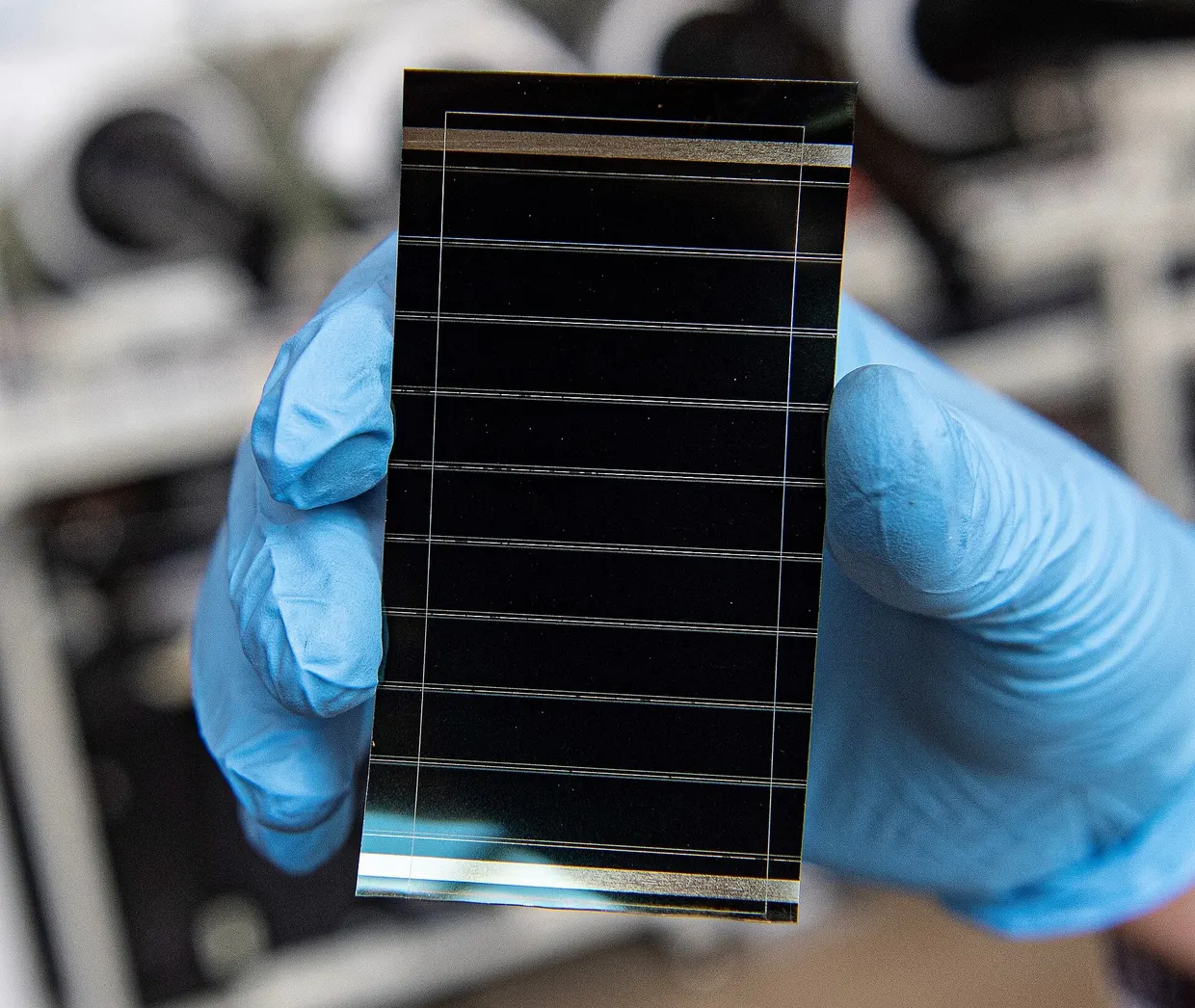
A research team has described a megalibrary-based method for rapidly studying quaternary perovskite derivatives, in a paper in Advanced Materials. The work targets perovskitoids based on Bi and Sb, whose large and tunable compositional space makes it slow to establish how composition governs structure and function, according to the authors wiley.com
Advanced Materialswiley.comOpen source ↗.
Using parylene templates, the authors synthesized one million compositionally distinct, positionally encoded Cs3Sb2−xBixBr9−yIy microcrystals on 2 × 2 cm² chips with 20 µm periodicity. Because each crystal's position encodes its composition, the whole space can be examined on a single chip.
Measurements across the compositional space
The chips were characterized with micro-area X-ray diffraction, position-resolved absorbance spectroscopy, scanning electron microscopy and confocal fluorescence microscopy. This made it possible to evaluate key optoelectronic parameters, including bandgap and phase purity, at the same time.
Non-monotonic bandgap and heterostructures
The authors observed an unusual non-monotonic bandgap shift with increasing Br content, reaching a minimum at 33% Br wiley.com
Advanced Materialswiley.comOpen source ↗. They attribute this to the formation of halide-segregated heterostructures: low-dimensional, I-rich shells surrounding Br-rich layered cores.
Phase separation was most pronounced in Sb-rich compositions, which were found to stabilize heterostructure formation. The authors conclude that megalibraries reveal complex, composition-dependent structure–function relationships in perovskitoids and offer a versatile platform for accelerating the discovery of optoelectronic-relevant materials.