Transient contacts between filaments explain the elasticity of branched actin networks
Authors report that branched actin, among the stiffest cytoskeletal networks, resists compression through proliferating interfilament contacts, like sheep's wool.
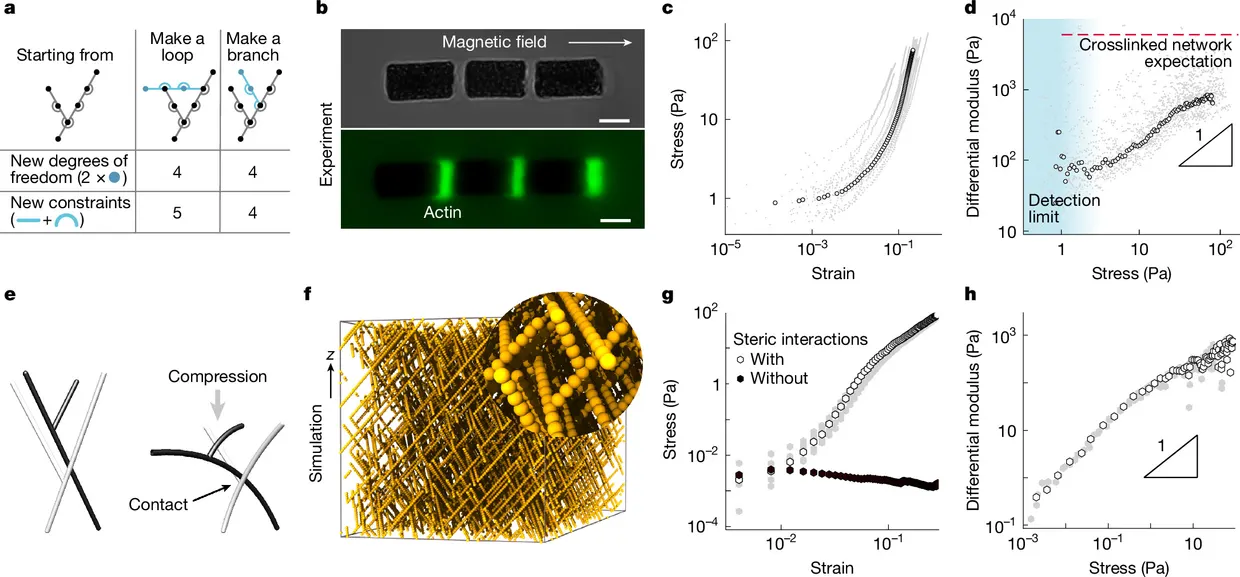
A paper in Nature examines why branched actin networks are so stiff and how they adapt to load. Cells assemble these networks dynamically to push on their environment during migration, endocytosis and the maintenance of cell–cell contact. The authors report that the mechanics of such networks are dominated by the proliferation of contacts between filaments under compression nature.com
Naturenature.comOpen source ↗.
Branched networks are among the stiffest structures in the cytoskeleton and can generate large pushing stresses against stationary obstacles. When they are grown against a controlled opposing stress, either in an atomic force microscope or inside the cell, they change their own architecture and adjust their compressional stiffness to the environment. Until now the underpinnings of this mechanics and adaptability were unclear.
Why standard elastic models do not apply
The authors show that the high density and low connectivity of branched actin place it outside the scope of standard elastic network models for actin. In those models rigidity comes from the network's own connections. Here, according to the authors, the response to compression is instead governed by the growing number of contacts that form between filaments.
This places branched actin in the same category as undercoordinated fibrous materials, for example sheep's wool. Such materials have few permanent connections per fiber, yet they stiffen as contacts between fibers multiply under load.
Entanglement under force
The authors report that when the network is grown under force, its filaments entangle as if knitted together. The entanglement traps contacts in the network structure nature.com
Naturenature.comOpen source ↗. Trapped contacts play a role similar to that of crosslinkers: they rigidify the network.
According to the study, these trapped contacts are key to the active adaptive mechanics of branched actin, that is, to its ability to adjust stiffness to the stress under which it grew. The simulation code used in the work is publicly available on GitHub, and the data are given in the main paper and the Supplementary Information.
Sources · 1
Found a mistake?Read also