Tohoku University stabilizes aluminum-foil battery anodes with manganese
Researchers alloyed aluminum with trace manganese to prevent structural degradation during cycling, developing a prototype foil anode.
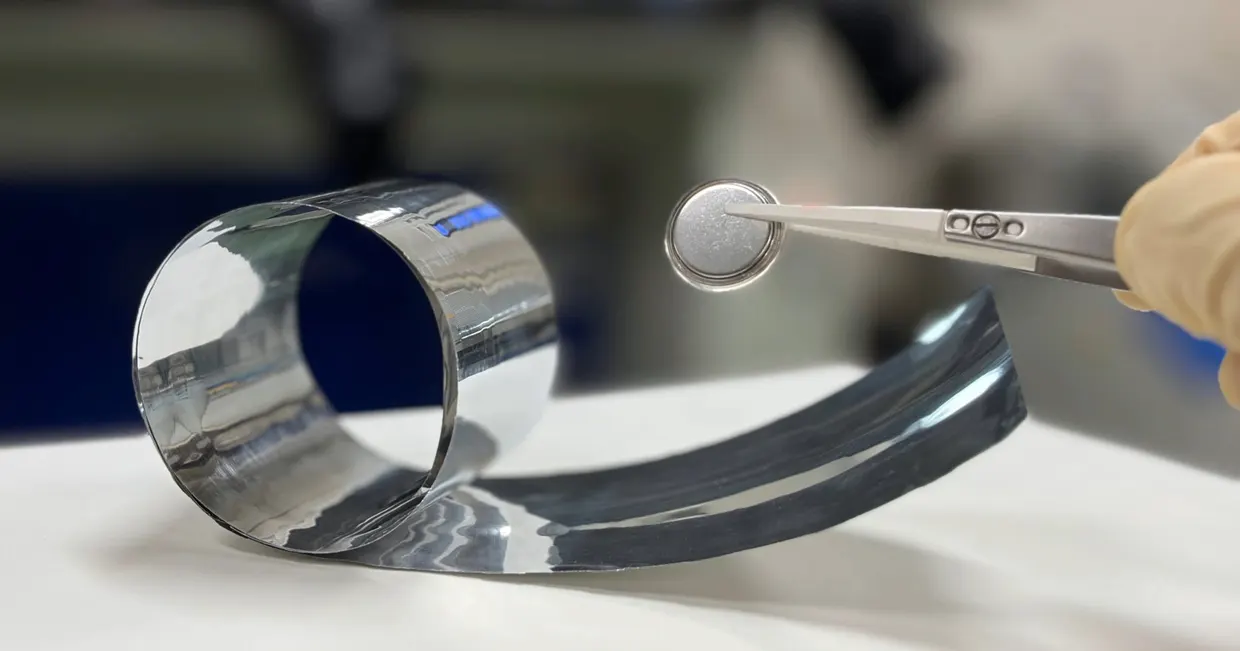
Researchers from Tohoku University and UACJ Corporation developed an aluminum-foil battery anode modified with a small amount of manganese, according to tohoku.ac.jp tohoku.ac.jp
tohoku.ac.jptohoku.ac.jpOpen source ↗. The findings were published on October 23, 2026, in the journal Communications Materials. The resulting prototype foil acts simultaneously as the lithium-storing active material and as the electrical current collector, evaluated in coin-cell test batteries.
Degradation mechanisms and manganese alloying
Pure aluminum can absorb substantial amounts of lithium, making it an attractive anode material. However, during repeated lithiation and delithiation cycles, pure aluminum develops voids, becomes porous, and deteriorates mechanically. Reactions with battery electrolytes also form passivating surface layers that degrade performance over time. While alloying aluminum with silicon has been tested to mitigate degradation, it traps lithium deep inside the material, decreasing usable energy storage capacity.
To address this trade-off, the team dissolved trace manganese uniformly into the aluminum matrix. Manganese exhibits a low chemical affinity for lithium and does not easily interact with it. By slowing the migration of lithium atoms through the metal, manganese promotes the spontaneous formation of a dense network of internal boundaries within the electrode during cell operation.
Boundary networks and commercial requirements
These newly formed internal boundaries serve as fast transport pathways that allow lithium to be extracted more thoroughly during discharge cycles tohoku.ac.jp
tohoku.ac.jptohoku.ac.jpOpen source ↗. Consequently, the aluminum electrode retains a dense, mechanically stable structure rather than collapsing into a porous network. According to the authors, this spontaneous microstructure reconfiguration prevents structural degradation without requiring complex nano-engineering processes.
The team noted that the simplified "foil-only" architecture eliminates the need for conventional copper current collectors, polymer binders, and high-temperature slurry coating stages. The researchers reported plans to further extend the cycle life of the electrode to satisfy commercial energy storage standards by testing optimized alloy compositions and protective surface coatings.