Plasmodium PfNCR1 uses a 141-residue HLH domain to reach narrow membrane contact sites
Authors identified a helix-linker-helix domain unique to Plasmodium that localizes the cholesterol transporter PfNCR1, a drug target, to membrane gaps of about 3–4 nm.
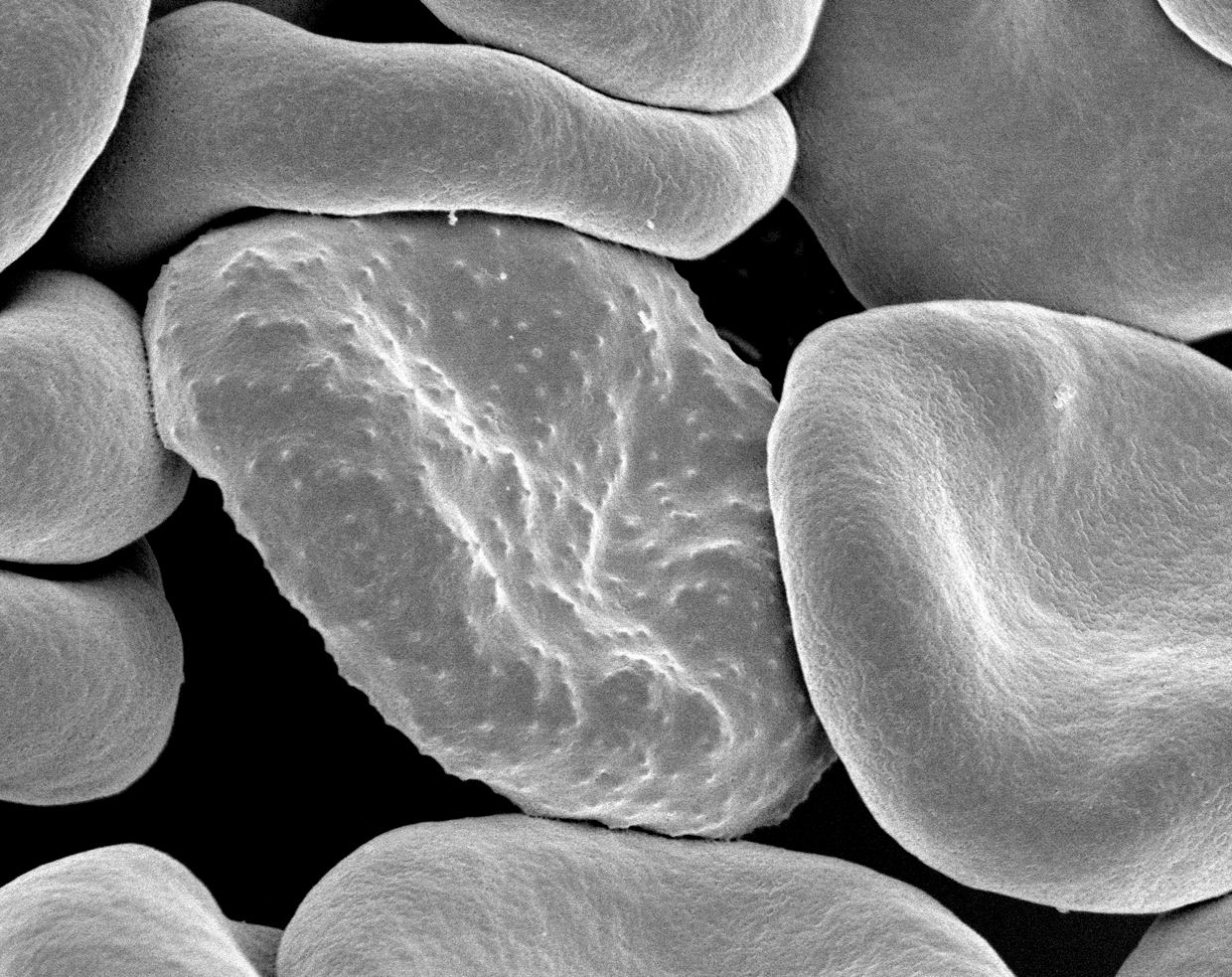
A study in Proceedings of the National Academy of Sciences describes how PfNCR1, the Niemann-Pick Type C1-Related protein of the malaria parasite Plasmodium falciparum, reaches its working position at the interface with the host red blood cell. PfNCR1 facilitates cholesterol homeostasis there and is considered a promising anti-malarial drug target. doi.org
Proceedings of the National Academy of Sciencesdoi.orgOpen source ↗ It localizes to regions covering about half of the host-parasite interface, which had been functionally uncharacterized.
doi.org
Proceedings of the National Academy of Sciencesdoi.orgOpen source ↗
These regions are exceptionally narrow membrane contact sites, where only about 3–4 nm of vertical aqueous space remains between the membranes. doi.org
Proceedings of the National Academy of Sciencesdoi.orgOpen source ↗ The authors set out to determine why PfNCR1 localizes there and what this means for cholesterol transport. The question also concerns a group of homologous proteins associated with congenital conditions and cancer.
The HLH domain
The authors identified a 141-amino-acid domain unique to Plasmodium spp.: an amphipathic helix, a linker and a second amphipathic helix, termed the HLH domain. It is necessary for efficient localization of PfNCR1 to the narrow contact sites. doi.org
Proceedings of the National Academy of Sciencesdoi.orgOpen source ↗ According to the authors, the localization relies on the physicochemical properties of the domain.
doi.org
Proceedings of the National Academy of Sciencesdoi.orgOpen source ↗
GPI-anchoring of the isolated HLH domain was sufficient to target a fluorescent protein to the regions of endogenous PfNCR1. doi.org
Proceedings of the National Academy of Sciencesdoi.orgOpen source ↗ The same held for a version in which the helices were replaced by the amphipathic helix of human ATG3.
doi.org
Proceedings of the National Academy of Sciencesdoi.orgOpen source ↗
Link to cholesterol transport
Functionally, the degree of PfNCR1 localization to narrow contact sites qualitatively correlated with its ability to maintain cholesterol homeostasis. doi.org
Proceedings of the National Academy of Sciencesdoi.orgOpen source ↗ This connects the membrane contact of the protein with its recognized transport function.
doi.org
Proceedings of the National Academy of Sciencesdoi.orgOpen source ↗
The authors conclude that the HLH domain is a key element for the localization and effectiveness of PfNCR1 in cholesterol transport, and that engineered proteins can be used to probe the narrow contact regions. doi.org
Proceedings of the National Academy of Sciencesdoi.orgOpen source ↗