Johns Hopkins model links Webb's QSO1 black hole to a primordial seed growing by gas accretion
A theoretical study compared three formation routes for black holes in Webb's Little Red Dots; gas growth of a seed of about 1,000 solar masses fits QSO1 best.
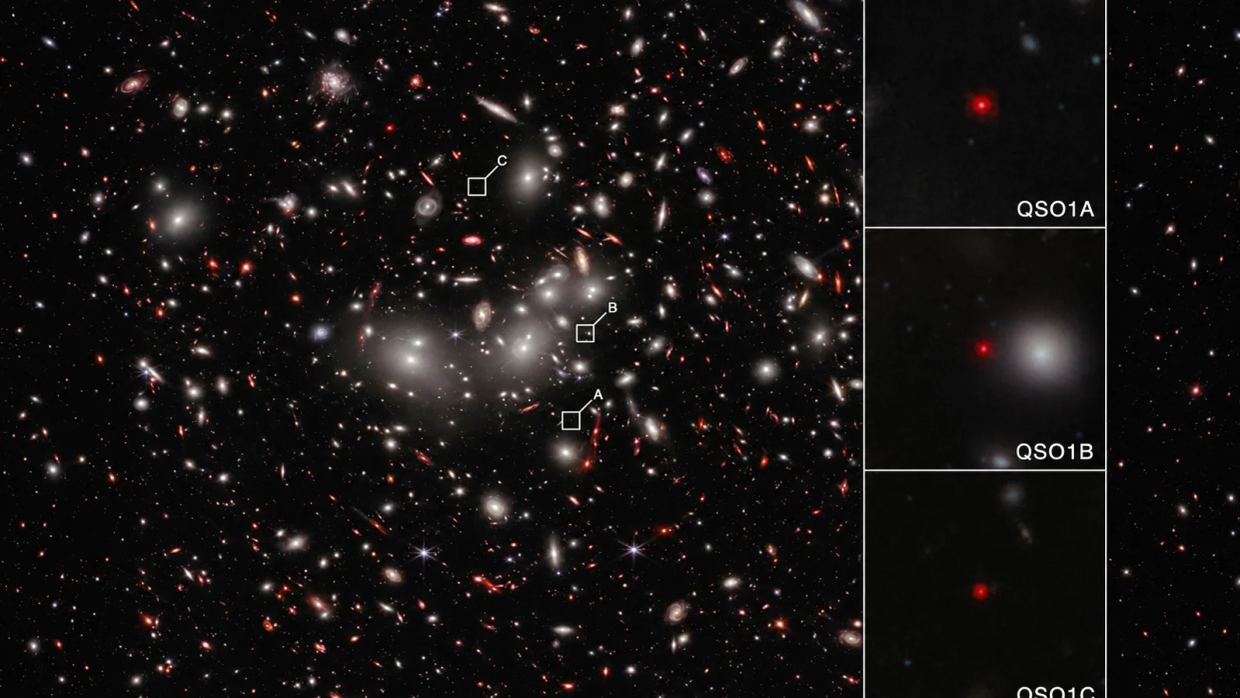
Researchers at Johns Hopkins University led by Valerio De Luca have modelled three ways in which black holes could form in the Little Red Dots, compact high-redshift sources found by the James Webb Space Telescope. The work, published in Physical Review Letters, is based on previously released Webb data doi.org
Physical Review Lettersdoi.orgOpen source ↗. Some of these objects appear to host black holes much heavier than their stellar content would suggest when compared with local scaling relations
doi.org
Physical Review Lettersdoi.orgOpen source ↗.
The test case was Abell 2744-QSO1 (QSO1), a source magnified by the gravitational lens of a foreground galaxy cluster. Its light dates from about 700 million years after the Big Bang. Its central black hole has roughly 50 million solar masses, while the surroundings contain less than one hundredth of the solar fraction of heavier elements doi.org
Physical Review Lettersdoi.orgOpen source ↗.
Direct formation and mergers
In the first scenario, a black hole of such mass would form directly in the early Universe. According to the calculations, this is excluded by cosmic microwave background μ-distortion limits: the required strong density fluctuations would have left measurable traces doi.org
Physical Review Lettersdoi.orgOpen source ↗. Primordial black holes that remain allowed as seeds have at most about 1,000 solar masses.
The second route is hierarchical merging of such lighter seeds. It can operate depending on the merger history, but the growing black holes would have to stay inside very massive dark matter halos despite the recoil from collisions. In the model, such halos are too rare at high redshift to explain the observed abundance of Little Red Dots doi.org
Physical Review Lettersdoi.orgOpen source ↗.
Growth by gas accretion
The third route proved the most promising in the calculations: a seed of about 1,000 solar masses accretes gas. With sufficiently efficient inflow, it could reach many millions of solar masses by the epoch of QSO1. At times the modelled accretion rate exceeds the classical Eddington limit doi.org
Physical Review Lettersdoi.orgOpen source ↗.
The low metallicity of QSO1 constrains this path. Stars forming from the infalling gas would produce heavier elements, so in the suitable models no more than about one percent of the inflowing gas turns into stars doi.org
Physical Review Lettersdoi.orgOpen source ↗. The authors tracked metallicity jointly with accretion and identified regions of parameter space that reproduce the observed properties of the Little Red Dots
doi.org
Physical Review Lettersdoi.orgOpen source ↗.
The result is a possible evolutionary path, not evidence that primordial black holes exist. Other scenarios, including the collapse of early stars or of very massive gas clouds, remain under discussion. Further observations are needed to show how common a primordial origin could be.
Sources · 2
Found a mistake?Read also