Lumina simulation at Harvard & Smithsonian CfA models the universe's first 2 billion years in a 1.5-billion-light-year cube
Researchers at the Center for Astrophysics | Harvard & Smithsonian built Lumina, a radiation hydrodynamics simulation, to compare its predictions with JWST and Roman telescope observations.
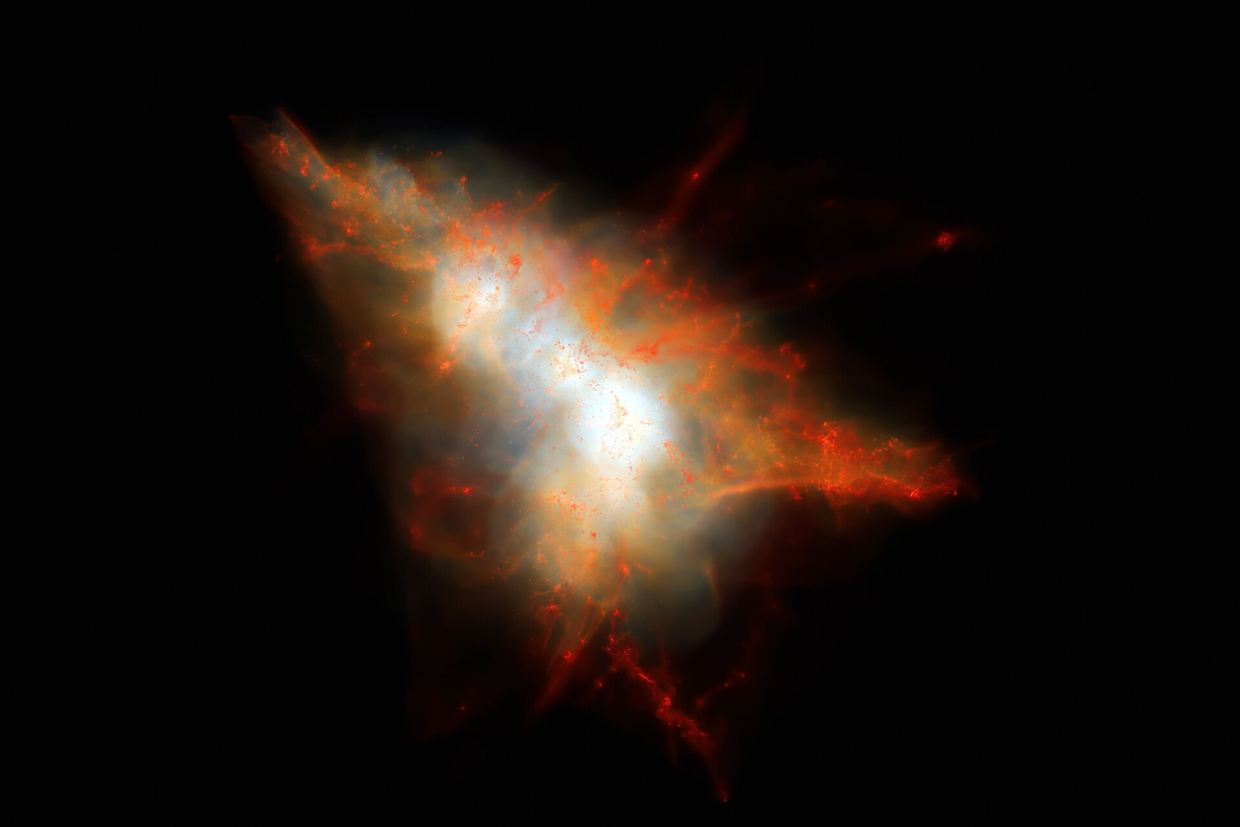
Researchers at the Center for Astrophysics | Harvard & Smithsonian have built Lumina, a simulation of the universe's first 2 billion years after the Big Bang, according to sciencedaily.com. The work was published in Monthly Notices of the Royal Astronomical Society and models interactions between ordinary matter, dark matter and radiation sciencedaily.com
sciencedaily.comsciencedaily.comOpen source ↗. The simulation is intended to help interpret observations from the James Webb Space Telescope (JWST) and the Nancy Roman Space Telescope
sciencedaily.com
sciencedaily.comsciencedaily.comOpen source ↗.
Scale and method of the simulation
The authors describe Lumina as the largest cosmological radiation hydrodynamics simulation produced to date. It calculates how gas, dark matter and light influenced one another as the young universe developed. This lets researchers examine how the earliest galaxies formed and how their activity changed the clouds of gas around them sciencedaily.com
sciencedaily.comsciencedaily.comOpen source ↗.
The modeled volume is more than 100 times larger than in earlier comparable projects. The virtual universe is a cube about 1.5 billion light-years on each side sciencedaily.com
sciencedaily.comsciencedaily.comOpen source ↗.
Another advance concerns helium reionization, a process in which radiation strips electrons from helium atoms. According to the authors, this is the first simulation of its kind to follow the process as it unfolds while accounting for its effect on the surrounding universe sciencedaily.com
sciencedaily.comsciencedaily.comOpen source ↗. Aaron Smith of the University of Texas at Dallas, a co-author, said that for the first time both hydrogen and helium can be followed as they changed into their modern form across such a large volume, while galaxies and other luminous objects are still resolved
sciencedaily.com
sciencedaily.comsciencedaily.comOpen source ↗.
Computing resources and planned use
The team used more than 15,000 graphics processing units on the Frontier supercomputer at Oak Ridge National Laboratory in Tennessee sciencedaily.com
sciencedaily.comsciencedaily.comOpen source ↗. This made it possible to simulate a very large region while keeping the detail needed for individual galaxies. Lumina tracks processes involved in the formation of stars, galaxies and black holes
sciencedaily.com
sciencedaily.comsciencedaily.comOpen source ↗.
The researchers plan to use the simulation to study the movement of gas between galaxies, the influence of radiation left over from the Big Bang, and regions where stars formed at especially high rates sciencedaily.com
sciencedaily.comsciencedaily.comOpen source ↗. Its predictions will be compared with observations from JWST, Roman and other telescopes. Differences between the simulated and real universe could show where current theories need to be refined
sciencedaily.com
sciencedaily.comsciencedaily.comOpen source ↗.
Lead author Oliver Zier, an ITC Fellow at the Center, said that to understand what JWST observes, theories have to be translated into detailed predictions sciencedaily.com
sciencedaily.comsciencedaily.comOpen source ↗.