Berkeley and Princeton: macaque neurons alternate between seen and suppressed faces 15 times a second
In a preprint on two macaques, the same neurons in inferotemporal and prefrontal cortex switched between a visible and a suppressed face about every 60 ms.
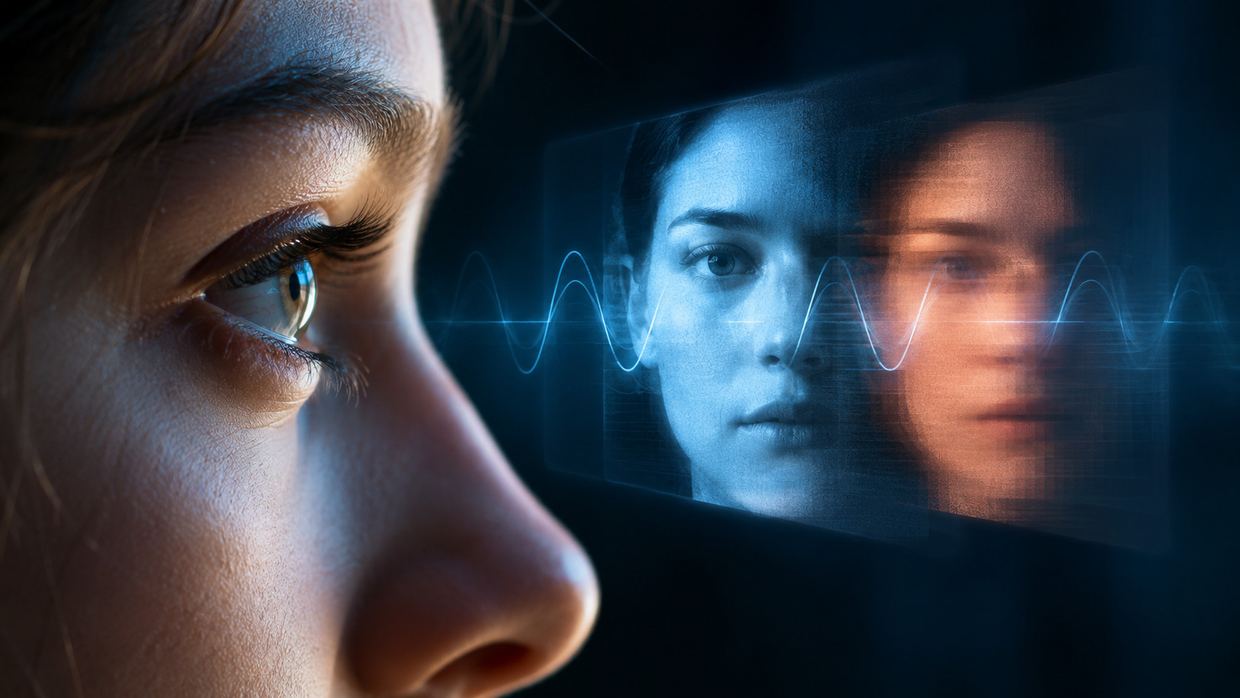
Neuroscientists at the University of California, Berkeley, and Princeton University, led by Janis K. Hesse and Doris Y. Tsao, report that the primate brain alternates between a consciously seen image and a suppressed one about 15 times per second, according to a bioRxiv preprint covered by ZME Science. zmescience.com
ZME Sciencezmescience.comOpen source ↗ The work used two rhesus macaques and has not yet passed peer review.
zmescience.com
ZME Sciencezmescience.comOpen source ↗
The authors argue that conscious access depends not only on where information is processed but also on when neurons fire. zmescience.com
ZME Sciencezmescience.comOpen source ↗ Earlier recordings, including the 2025 COGITATE Consortium study in Nature, did not reveal a pure neural representation of conscious perception in any recorded region during rivalry.
zmescience.com
ZME Sciencezmescience.comOpen source ↗
Binocular flash suppression and recordings
The team used binocular flash suppression. Each macaque wore red-and-cyan 3D glasses, so each eye received a different face. zmescience.com
ZME Sciencezmescience.comOpen source ↗ When a second face was flashed to one eye, the first dropped out of awareness although both images stayed in front of the eyes.
zmescience.com
ZME Sciencezmescience.comOpen source ↗ To validate the effect, 14 human volunteers viewed the same display and reported that the second face dominated their awareness 82 percent of the time.
zmescience.com
ZME Sciencezmescience.comOpen source ↗
The researchers then inserted Neuropixels probes and recorded hundreds of neurons at once across 1,500 face presentations. zmescience.com
ZME Sciencezmescience.comOpen source ↗ The targets were face-selective areas of the inferotemporal cortex and the prefrontal cortex.
zmescience.com
ZME Sciencezmescience.comOpen source ↗
Decoding faces in 60-millisecond windows
First, the monkeys viewed 1,500 faces without rivalry. An algorithm learned to translate the spikes of 3,501 neurons into 50 measurements of facial shape and appearance. zmescience.com
ZME Sciencezmescience.comOpen source ↗ Averaged over a full second, the decoded output was a blurred merger of both faces.
zmescience.com
ZME Sciencezmescience.comOpen source ↗ Split into alternating 60-millisecond states, it gave sharp reconstructions of the consciously seen face in one state and of the suppressed face in the other.
zmescience.com
ZME Sciencezmescience.comOpen source ↗
The same neurons produced both portraits, rather than two separate groups of cells. zmescience.com
ZME Sciencezmescience.comOpen source ↗ During conscious windows, neurons were about 21 percent more sensitive to facial features than during suppressed windows.
zmescience.com
ZME Sciencezmescience.comOpen source ↗ The authors say the suppressed stimulus is not a weak residual trace but occupies the same face space.
zmescience.com
ZME Sciencezmescience.comOpen source ↗
The study covered specific visual and frontal areas in only two monkeys. zmescience.com
ZME Sciencezmescience.comOpen source ↗ What drives the 15-hertz rhythm, and why only some time segments reach awareness, remains unknown.
zmescience.com
ZME Sciencezmescience.comOpen source ↗