University of Tokyo engineers 3D-print a life-size robot leg with muscles and tendons from one TPU plastic
A 95 cm prototype leg has printed muscles, tendons and ligaments made from a single TPU. Stiffness is set by the lattice pattern, so no manual casting or bearings are needed.
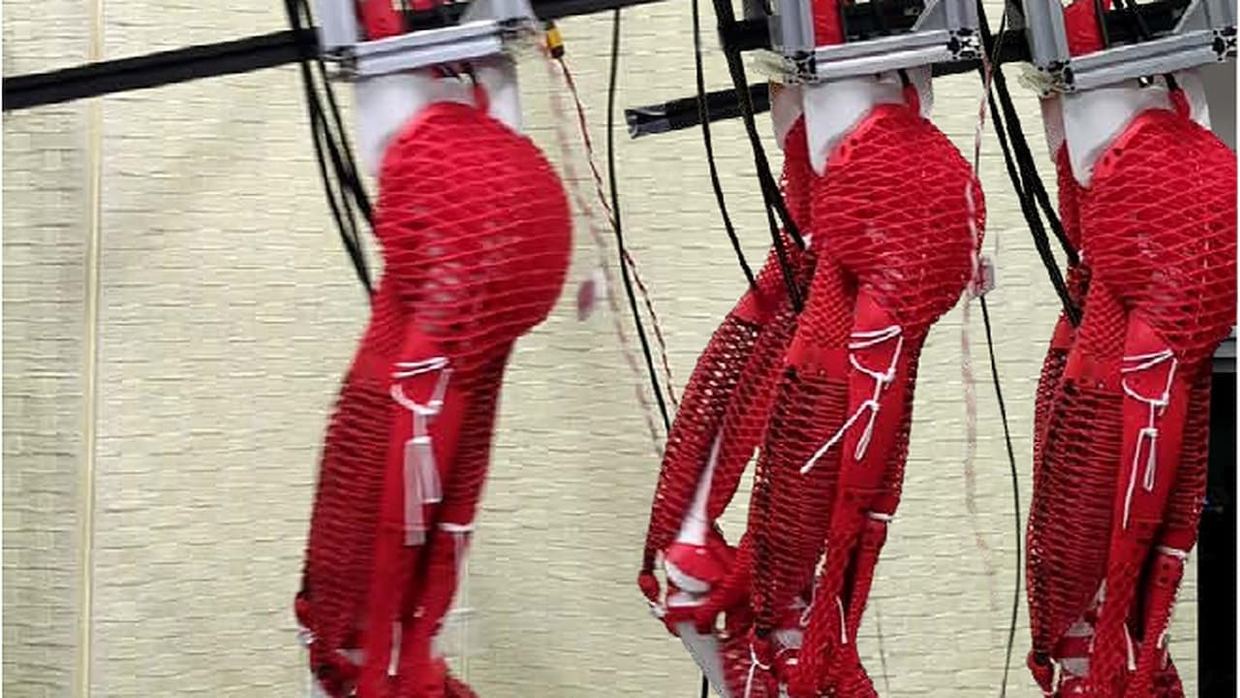
Engineers at the University of Tokyo have 3D-printed a life-size robot leg in which muscles, tendons and ligaments are made from one flexible plastic, thermoplastic polyurethane (TPU). The work was published in Advanced Intelligent Systems doi.org
Advanced Intelligent Systemsdoi.orgOpen source ↗. The leg is 95 centimeters tall and is a laboratory prototype.
The authors note that conventional musculoskeletal robots often replace soft tissues with wires or rigid joints. This limits biological flexibility and requires extensive customization. They propose a single parametric design and printing process for all soft elements doi.org
Advanced Intelligent Systemsdoi.orgOpen source ↗.
Stiffness set by the lattice
The parts differ in stiffness because of the lattice printed inside them. Tuning parameters such as lattice density and branch thickness changes the mechanical properties in different regions of the body doi.org
Advanced Intelligent Systemsdoi.orgOpen source ↗. The lattice of the muscles is sparser, so they are more compliant, while the lattice of the tendons is denser and stiffer. The joints are held only by printed ligaments made from the same plastic, without bearings
doi.org
Advanced Intelligent Systemsdoi.orgOpen source ↗.
The leg has a pelvis, femur, tibia and foot made of rigid plastic, three joints and six muscles. The printed muscles do not contract by themselves: motors mounted on the pelvis pull them with cables, and the lattice works as a spring and damper. Printing one muscle took 20 to 40 hours.
Test results
By setting the cable lengths, the engineers raised the leg forward by about 90 degrees, moved it sideways by 30 degrees and bent the knee by 105 degrees. The authors also fitted a bipedal robot with such legs, and it made steps of up to 80 centimeters doi.org
Advanced Intelligent Systemsdoi.orgOpen source ↗.
The robot did not walk on its own. Its torso was held by cables that took part of the body weight and limited roll, pitch and yaw each to the range from −20° to +20° doi.org
Advanced Intelligent Systemsdoi.orgOpen source ↗.
Samples of muscles, tendons and joints withstood 999 loading cycles without breaking. The tendons became almost twice as soft, mostly during the first hundred cycles. The authors say the approach could be extended to whole-body humanoids and embedded sensing doi.org
Advanced Intelligent Systemsdoi.orgOpen source ↗.