NYU Langone: ESCO2 loss makes cancer cells sensitive to PARP inhibitors via G4 DNA lesions
In cancer cell models, loss of ESCO2 led to G-quadruplex DNA buildup at pericentromeric sites; PARP inhibition blocked the protective response to it.
Researchers at NYU Langone Health and its Perlmutter Cancer Center report that replication-fork lesions in specific genomic regions determine how sensitive cancer cells are to PARP inhibitors (PARPi). The study was published online on November 5 in Nature Cell Biology and is available on nature.com nature.com
nature.comnature.comOpen source ↗. The experiments were done in cancer cell models. Eli Rothenberg, professor at NYU Grossman School of Medicine, is a co-corresponding author.
PARPi are used against cancers with defective homologous recombination, but hypersensitivity has also been seen in other genetic contexts. The DNA lesions behind PARPi cytotoxicity remained poorly defined nature.com
nature.comnature.comOpen source ↗.
ESCO2 loss and G4 lesions
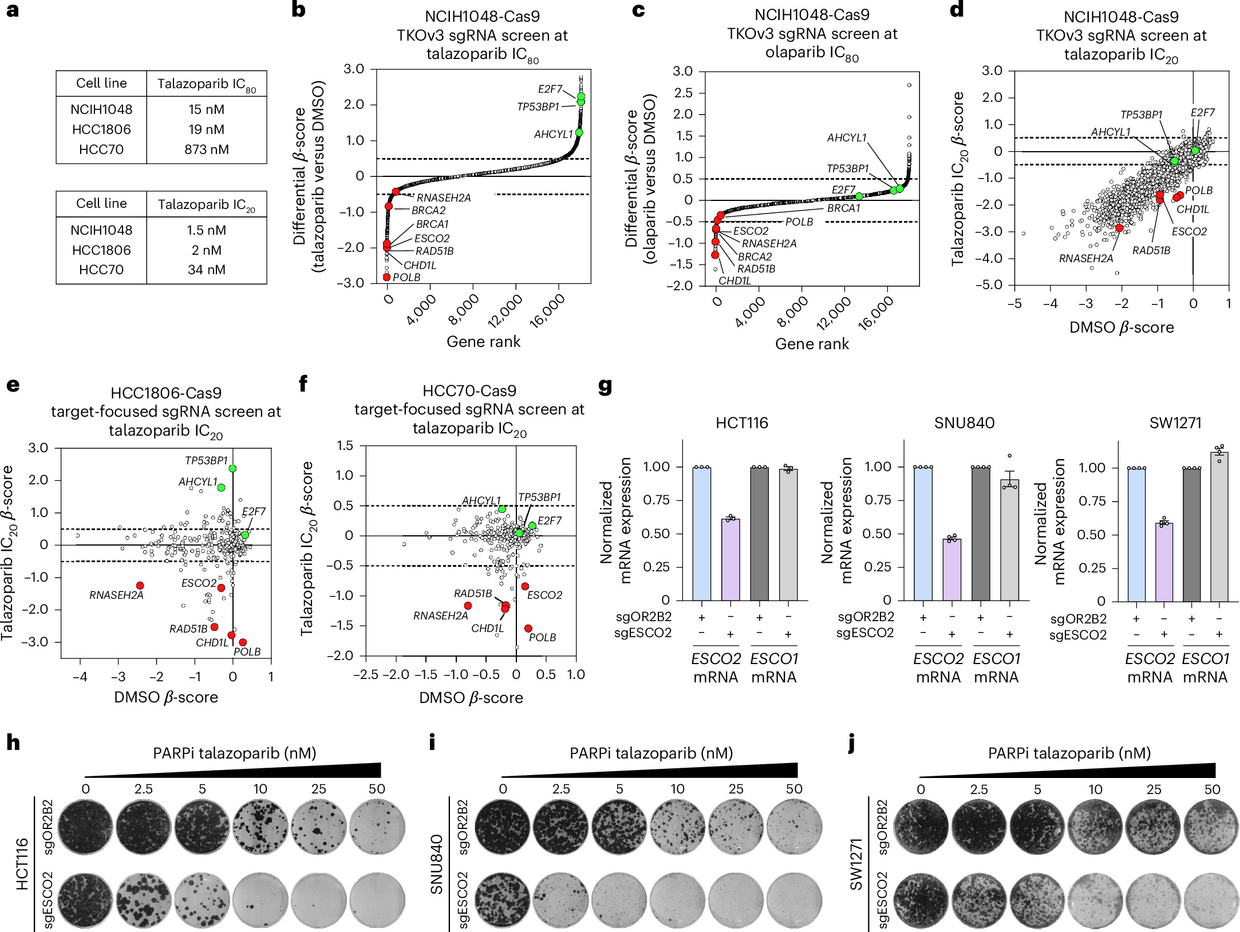
CRISPR screens in breast and small cell lung cancer models identified loss of ESCO2, a replication-coupled cohesin acetyltransferase, as a cause of PARPi hypersensitivity independent of homologous recombination deficiency nature.com
nature.comnature.comOpen source ↗. Follow-up experiments showed that even partial reduction of ESCO2 increased sensitivity to PARPi in colorectal, ovarian and lung cancer cells.
The team used quantitative single-molecule imaging developed in Rothenberg's laboratory. It showed that ESCO2 loss promotes accumulation of G-quadruplex (G4) DNA structures at a subset of replication-associated sites nature.com
nature.comnature.comOpen source ↗. These sites were associated with PARP1 activation and with engagement of the fork protection factor TIMELESS, which mitigates G4-induced stress. The G4 lesions localized to fragile pericentromeric regions and engaged the G4 helicase DDX11.
How PARP inhibition removes the protection
According to the authors, PARP inhibition disrupts this protective G4-processing response by preventing PARP1-dependent engagement of TIMELESS and DDX11. The result is G4 accumulation, DNA damage and chromosomal instability nature.com
nature.comnature.comOpen source ↗. The authors define the G4–PARP1–TIMELESS–DDX11 axis as a safeguard of replication fork stability at hard-to-replicate loci and describe ESCO2 as a potential therapeutic target for promoting synthetic lethality in PARPi-treated cancers.
Rothenberg noted that DNA damage is usually considered in terms of quantity, whereas this work points to a small subset of sites where replication problems have disproportionately severe consequences. The authors say the location of damage can shape treatment response and may provide a basis for new biomarkers of drug sensitivity. The findings come from laboratory cell models and have not been tested in patients.