USTC physicists observe Bell nonlocality with a single rubidium atom emitting 1530 nm photons
A Hefei team obtained spin–photon entanglement from a single rubidium atom directly in the C-band, the minimum-loss band of optical fiber, and observed a Bell inequality violation.
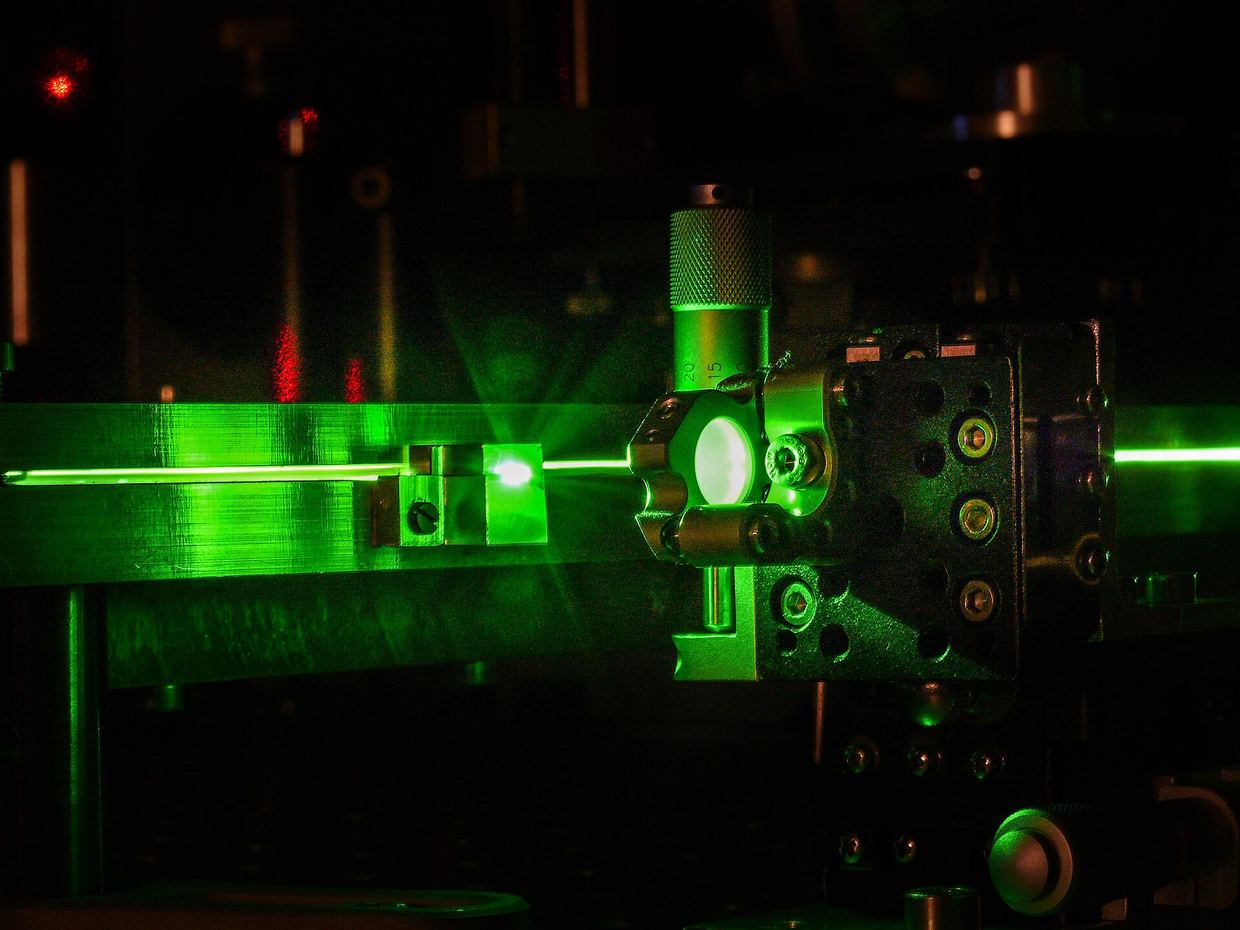
A team from the Laboratory of Quantum Information at the University of Science and Technology of China in Hefei generated entanglement between a single rubidium atom and a telecom C-band photon, and used it to verify Bell nonlocality. The result was published in Nature Communications on 4 November 2026. The authors report a measured Bell state fidelity exceeding 91.4% and a Bell inequality violation of 2.455(77) > 2 doi.org
Nature Communicationsdoi.orgOpen source ↗.
Why the telecom C-band matters
Quantum nonlocality is typically revealed through entanglement distribution across quantum networks and is a cornerstone of quantum information science doi.org
Nature Communicationsdoi.orgOpen source ↗. Long-distance distribution requires the information carrier, the flying photon, to operate in the minimum-loss telecom band of optical fiber
doi.org
Nature Communicationsdoi.orgOpen source ↗.
Extensive efforts have gone into the direct generation of entanglement between C-band telecom photons and various stationary spins. Verification of quantum nonlocality in such systems, however, remained an outstanding challenge, the authors write doi.org
Nature Communicationsdoi.orgOpen source ↗.
Single-atom experiment
The experiment relies on a dipole transition in rubidium atoms with a wavelength of 1530 nm and a cavity-assisted protocol. With this approach the group achieved resonant excitation and direct emission of C-band telecom photons from a single atom doi.org
Nature Communicationsdoi.orgOpen source ↗.
The emitted photon and the atomic spin formed an entangled pair with a measured Bell state fidelity exceeding 91.4% doi.org
Nature Communicationsdoi.orgOpen source ↗. Using this pair, the researchers observed a Bell inequality violation of 2.455(77), which exceeds the threshold of 2
doi.org
Nature Communicationsdoi.orgOpen source ↗.
According to the authors, the work extends the wavelength of a single-atom quantum emitter to the telecom C-band and reaches spin–photon entanglement of sufficiently high fidelity to verify Bell nonlocality doi.org
Nature Communicationsdoi.orgOpen source ↗. This is a laboratory demonstration with a single atom.
The paper has eleven authors. Dong-Yu Huang and Jian Wang contributed equally, and correspondence is addressed to Jian Wang and Chuan-Feng Li. The work involved the Anhui Province Key Laboratory of Quantum Network, the CAS Center for Excellence in Quantum Information and Quantum Physics, and Hefei National Laboratory.