UNLV physicists find ice-X distorts into a less symmetric structure above 222 GPa in a diamond anvil cell
In diamond-anvil experiments with X-ray diffraction, water ice-X lost its cubic symmetry at 222(12) GPa, which redefines the upper stability limit of this phase.
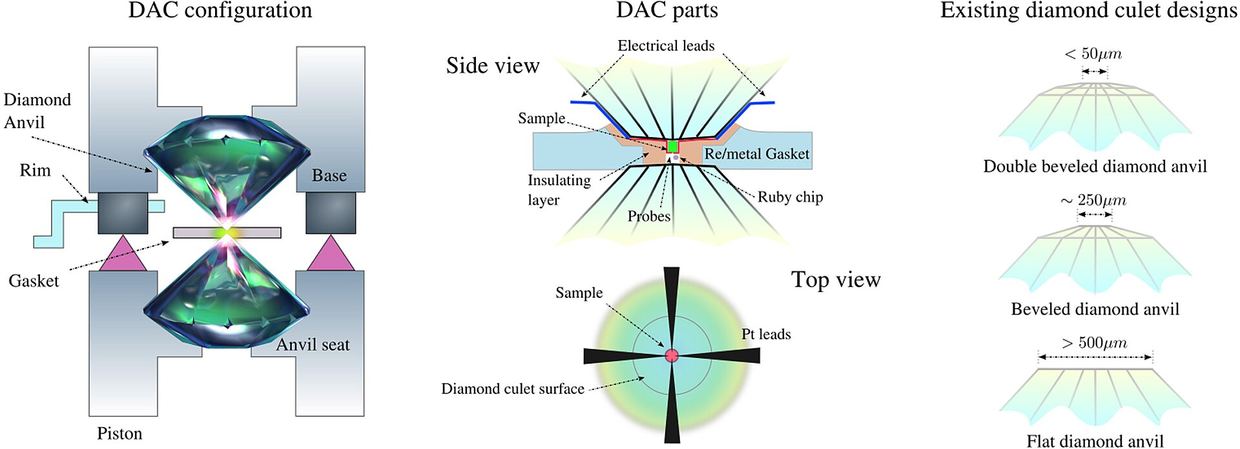
Physicists from the University of Nevada, Las Vegas, compressed water between diamond anvils and recorded a change in its atomic structure above 222(12) GPa, about 2.2 million times standard atmospheric pressure at sea level. The work was published in Communications Chemistry. According to the authors, ice-X transforms into a less symmetric structure at this pressure doi.org
Communications Chemistrydoi.orgOpen source ↗.
Water governs the structure and dynamics of icy planets and, through the pressure-induced transition from hydrogen to ionic bonding, changes markedly across the pressure range of planetary interiors doi.org
Communications Chemistrydoi.orgOpen source ↗. Researchers therefore study its state under conditions found in the interiors of bodies such as Uranus and Neptune.
Experiment and diffraction data
The structure was probed with synchrotron X-ray diffraction. Many materials are expected to favour simple, densely packed lattices under growing compression, and ice-X follows this pattern in the form of a cubic lattice with hydrogen atoms positioned symmetrically between oxygen atoms. In this experiment, however, the cubic lattice became distorted doi.org
Communications Chemistrydoi.orgOpen source ↗.
The diffraction data are consistent with either Pbcm or P4₂/nnm symmetry. Ab initio calculations strongly favour the Pbcm variant, according to the report doi.org
Communications Chemistrydoi.orgOpen source ↗. The diffraction data alone do not choose between the two candidates.
Upper limit of ice-X stability
The authors state that the transition marks the onset of a new regime of structural complexity in high-pressure H₂O and redefines the upper stability limit of ice-X doi.org
Communications Chemistrydoi.orgOpen source ↗. Such behaviour has been seen in other elements: the complex hP4 phase of sodium is cited as an example of unexpected structural complexity at extreme pressures
doi.org
Communications Chemistrydoi.orgOpen source ↗.
The NV Techno account of the study adds that the lattice stretched and became asymmetric instead of forming a denser, more symmetric arrangement. The outlet links such a deformation to properties of planetary matter, including thermal conductivity and density. These links are the outlet's interpretation and are not part of the original abstract.
The result comes from a laboratory experiment on a small sample of water under static compression. The reported transition pressure is 222 GPa with an uncertainty of 12 GPa doi.org
Communications Chemistrydoi.orgOpen source ↗.