Osaka Metropolitan University finds fault rock fluidizes to near-water viscosity
Hydrodynamic analysis reveals thermal pressurization drops fault viscosity to 10⁻⁴ Pa·s, explaining massive coseismic slip.
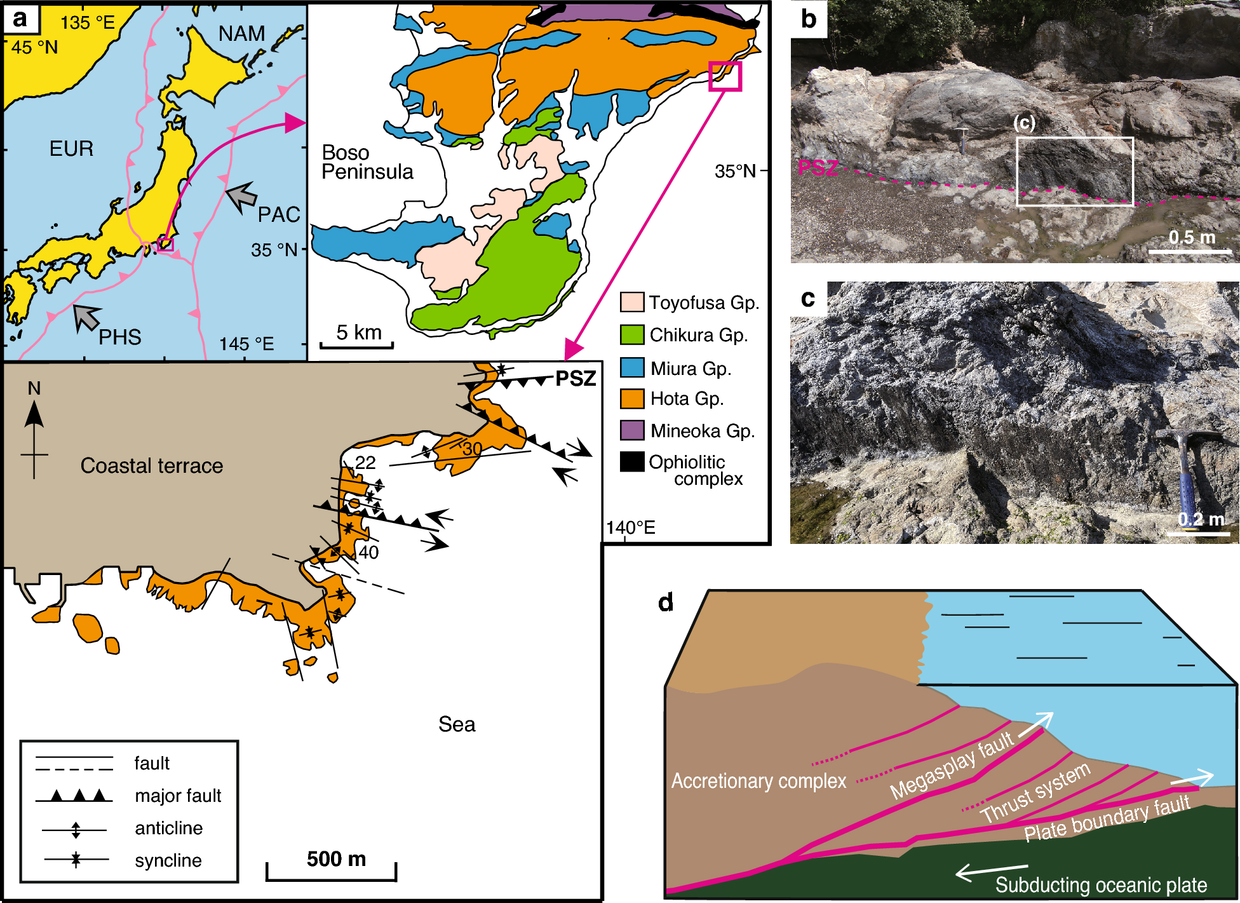
Researchers led by Professor Tetsuro Hirono from Osaka Metropolitan University analyzed the principal slip zone of a fossil thrust fault in the Hota Group on Japan's Boso Peninsula. By combining microstructural observations with fluid dynamics modeling, the team determined that fault rock fluidization induced by thermal pressurization lowers coseismic viscosity to values approaching that of water, as reported in nature.com nature.com
nature.comnature.comOpen source ↗.
Microstructural slip signatures
The target fault consists of a major east–west-striking thrust within an ancient accretionary wedge formed roughly 15 million years ago. The principal slip zone measures approximately 5 to 25 mm in thickness and is composed of glossy black fault material with well-developed slickensides dipping 80° to 85° southward. Microscopic examination identified a complex layered interior comprising planar-laminated, breccia, non-foliated massive, and turbulent-flow-like layers nature.com
nature.comnature.comOpen source ↗.
Sharp boundaries between adjacent layers indicate that each distinct band represents an independent seismic slip event. The turbulent-flow-like intervals exhibit characteristic wavy, curved geometries and vortex-like swirling structures. These geometric patterns indicate that granular rock material underwent dynamic fluidization rather than brittle cataclastic deformation during rupture propagation.
Hydrodynamic viscosity constraints
To constrain the physical properties of the moving fault gouge, the authors modeled the turbulent-flow-like structures assuming Couette–Poiseuille flow within the confined slip zone. The calculations established that thermal pressurization—the rapid thermal expansion of interstitial pore fluid triggered by frictional heating—fluidized the granular matrix. The resulting dynamic viscosity ranged from 1.2 × 10⁻⁴ to 2.3 × 10⁻³ Pa·s during high-speed displacement nature.com
nature.comnature.comOpen source ↗.
This extreme coseismic viscosity reduction functions as dynamic fluid lubrication along the rupture interface. By dramatically lowering shear resistance and promoting substantial stress drops, this fluidization mechanism provides physical evidence for the mechanical conditions that facilitate extensive fault slip, large seafloor displacements, and subsequent tsunami generation.