USF researchers test passive radiative cooling paint on outdoor prototypes
A coating reflected up to 98 percent of sunlight and dropped prototype surface temperatures up to 7.5 °C below ambient air.
Researchers at the University of South Florida (USF) led by Yogi Goswami have developed a white roof coating designed to combine high solar reflectance with passive radiative cooling, scinexx reported scinexx.de
scinexxscinexx.deOpen source ↗. According to a university announcement, the paint reflects up to 98 percent of incoming solar radiation while emitting thermal energy through the infrared atmospheric window directly into space
scinexx.de
scinexxscinexx.deOpen source ↗. The formulation uses natural materials, though specific chemical constituents have not been publicly disclosed. The approach is intended to reduce surface temperatures below ambient air levels during daylight hours without power consumption.
Outdoor test results
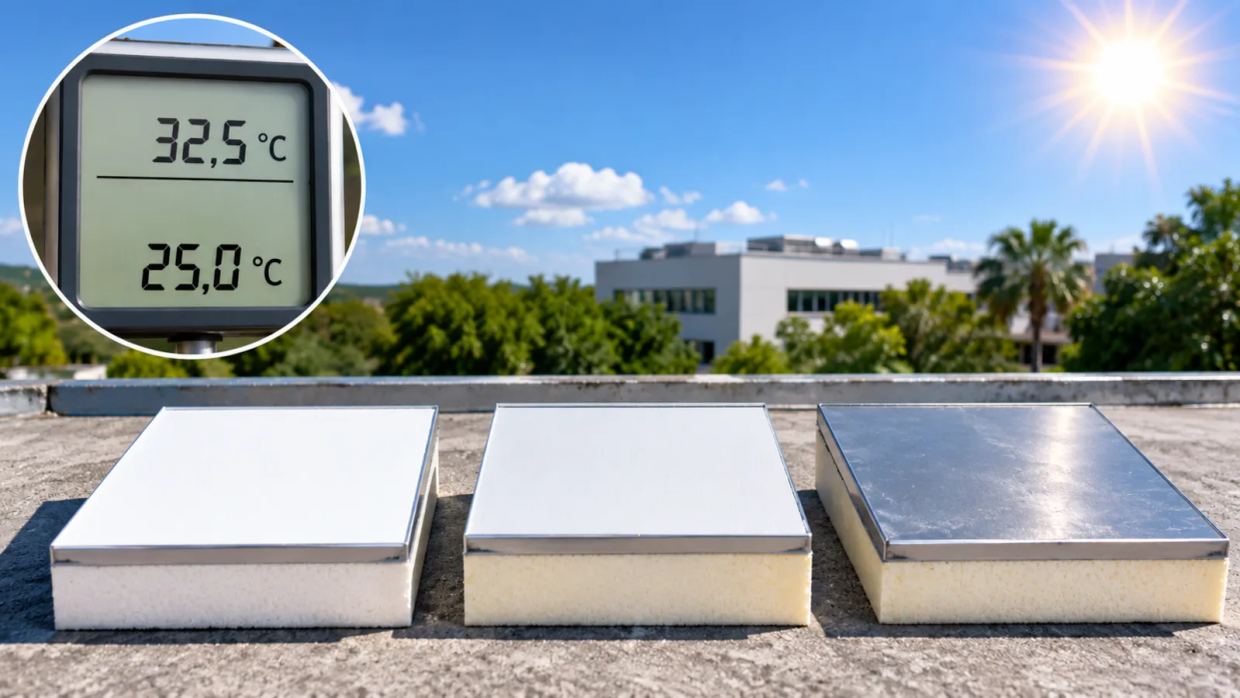
To evaluate cooling performance, researchers set up an outdoor experiment in Tampa using three identical, thermally insulated test samples backed with aluminum foil scinexx.de
scinexxscinexx.deOpen source ↗. One sample was coated with the experimental formulation, a second with a commercial cool-roof paint, and the third remained uncoated. Surface temperatures were recorded between 10:00 and 17:00 daily over a 28-day period. The experimental paint achieved the lowest temperatures throughout the trials, showing a maximum temperature reduction of 13.5 degrees Fahrenheit (approximately 7.5 degrees Celsius) below the surrounding air temperature
scinexx.de
scinexxscinexx.deOpen source ↗.
Limitations and development
This peak cooling figure represents a maximum observed differential rather than a 28-day average scinexx.de
scinexxscinexx.deOpen source ↗. The initial experiment tested only small-scale physical specimens under ambient conditions, and researchers have not yet measured internal room temperatures, overall heat flux into an enclosed structure, or actual power consumption reductions in full-scale buildings. Goswami stated that the paint could theoretically halve building energy costs, though empirical validation on active structures remains pending. The team is currently developing a transparent protective overcoat to improve durability against wind and rain without degrading radiative performance
scinexx.de
scinexxscinexx.deOpen source ↗. Initial deployment plans target commercial building applications before potential use on residential structures.