JWST resolves stellar clumps in lensed galaxy Misty Moons at redshift z ~ 11–12
Gravitational lensing revealed dense stellar clumps that account for over 80% of the stellar mass in a distant early galaxy.
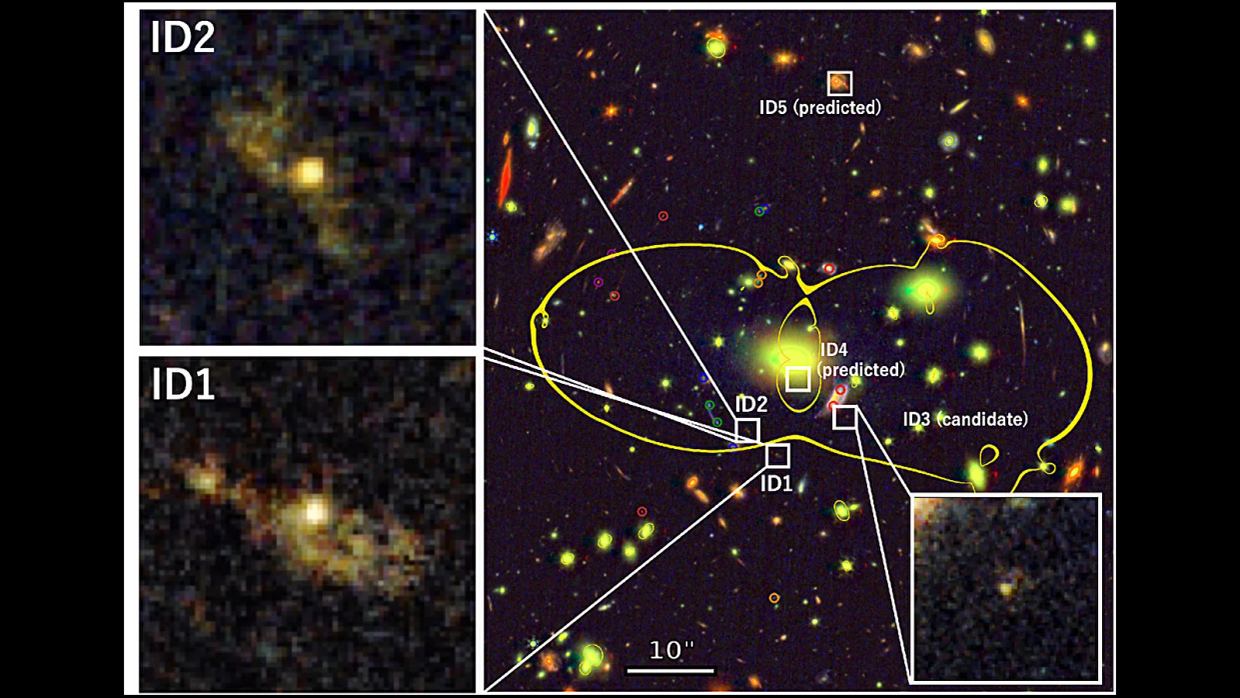
Astronomers using the James Webb Space Telescope have identified a strongly lensed galaxy at redshift z ~ 11–12, designated as Misty Moons, within the VENUS Treasury Survey doi.org
The Astrophysical Journaldoi.orgOpen source ↗. Gravitationally magnified by the foreground galaxy cluster MACS J0257.1-2325 at z = 0.505, the system was detailed in a study published in The Astrophysical Journal. Lens reconstruction models predict five separate images of the background source, two of which experience flux magnifications between 20 and 30.
Stellar clump morphology
Reconstruction in the source plane indicates that Misty Moons is an intrinsically faint sub-L* galaxy with an absolute ultraviolet magnitude of M UV ~ -18.0 mag doi.org
The Astrophysical Journaldoi.orgOpen source ↗. High magnification allowed researchers to resolve the source into multiple individual stellar clumps. Each clump exhibits an effective radius ranging from 10 to 70 pc and holds a stellar mass of approximately 10^7 solar masses. According to the baseline photometric analysis, these compact clumps contain more than 80% of the total stellar mass of the galaxy, indicating a highly clustered mode of early star formation distinct from local dwarf systems.
Mock imaging and comparisons
The two brightest magnified images, ID1 and ID2, reach apparent magnitudes of F200W ~ 26 AB mag and display blue spectral energy distributions marked by distinct Lyman-alpha breaks doi.org
The Astrophysical Journaldoi.orgOpen source ↗. To evaluate how the galaxy would appear without lensing distortion, the authors convolved the reconstructed source-plane light distribution with the JWST NIRCam point-spread function. The resulting mock image yields a radial surface-brightness profile consistent with typical unlensed faint systems observed at z ≳ 10, such as JADES-GS-z13-0 and JADES-GS-z14-1.