Hefei Institutes: Al–O3N single-atom catalyst gives Na–S cathode 1196 mAh/g after 100 cycles
A lab cathode with aluminum single atoms in Al–O3N coordination kept 1196 mAh/g after 100 cycles at 0.1 C. The design targets polysulfide shuttling in sodium–sulfur cells.
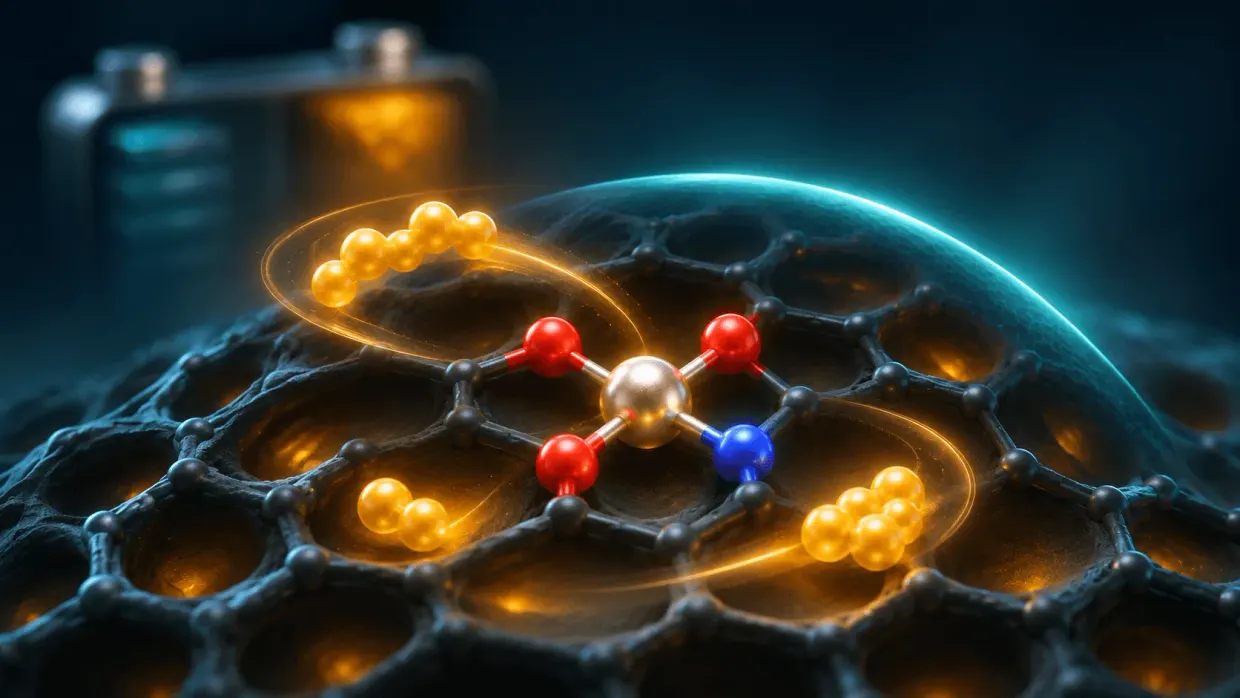
A team from the Hefei Institutes of Physical Science, Chinese Academy of Sciences, reported an aluminum single-atom catalyst for sodium–sulfur (Na–S) battery cathodes. In the paper in Angewandte Chemie International Edition, one oxygen atom in the coordination shell of each Al atom is replaced by nitrogen. The Al–O3N–C/S cathode delivered 1196 mAh g⁻¹ at 0.1 C after 100 cycles wiley.com
Angewandte Chemie International Editionwiley.comOpen source ↗.
Asymmetric Al–O3N coordination
Main-group metal single-atom catalysts are attractive for Na–S batteries because of their low toxicity and economic viability, according to the authors. Their catalytic activity, however, is inherently low, and the orbital interplay between p-block metal atoms and sodium polysulfides (Na2Sn) was unclear. The team anchored Al atoms on carbon in a planar Al–O3N arrangement: three oxygen atoms and one nitrogen atom around each Al.
The nitrogen ligand breaks the symmetry of the coordination and creates localized charge at the Al sites. According to the authors, this strengthens the p–p orbital hybridization between Al-3p and the S-3p orbitals of Na2Sn. The central metal is unchanged; only the neighboring atoms are different.
Capacity and cycling results
Polysulfides dissolving into the electrolyte and migrating between electrodes (the shuttle effect) and slow sulfur redox kinetics limit Na–S cells. The authors report that the new catalyst suppresses shuttling and accelerates sulfur redox kinetics wiley.com
Angewandte Chemie International Editionwiley.comOpen source ↗. They also report an ultralow capacity decay of 0.017% per cycle over 2500 cycles, and state that the result outperforms most reported d-block single-atom catalysts for Na–S batteries.
The 1196 mAh g⁻¹ value refers to 100 cycles at 0.1 C. It is not a capacity after 2500 cycles. The conditions of the long-term test are not given in the abstract.
The assessment rests on the published abstract; the full text and supplementary data were not reviewed. The mass basis of the capacity, sulfur loading and electrolyte amount are therefore not confirmed, and no independent reproduction was found. The results come from laboratory cells, not commercial cells or battery packs.
The authors propose regulating p-orbital charge distribution as a general guideline for designing other main-group metal single-atom catalysts wiley.com
Angewandte Chemie International Editionwiley.comOpen source ↗. In 2025 the same group published work on calcium single-atom catalysts with modified axial coordination in Nature Communications. The new study changes the in-plane coordination of aluminum instead.