UT Austin and Zhejiang University make a triaxial woven polymer that separates benzene from cyclohexane
A two-dimensional triaxial woven polymer network of C3-symmetric macrocycles is chiral, strong and porous, and separates aromatic from aliphatic compounds, the authors report.
Chemists from the University of Texas at Austin and Zhejiang University have built a two-dimensional triaxial woven polymer network and tested it as a separation material, according to a paper on nature.com. The network is made by incorporating C3-symmetric macrocycles into the woven structure through dative B–N polymerization nature.com
nature.comnature.comOpen source ↗. The authors report that it permits the separation of representative aromatic and aliphatic compounds.
How the network is woven
Molecular weaving interlaces molecular strands into ordered networks, by analogy with textile weaving. Until now it has relied mainly on linear building blocks and biaxial structures. The new work uses nonlinear, C3-symmetric building blocks and weaves along three axes rather than two.
The authors say the material shows topological chirality, meaning the woven layers can adopt one of two mirror-image arrangements. According to the university's account, the networks cross in either a clockwise or a counterclockwise spiral, and the layers can be alternated between the two as they are stacked. The interlocking multi-thread structure also gives the material robust mechanical properties, and the authors describe it as springy and thick.
Separating benzene and cyclohexane
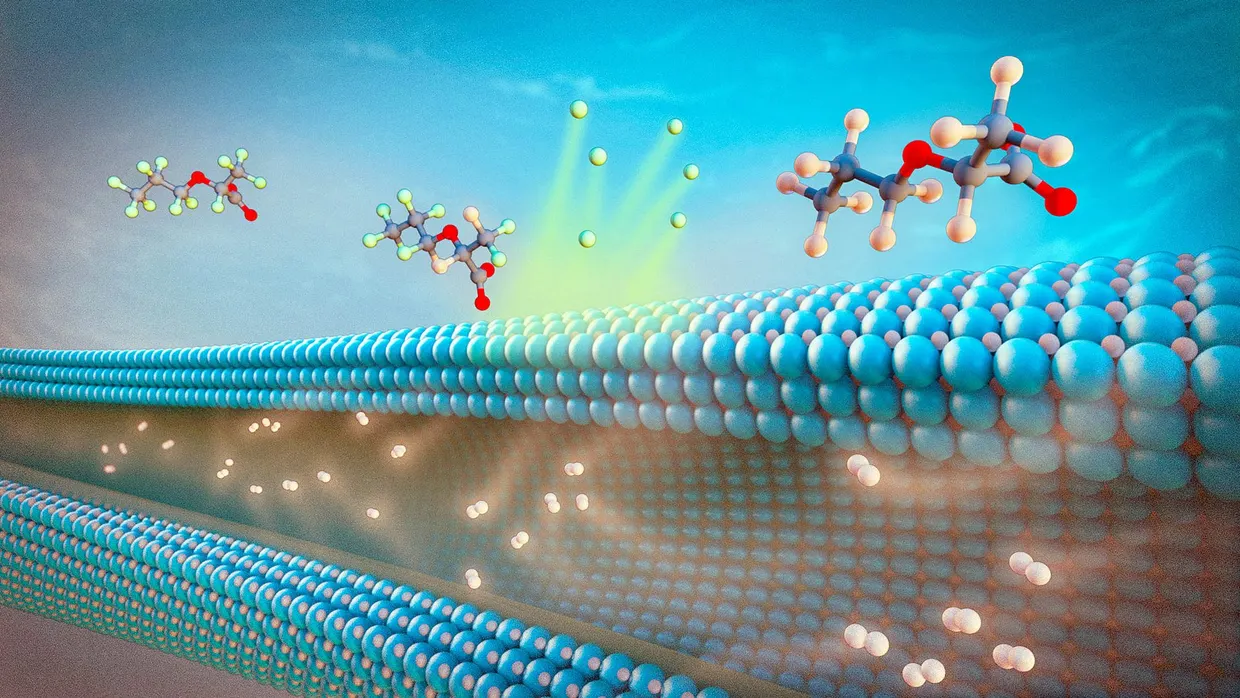
The material is porous. In the study it was used to separate representative aromatic and aliphatic compounds, and the university's account names benzene and cyclohexane as the pair nature.com
nature.comnature.comOpen source ↗. Cyclohexane is commonly produced from benzene, a known carcinogen that can remain in it as an unwanted byproduct.
The two liquids have nearly identical boiling points, so distillation separates them poorly and often needs additives and considerable energy. The researchers propose a porous woven material as an alternative route for this separation. Jonathan Sessler, a corresponding author, said that large amounts of energy go into chemical separation.
The authors say the results show how higher-order triaxial woven topologies can regulate material properties and add a topological dimension to the design of functional materials. The crystallographic data are deposited with the Cambridge Crystallographic Data Centre, and the source data are provided with the paper.