University of Maryland electrolyte lets a 4-Ah pouch cell reach 80% charge in 12.8 minutes
Researchers found that solvent withdrawal dries thick electrodes during fast charging, and designed an electrolyte that reduces the effect in a 4-Ah pouch cell.
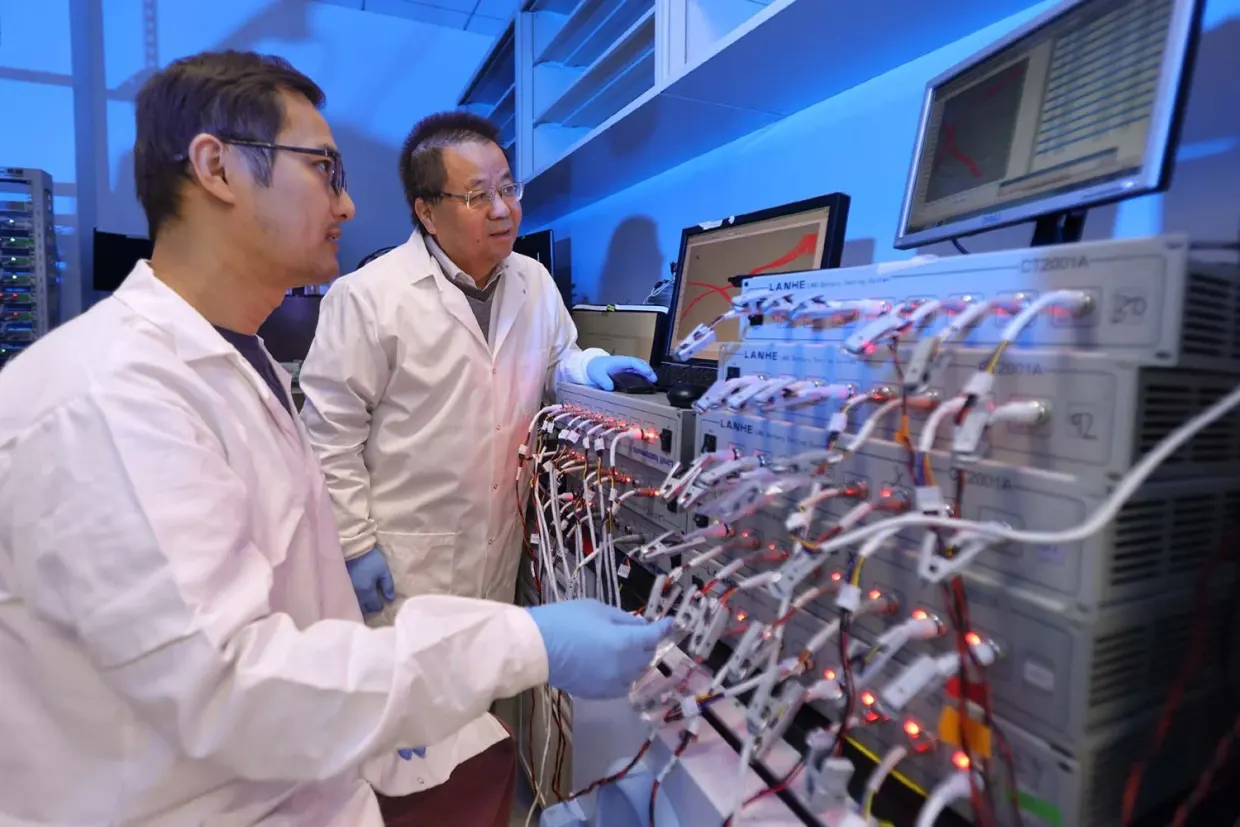
A team at the University of Maryland has developed an electrolyte that reduces electrode drying during fast charging of lithium-ion cells, according to a paper in Science. In a 4-Ah pouch cell the team reached 80% charge in 12.8 minutes and 90% in 14.7 minutes science.org
Sciencescience.orgOpen source ↗. The authors report that thick-electrode, energy-dense batteries with this electrolyte achieve 80% charge within 13 minutes.
Fast charging at rates above 4 C is essential for high-energy lithium-ion batteries in electric vehicles, but the barriers to it have been poorly understood. Conventional optimization shortens lithium-ion transport pathways by modifying the electrode structure, which often compromises energy density.
Why electrodes dry out
The starting point was the finding that each ion moving between the electrodes carries several solvent molecules with it. When charging is slow, the solvent can flow back into the porous electrode and refill it. When charging is fast, the solvent does not return quickly enough, the electrode dries out and charging slows markedly, the researchers explain.
The authors show that thick-electrode fast charging is constrained by solvent withdrawal within porous electrodes and the resulting electro-osmotic drag polarization, which is driven by cation-induced electro-osmotic drag science.org
Sciencescience.orgOpen source ↗. Chemists know this phenomenon mainly from fuel cells. According to the university, it had gone unnoticed in lithium-ion batteries until this study.
Electrolyte design and test
To reduce the polarization, the team designed electrolytes with weak cation solvation and strong anion solvation. A difluorinated solvent weakens the solvation of the lithium cation, and its difluoromethyl hydrogen atoms enhance anion solvation through hydrogen bonding. Weaker attraction between solvent and lithium ions makes it easier for the solvent to flow back into the electrode. According to the authors, electrode drying is sharply reduced even at fast charging rates.
The modified electrolyte was tested in the 4-Ah pouch cell, which gave the charging times above. The researchers plan to push charging below 10 minutes by combining the fluorinated solvent with a second chemical approach: a self-developed adaptive electrolyte. According to the university, this substance separates into parts and protects both electrodes from the stresses of fast charging.