POSTECH coats graphite particles with 5 nm ZrO2 layer: dual-ion cathode withstands 4,000 cycles
Korean researchers applied atomic layer deposition to graphite powder for a dual-ion battery cathode; in lab tests it kept performance over 4,000 cycles at about 12-minute charging.
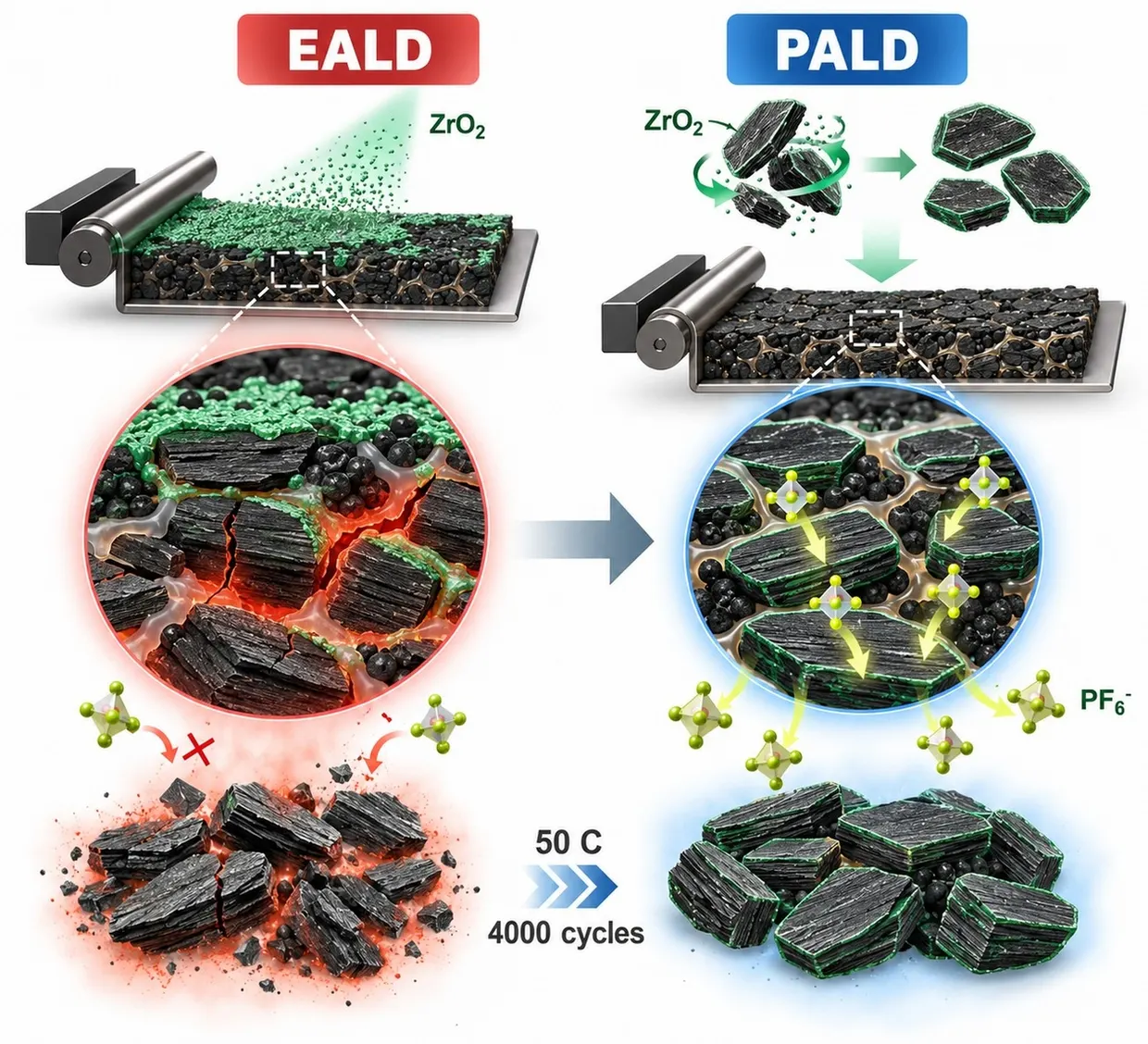
Researchers at POSTECH and Sogang University in South Korea have coated individual graphite particles with a 5 nm layer of zirconium oxide (ZrO₂) and obtained a dual-ion battery cathode that withstood 4,000 charge-discharge cycles under roughly 12-minute fast-charging conditions, according to biz.heraldcorp.com biz.heraldcorp.com
biz.heraldcorp.combiz.heraldcorp.comOpen source ↗. The work was done by the groups of Prof. Park Su-jin (Department of Chemistry) and Prof. Ahn Ji-hwan (Department of Mechanical Engineering) at POSTECH, together with the group of Prof. Ryu Jae-geon (Department of Chemical and Biomolecular Engineering) at Sogang University.
The graphite degradation problem
In a dual-ion battery, anions from the electrolyte enter the graphite during charging and store energy there. The authors note that this gives fast charging and low material cost, but that capacity loss over repeated cycling has been an obstacle to commercialization.
Graphite consists of stacked thin layers. Each time large anions enter between the layers the graphite expands, and on discharge it contracts. Repeated cycles crack and collapse the structure and reduce battery performance. At voltages of 4.5 V and above, the electrolyte also decomposes, which accelerates the loss.
Atomic layer deposition before electrode assembly
The team used atomic layer deposition (ALD), a semiconductor-manufacturing technique that builds an ultrathin film one atomic layer at a time. Instead of coating a finished electrode, as was done previously, they formed the ZrO₂ film on each graphite particle before the electrode was made. The film is 5 nm thick biz.heraldcorp.com
biz.heraldcorp.combiz.heraldcorp.comOpen source ↗.
According to the researchers, the coating keeps the graphite structure intact through repeated expansion and contraction while still allowing anions to move into the graphite quickly.
In tests under ultrafast charge-discharge conditions of about one minute, the coated graphite showed more than three times the charge storage of uncoated graphite. At about 12-minute fast charging it kept its performance over 4,000 cycles, while uncoated graphite lasted fewer than 1,000 cycles.
Because the graphite powder is coated before electrode fabrication, the team confirmed the possibility of using the approach in existing electrode manufacturing processes. The article says the technique is expected to find use in electric vehicles and large-capacity energy storage systems, and the researchers point to possible extension to other cathode and anode materials, fuel cells and water-electrolysis catalysts biz.heraldcorp.com
biz.heraldcorp.combiz.heraldcorp.comOpen source ↗.
Park Su-jin said the approach could become a new design principle for batteries that charge quickly and last long using inexpensive graphite. The results were published online in the journal Advanced Functional Materials.