Waseda team demonstrates isolator-free SiN/TFLN laser transmitter at 180 Gbit/s
Japanese researchers combined a SiN external-cavity laser with a thin-film lithium niobate modulator; the laboratory prototype operates stably without an optical isolator.
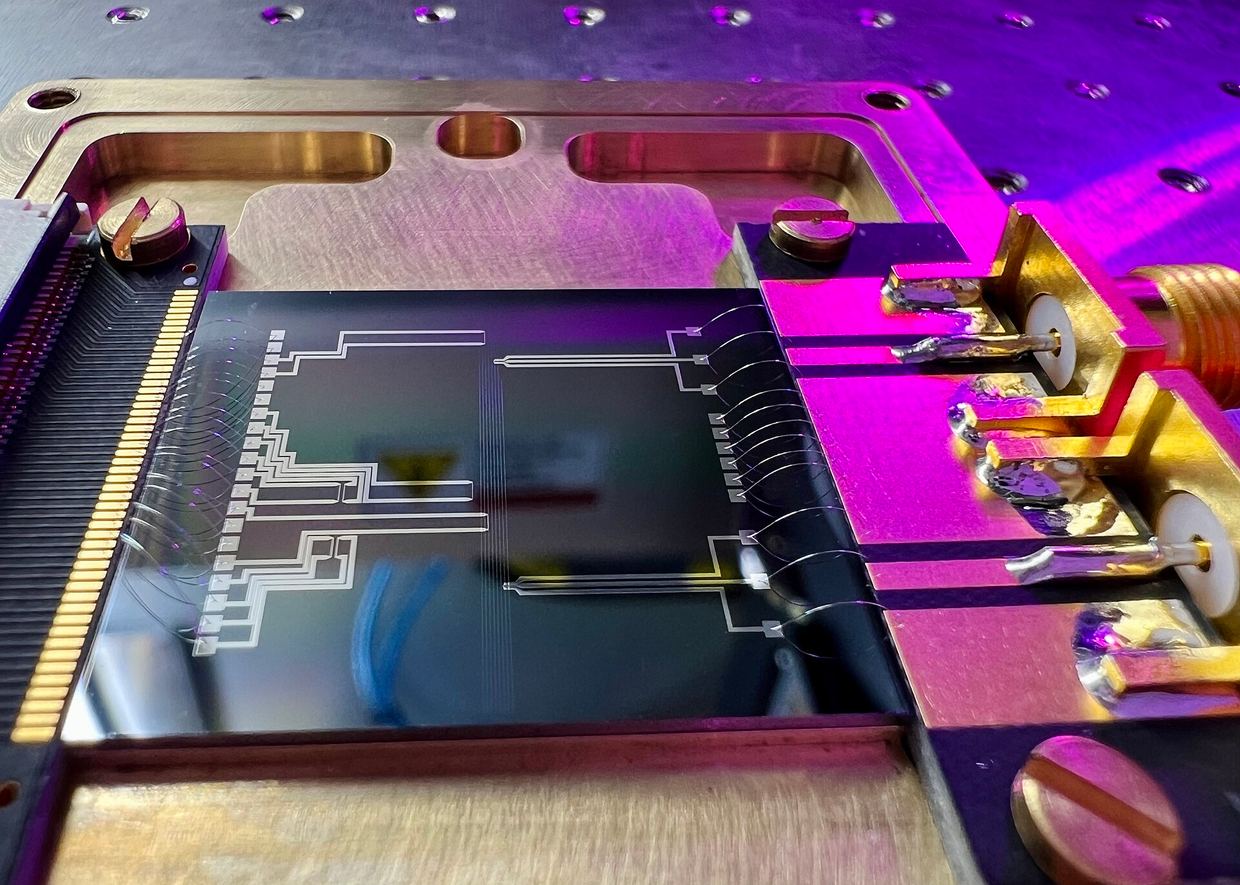
Researchers at Waseda University in Japan, together with Sumitomo Osaka Cement and the National Institute of Information and Communications Technology (NICT), have experimentally demonstrated a silicon photonic transmitter that works without an optical isolator. The study, led by Professor Tomohiro Kita, was published on 7 October 2026 in the Journal of Lightwave Technology. The device combines a silicon nitride (SiN) external-cavity wavelength-tunable laser with a thin-film lithium niobate (TFLN) modulator and supports large-signal intensity modulation up to 180 Gbit/s doi.org
Journal of Lightwave Technologydoi.orgOpen source ↗.
Why the isolator is normally needed
When a laser and a modulator are built on different platforms, the modulator can reflect light back into the laser. Such reflections can destabilize the laser and disrupt data transmission. Conventional systems block this backward-travelling light with optical isolators.
Spectral co-design of laser and modulator
The laser consists of a semiconductor gain chip and a silicon photonics circuit with two SiN ring resonators. The rings form a Vernier filter that selects the lasing wavelength. The TFLN modulator contains an asymmetric Mach–Zehnder interferometer (AMZI), whose transmission depends on wavelength. The authors designed the AMZI response together with that of the Vernier filter to shape the wavelength-dependent feedback returning to the laser doi.org
Journal of Lightwave Technologydoi.orgOpen source ↗.
According to the authors, this cross-platform design suppresses the side modes induced by the Vernier filter and gives stable single-mode oscillation without an isolator doi.org
Journal of Lightwave Technologydoi.orgOpen source ↗. The two platforms are joined by edge coupling with spot-size converters. The modulator uses capacitively loaded traveling-wave electrodes, which, the authors report, provide high-speed electro-optic modulation while limiting reflections into the laser cavity
doi.org
Journal of Lightwave Technologydoi.orgOpen source ↗.
Measured parameters
Optical frequency noise measurements gave a white-noise linewidth of 14.41 kHz without temperature control doi.org
Journal of Lightwave Technologydoi.orgOpen source ↗. Data transmission at 180 Gbit/s was the highest rate investigated in the experiment, and the test results showed the optical signals remained distinguishable at that speed. The university's release also reports an operating wavelength range of about 67 nm.
Kita said the technology is relevant to high-capacity optical links between data centers, and that its broad wavelength tunability suits wavelength-division multiplexing, where several channels at different wavelengths share one fiber. The reported results come from a laboratory demonstration of the transmitter architecture.
Sources · 2
Found a mistake?Read also