Kilimanjaro 20-year temperature maps: summit warms by day, slopes at 3000–3500 m cool, Portsmouth study
Researchers at the University of Portsmouth mapped clear-sky air temperature on Kilimanjaro at 1 km resolution, showing that trends differ by elevation and time of day.
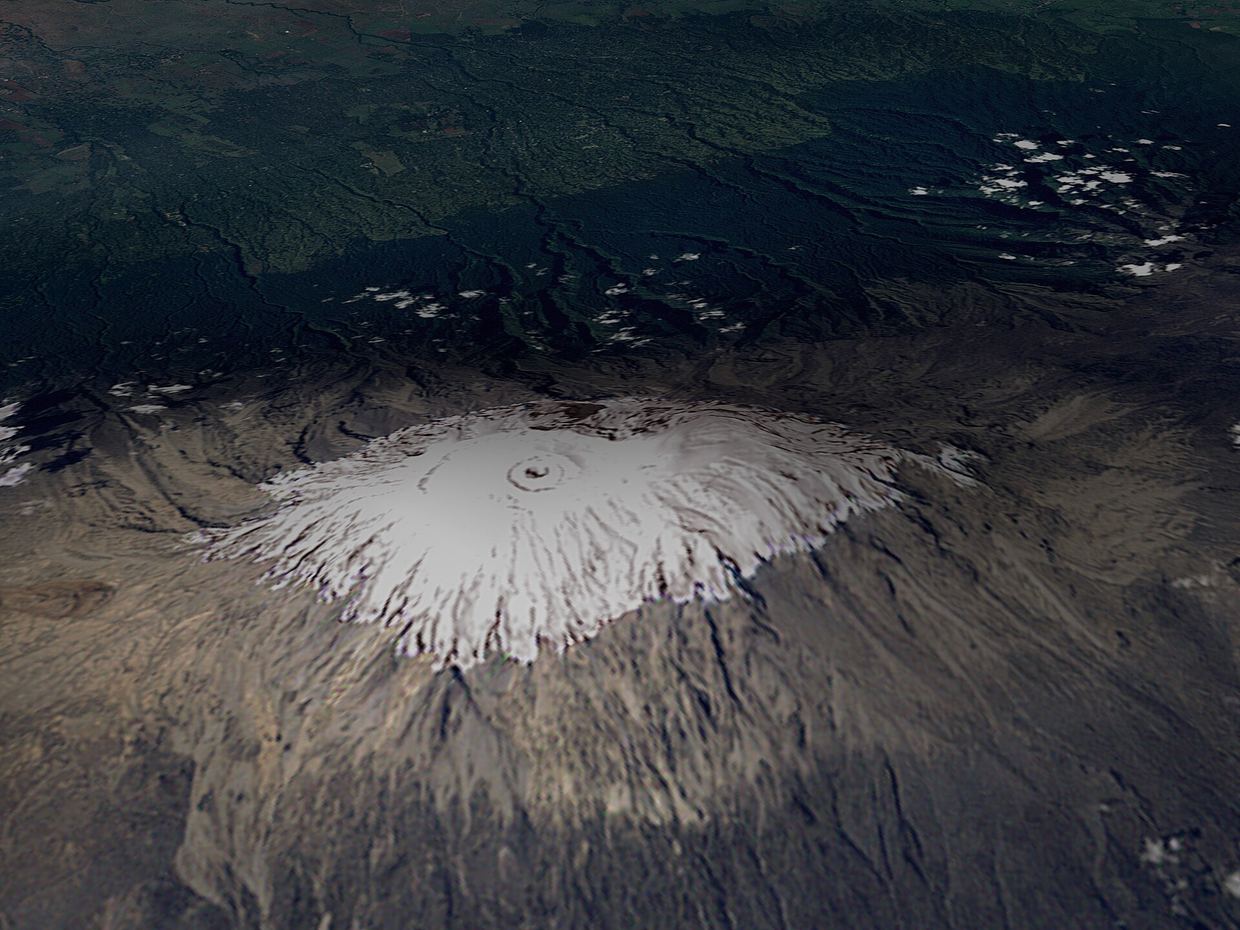
A team from the University of Portsmouth reconstructed air temperature across Mount Kilimanjaro for 2004–2024 and found that trends differ by elevation. The results are published in npj Climate and Atmospheric Science. Daytime air near the summit warmed, while the strongest cooling was recorded on the middle slopes doi.org
npj Climate and Atmospheric Sciencedoi.orgOpen source ↗.
The researchers combined data from 22 temperature loggers, installed and maintained by the university along a transect of about 5,000 m, with MODIS land-surface temperature and surface and topographic datasets. The loggers cover elevations from 900 m to 5,803 m. Long-term records over such a range are rare in tropical mountains, where stations are sparse at high elevations.
Method: from satellite surface temperature to air temperature
Satellites measure land-surface temperature, which differs from air temperature. According to the university, exposed ground in the dry season can be 10–15 °C hotter than the air above it. The authors used machine learning to map clear-sky air temperature at four MODIS overpasses at 1 km resolution doi.org
npj Climate and Atmospheric Sciencedoi.orgOpen source ↗.
The models showed RMSE of 1.76 °C for daytime and 1.36 °C for nighttime, with R² of 0.94 and 0.95 respectively. Daytime temperature varied strongly in space, depending on radiation and surface properties, while nighttime temperature changed more gradually with elevation doi.org
npj Climate and Atmospheric Sciencedoi.orgOpen source ↗.
Results: trends by elevation
The trend analysis covers 2004–2019 under clear-sky conditions. Daytime trends near the summit were positive, +0.05 to +0.10 °C per decade. At 3000–3500 m daytime air cooled by 0.13–0.14 °C per decade doi.org
npj Climate and Atmospheric Sciencedoi.orgOpen source ↗.
At night, weak warming of +0.04 to +0.15 °C per decade prevailed at most elevations, and the summit stayed near-neutral doi.org
npj Climate and Atmospheric Sciencedoi.orgOpen source ↗.
The authors note that the cooling zone coincides with vegetation and land-cover change. Lead author Yaping Mo said the cooling on the middle slopes coincides with the upslope expansion of the heathland zone, and that other factors are also likely to contribute. The authors conclude that warming on Kilimanjaro reflects both elevation-dependent climate responses and changes in local surface–atmosphere coupling caused by vegetation doi.org
npj Climate and Atmospheric Sciencedoi.orgOpen source ↗.
Mo also reported relatively little daytime warming in the rainforest zone. She suggested that conservation and reforestation may have limited local temperature increases, but said this relationship requires further investigation.
Sources · 2
Found a mistake?Read also