Bremen researchers find 4,139 organisms in 244 Pacific seafloor nodules, 245 in one rock
University of Bremen researchers counted living organisms in the cracks of polymetallic nodules at 5,000 m depth. The same nodules are a target of deep-sea mining.
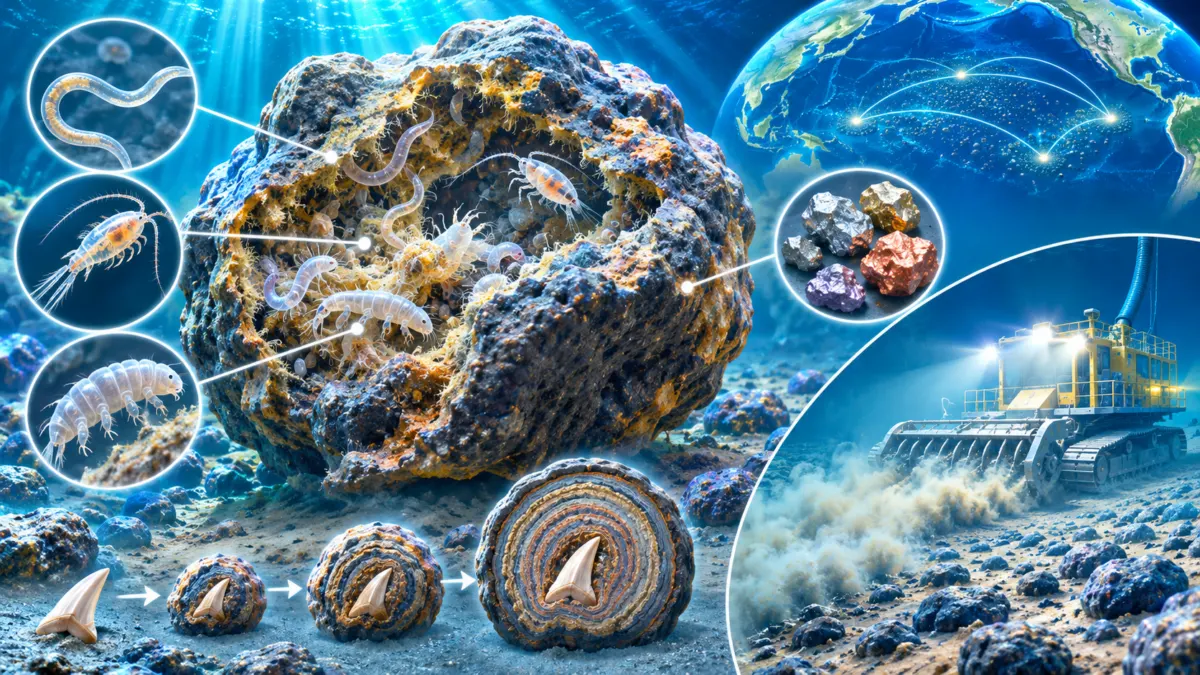
Researchers at the University of Bremen examined 244 polymetallic nodules from the floor of the Pacific Ocean and found 4,139 living organisms in their microscopic cracks and cavities, according to meteoweb.eu. meteoweb.eu
meteoweb.eumeteoweb.euOpen source ↗ One nodule held 245 animals, reported as the highest count in the study. The rocks lie at a depth of about 5,000 metres, in total darkness, at temperatures close to zero and under very high pressure.
Life inside the nodules
Until now, marine biology had focused mostly on animals living in muddy sediment or swimming in deep currents. The nodules offer a solid surface to attach to on a seabed made mainly of mud and fine silt. The fauna inside them consists of small invertebrates, including nematodes, copepods and other representatives of abyssal meiofauna.
According to the researchers, the communities in the rock cracks are distinct from the animal populations in the soft mud around the nodules. Microbial and animal communities in nodules more than 1,000 kilometres apart proved very similar. The scientists do not yet know whether some of the species found exist only inside the rocks or can survive elsewhere.
Slow growth and mining interest
Nodules grow as minerals dissolved in seawater precipitate around a nucleus, which can be a bone fragment or the tooth of an ancient shark. Growth is measured in a few millimetres per million years. meteoweb.eu
meteoweb.eumeteoweb.euOpen source ↗ The nodules accumulate nickel, cobalt, copper and manganese, metals used in batteries and other technologies of the energy transition.
Companies are developing tracked machines designed to descend to the seabed, scrape it and lift nodules to the surface, a practice known as deep-sea mining. Removing the nodules eliminates the only solid substrate over large areas of the seabed. Because they take millions of years to form, they cannot regenerate on human timescales. The source also notes that sediment clouds raised by collectors could affect filter-feeding organisms tens of kilometres away.
The study documents a part of deep-sea biodiversity that, according to the source, ecological risk-assessment models had almost entirely overlooked.