Model: slowing of Earth's spin after Moon formation may have deformed the first crust
Calculations by Simon J. Lock of the University of Bristol show that tidal braking of the young Earth's rotation could have stretched and compressed its earliest crust.
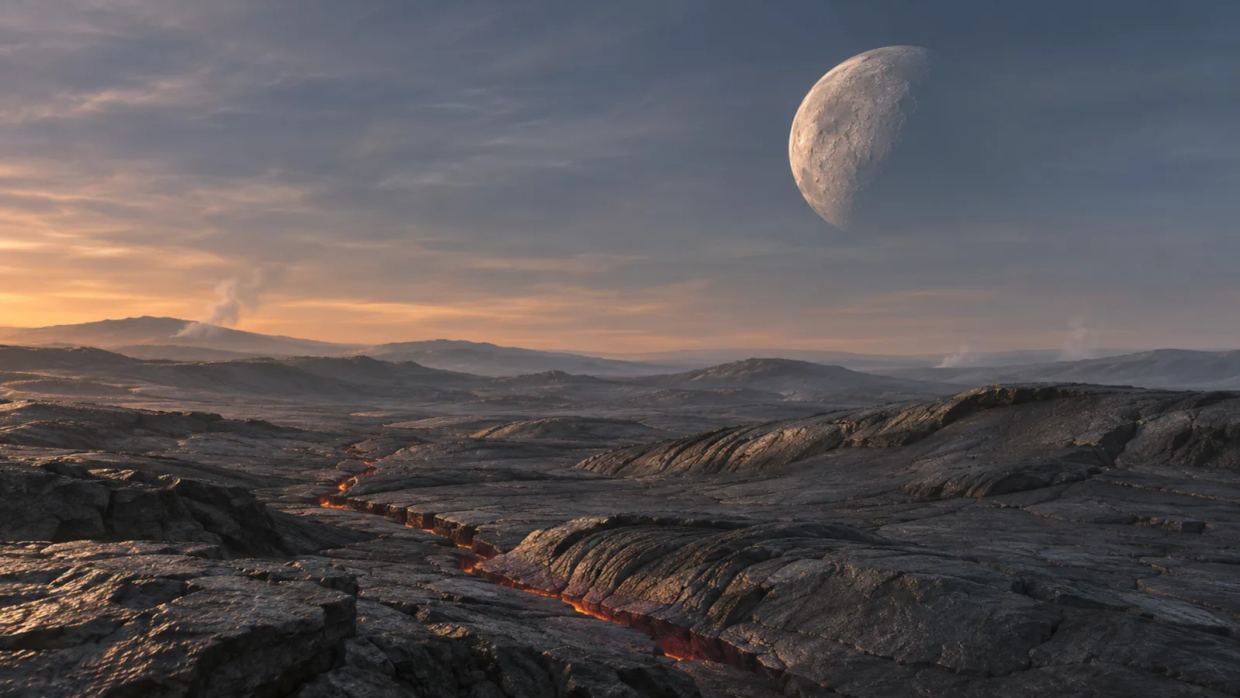
Planetary geophysicist Simon J. Lock of the University of Bristol has calculated how the slowing rotation of the young Earth could have affected its first crust, according to a study in Journal of Geophysical Research Solid Earth doi.org
Journal of Geophysical Research Solid Earthdoi.orgOpen source ↗. The Moon-forming impact about 4.5 billion years ago left Earth rotating rapidly, with a day of roughly 2.3 to 5 hours. Over the following tens of millions of years the rotation slowed substantially as tides pushed the Moon outward
doi.org
Journal of Geophysical Research Solid Earthdoi.orgOpen source ↗.
Crust thickness and planetary shape
Lock combined models of Earth's internal structure with several scenarios of the early lunar orbit and its tidal evolution. Right after the impact the planet was strongly flattened. In the most extreme scenarios the equatorial radius was twice the polar one. This reduced effective gravity near the equator, and with it the pressure under which mantle melts collected into a first crust doi.org
Journal of Geophysical Research Solid Earthdoi.orgOpen source ↗.
As a result, the crust would have been thicker at the equator than at the poles. In the typical scenario the difference is about 15 percent; for a very fast-spinning early Earth the equatorial crust could have been up to ten times thicker doi.org
Journal of Geophysical Research Solid Earthdoi.orgOpen source ↗.
As the Moon receded, the day lengthened and Earth became rounder. Its surface had to expand near the poles and be compressed near the equator. According to the calculations, this change of shape could trigger tectonic deformation at least temporarily comparable to that at present-day plate boundaries. Even in the conservative scenario, deformation rates exceeded those of slow modern plate boundaries, in places for several million years. In scenarios with high initial angular momentum, equatorial compression lasted considerably longer, and short peaks reached Himalayan rates, but along the entire equator doi.org
Journal of Geophysical Research Solid Earthdoi.orgOpen source ↗.
Possible consequences for early rocks
The outcome depended on the rheology of the earliest crust. Convergence could have buried hydrated and weathered surface material, which on remelting would yield silica-rich magmas and rocks resembling continental crust. Extensive volcanism and degassing of Earth's interior are also possible consequences doi.org
Journal of Geophysical Research Solid Earthdoi.orgOpen source ↗.
A second effect came from rising internal pressure as rotation slowed. Phase changes could have made parts of the deeper crust denser, causing delamination and sinking into the mantle, which would produce early mantle heterogeneities. Together, these processes could explain a diversity of rock types within tens of millions of years of Earth's formation doi.org
Journal of Geophysical Research Solid Earthdoi.orgOpen source ↗.
The author stresses that this does not imply a modern system of moving plates. The model gives stresses and deformation caused by the changing shape, while the behavior of the young, partly hot rock depended on its material properties. The early motion of the Moon and the time the surface solidified remain uncertain, so the result describes a plausible additional driver of early crustal motion, not direct evidence of how it proceeded. Future models will need to treat tides, cooling and rock behavior together.