Twisted bilayer MoTe2 at 3.79°–5.76°: transport maps fractional states giving way to superconductivity
A transport study of twisted bilayer MoTe2 across 3.79°–5.76° traces how fractional topological states give way to correlated insulators and superconductivity.
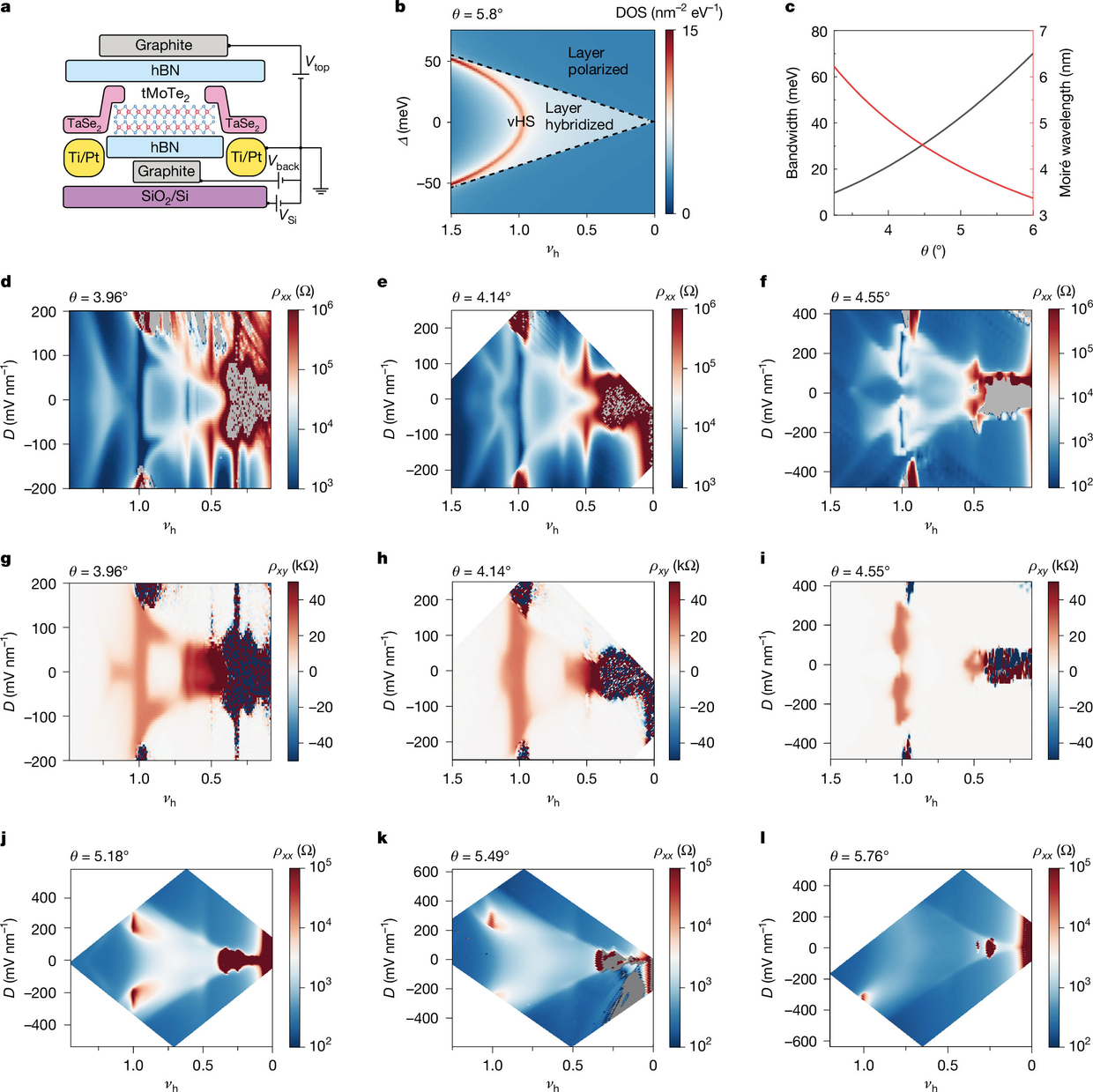
A research group has reported a systematic transport study of twisted bilayer MoTe2 (tMoTe2) across twist angles from 3.79° to 5.76°, published in Nature. According to the authors, the phase diagram evolves from valley-polarized fractional topological states to valley-degenerate correlated states and, at the largest angles, superconductivity doi.org
Naturedoi.orgOpen source ↗.
Two-dimensional semiconducting moiré superlattices are considered a highly tunable platform for strongly correlated and topological quantum phases. tMoTe2 had already been shown to host fractional topological phases at zero magnetic field. How these phases change with twist angle, and how they compete with other correlated states, had remained largely unexplored doi.org
Naturedoi.orgOpen source ↗.
Fractional states at small twist angles
At relatively small angles, the partially filled Chern bands of tMoTe2 host fractional quantum anomalous Hall states that follow the Jain sequence. The authors also report signatures of an anomalous composite Fermi liquid at a moiré hole filling factor of νh = 1/2 doi.org
Naturedoi.orgOpen source ↗.
Increasing the twist angle progressively suppresses the fractional topological phases. The half-filled Chern band is reconstructed into symmetry-breaking integer Chern insulating states doi.org
Naturedoi.orgOpen source ↗.
Correlated insulators and superconductivity at larger angles
At νh = 1 the authors observe a transition. At small angles the material shows robust integer quantum anomalous Hall insulators. At larger angles these are replaced by topologically trivial correlated insulators that are tuned by the displacement field doi.org
Naturedoi.orgOpen source ↗.
At twist angles above approximately 5.6°, superconductivity emerges adjacent to the νh = 1 correlated insulator. Its phase diagram closely resembles the one recently reported for twisted bilayer WSe2 doi.org
Naturedoi.orgOpen source ↗.
The authors conclude that the results point to a unified, twist-angle-driven evolution linking fractional topology, symmetry breaking, magnetic order and superconductivity in moiré systems doi.org
Naturedoi.orgOpen source ↗. The work is an experimental transport study of device samples, and the findings describe phases observed in this material system.