Water molecule splits into neutral oxygen within core-hole lifetime in X-ray experiments at DESY and MAX IV
Gas-phase water excited by X-rays above the O 1s threshold dissociated before Auger decay, leaving excited neutral oxygen atoms, spectroscopy at two synchrotrons shows.
A team led by Florian Trinter of FHI in Berlin has observed gas-phase water molecules breaking apart faster than their electrons complete Auger decay. The work, published on 5 November 2026 in Physical Review Letters, used photoexcitation above the O 1s ionization threshold aps.org
Physical Review Lettersaps.orgOpen source ↗.
According to the authors, both oxygen-hydrogen bonds can rupture within a few femtoseconds, leaving an excited, electrically neutral oxygen atom.
What the spectra show
When a water molecule absorbs a sufficiently energetic X-ray photon, an electron can be ejected from the inner shell of the oxygen atom. The vacancy normally triggers Auger decay, in which another electron fills it and a second electron is ejected.
High-resolution resonant Auger spectroscopy revealed sharp features at constant kinetic energy. They arise from nonradiative decay of neutral atomic oxygen formed within the O 1s core-hole lifetime aps.org
Physical Review Lettersaps.orgOpen source ↗. Comparison with Auger spectra identified them as transitions from the atomic (1s)1(2s)2(2p)5 1P state. Neutral fragments can therefore form in well-defined electronic states before Auger decay.
The peaks could not be explained by the decay of intact water molecules or by the fragments usually expected after X-ray absorption. Calculations of the molecular and atomic states gave electron energies that matched excited neutral oxygen atoms rather than hydroxyl (OH) fragments.
The authors say the electronic state created by X-ray absorption produces strong repulsive forces, so the nuclei move apart before the electronic relaxation finishes. Trinter described it as nuclear motion winning the race against the electrons.
Two synchrotrons, one result
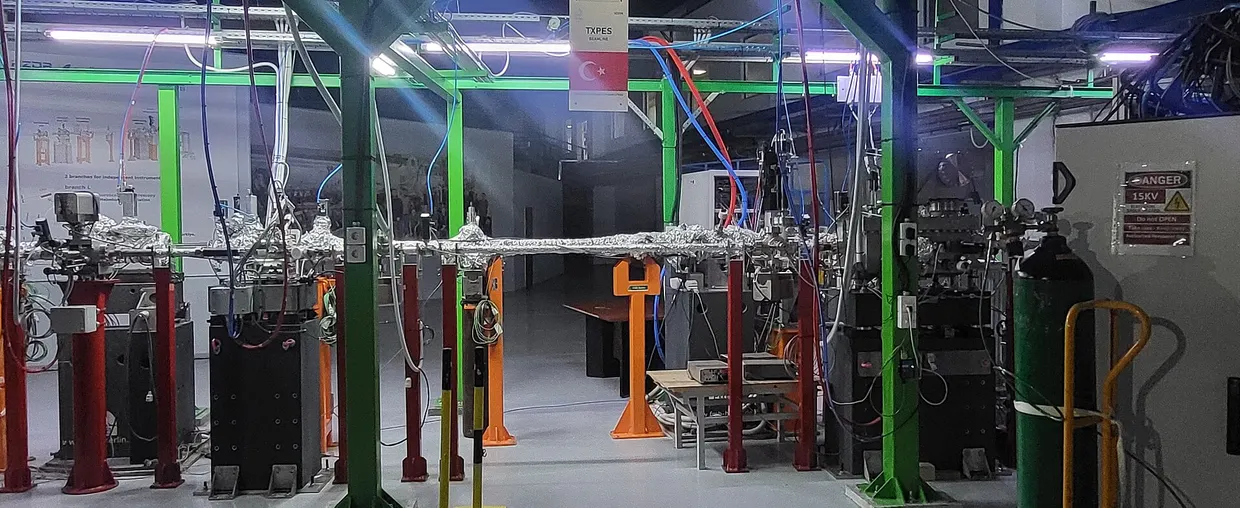
The team measured isolated water molecules at two facilities: PETRA III at DESY in Hamburg, Germany, and the FlexPES beamline at MAX IV in Lund, Sweden. Both experiments detected the same unusually narrow peaks. Gunnar Öhrwall of MAX IV said the measurements at the two sites give a consistent picture of the process.
Ludger Inhester of CFEL at DESY noted that the energy of the emitted electrons acts as a fingerprint of the state formed. The calculations, he said, are consistent with the decay of an excited neutral oxygen atom already separated from the water molecule.
The authors propose a new explanation for high-energy electron features seen in earlier water experiments. Signals previously attributed to hydroxyl fragments may instead come from excited neutral oxygen atoms formed by this very fast fragmentation.