Trypanosoma brucei keeps moving in viscous methylcellulose solutions via network-threading propulsion
In vitro, bloodstream-form T. brucei kept stable forward motion as viscosity and confinement increased, despite reduced flagellar wave parameters, the authors report.
Researchers have studied how Trypanosoma brucei, a parasite living in blood and interstitial fluids of its hosts, moves in media of different viscosity and elasticity. The work was published in Nature Communications. nature.com
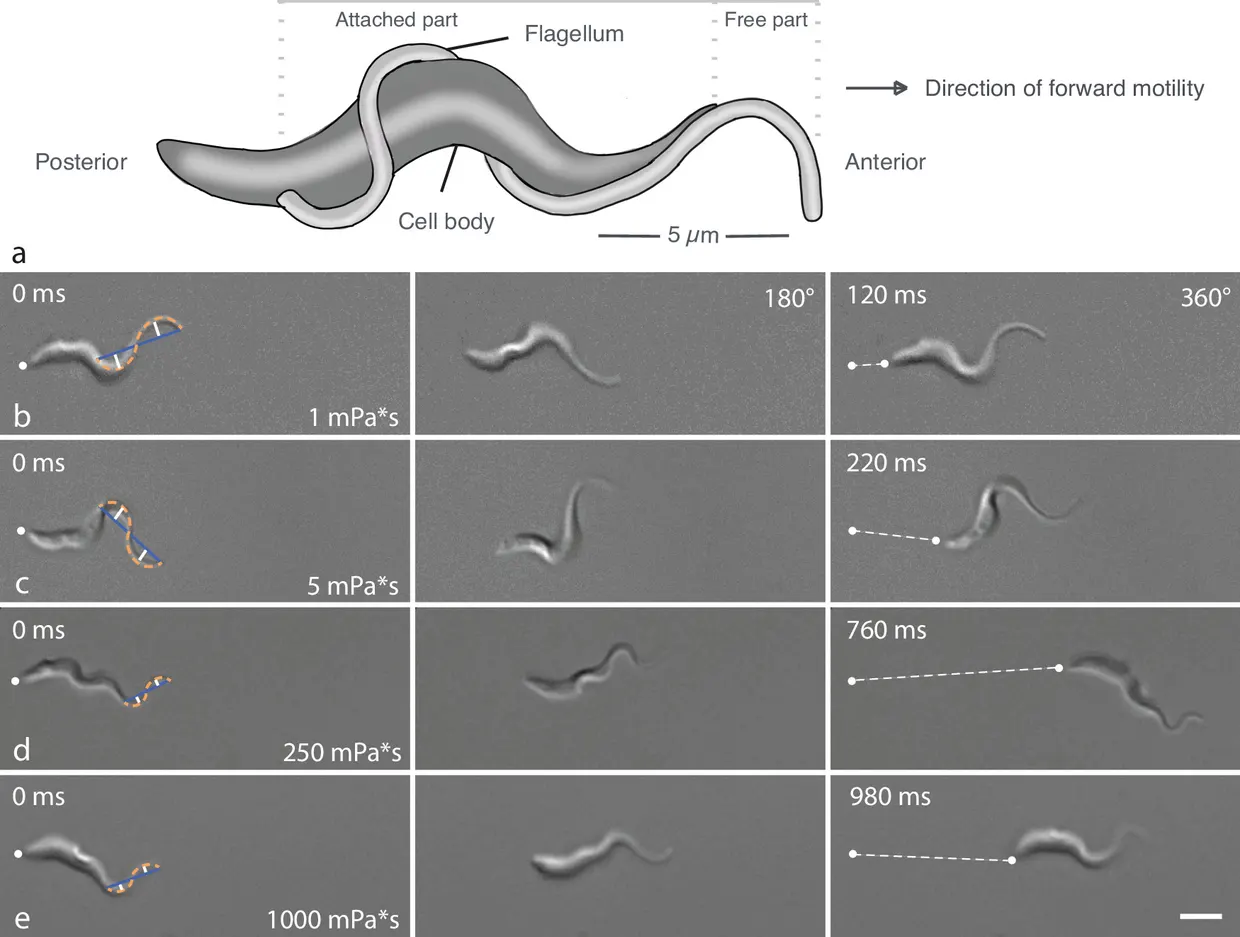
Nature Communicationsnature.comOpen source ↗ They used bloodstream-form cells in methylcellulose solutions with dynamic viscosities of 1, 5, 250 and 1000 mPa·s. With quantitative high-speed video microscopy and digital holography microscopy, they recorded the three-dimensional reaction of the flexible cell body and its flagellum to increasing confinement.
Why the parasite's motility matters
African trypanosomes are unicellular parasites that cause severe disease in humans and livestock, including sleeping sickness, which is transmitted by the tsetse fly. Motility is known to be crucial for infection of both flies and mammals. How the parasite disseminates within the host remains largely unresolved, the authors note.
The cell has an unusual structure: the flagellum is attached along the cell body, and only a relatively short portion extends beyond the anterior pole. In low-viscosity culture media, waves run almost simultaneously in both directions along the flagellum, and the cell tumbles without progress. Under more blood-like conditions it swims more unidirectionally, in a corkscrew-like rotational fashion.
Viscosity as a model of tissue confinement
Methylcellulose solutions behave as Newtonian fluids at low viscosity and become increasingly viscoelastic above an entanglement threshold of around 40 mPa·s. nature.com
Nature Communicationsnature.comOpen source ↗ The values of 1 and 5 mPa·s lie in the Newtonian regime, while 250 and 1000 mPa·s were expected to show non-Newtonian effects. The authors used the dense solutions to mimic the confinement cells meet in the extracellular matrix of tissues, built from collagen and elastin meshes and viscous polymers such as proteoglycans.
According to the authors, increasing confinement leads the cell to a network-threading type of propulsion. This allows stable progressive motility despite a reduction in wave parameters, up to tissue-like confinement. Where confinement forces cells to reverse their movement, flagellar beat reversal lets them explore different routes.
The authors describe these adjustments as purely mechanical. The measurements were made in model polymer solutions, not in animal tissue.
Sources · 1
Found a mistake?Read also