JUNO measures two neutrino oscillation parameters from 59.1 days of data, 1.6 times more precisely
The 20-kilotonne JUNO detector measured sin²θ12 and Δm²21 simultaneously from reactor neutrinos; the authors say the result validates the detector design.
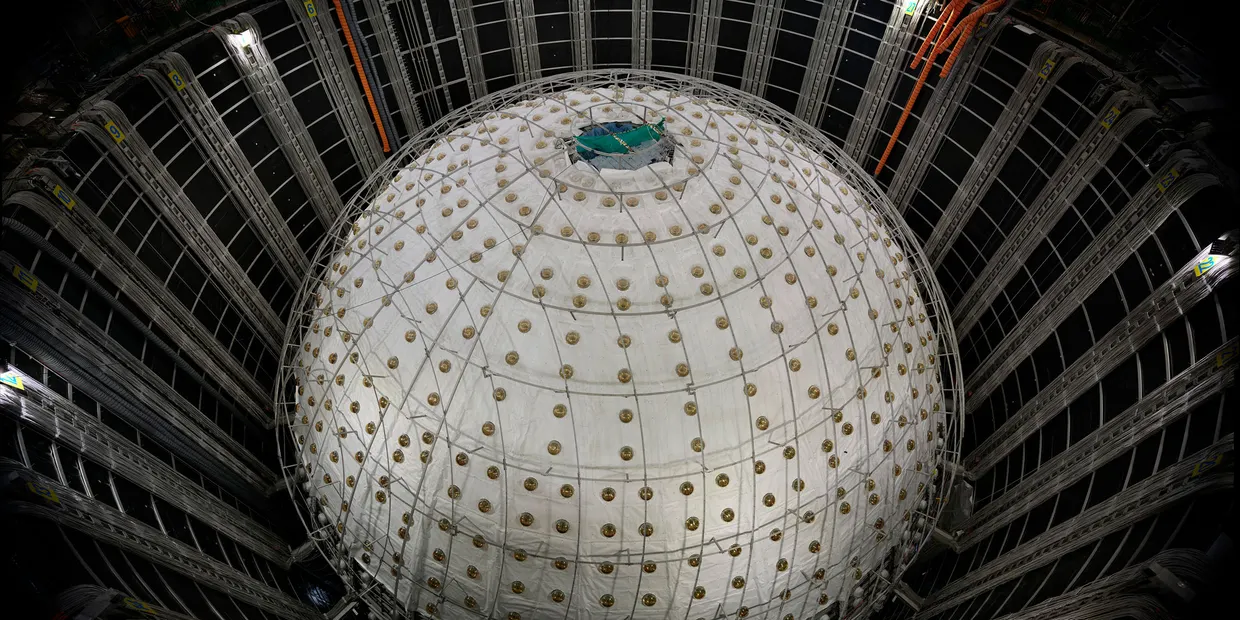
The JUNO collaboration reported, in a paper on nature.com, the first simultaneous high-precision determination of two neutrino oscillation parameters. The analysis uses the first 59.1 days of data collected since the detector was completed in August 2025 nature.com
nature.comnature.comOpen source ↗. JUNO is a 20-kilotonne liquid-scintillator detector located 52.5 km from multiple reactor cores.
Measured oscillation parameters
For the normal mass ordering scenario, the authors obtained sin²θ12 = 0.3092 ± 0.0087 and Δm²21 = (7.50 ± 0.12)×10⁻⁵ eV². According to the authors, this improves the precision by a factor of 1.6 relative to the combination of all previous measurements.
Neutrino oscillations are a quantum effect that manifests at macroscopic scales. They are governed by lepton flavour mixing angles and neutrino mass-squared differences, which are fundamental parameters of particle physics and represent phenomena beyond the Standard Model. Precision measurements of these parameters are needed to test the completeness of the three-flavour framework, to determine the neutrino mass ordering and to probe possible new physics.
Detector performance and next steps
JUNO was designed to resolve the interference pattern of reactor neutrinos with sub-percent precision nature.com
nature.comnature.comOpen source ↗. The authors state that the result validates the design of the detector and indicates its readiness for resolving the neutrino mass ordering with a larger dataset. They add that reaching this precision with a short exposure highlights the potential of JUNO for precision neutrino physics and paves the way for its broad scientific programme.
The raw experimental data are not publicly accessible because of their complexity and volume. Source data for several figures are provided, and inquiries about the data and posteriors can be directed to the collaboration. The simulation and statistical-analysis code is shared within the collaboration and is not publicly distributed.
The reference list of the paper includes earlier JUNO studies of its sensitivity to supernova neutrinos, geoneutrinos, solar and atmospheric neutrinos, proton decay, MeV dark matter and invisible decay modes of neutrons. These are listed as prospects of the programme, not as results of the present measurement.
Sources · 2
Found a mistake?Read also