Max Born Institute develops magnon momentum microscopy and applies it to yttrium iron garnet
A soft X-ray technique images short-wavelength magnons across two-dimensional momentum space; in yttrium iron garnet it revealed nonlinear interactions not observed before.
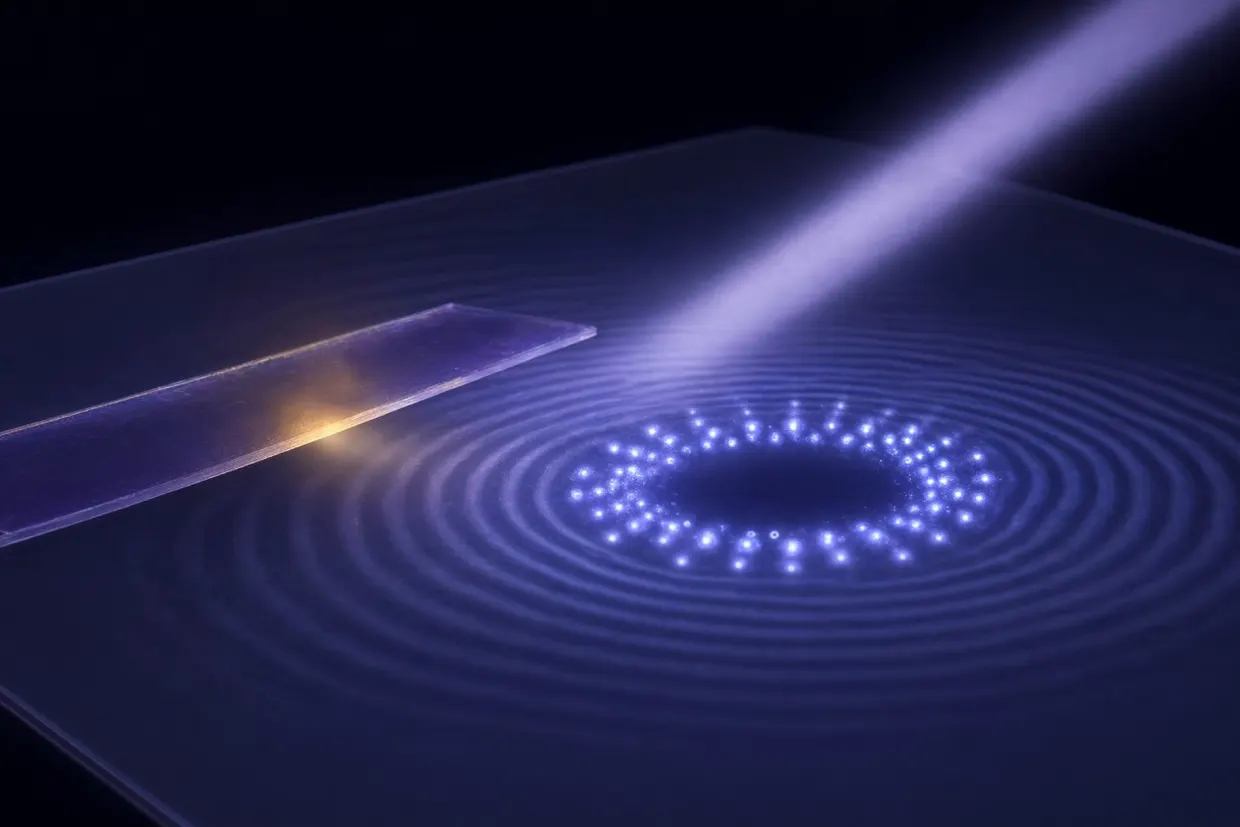
An international group led by the Max Born Institute has developed magnon momentum microscopy, a method that directly images magnons in two-dimensional momentum space using soft X-rays. The work was published in Nature Physics. nature.com
Nature Physicsnature.comOpen source ↗ The group also includes researchers from Helmholtz-Zentrum Berlin, the University of Naples Federico II and EPFL, according to the publication's account.
Magnons are quantized collective excitations of long-range ordered spins. At nanometre wavelengths, exchange interactions increasingly govern their dynamics, which opens a largely unexplored regime of couplings between magnons and other quasi-particles. Detecting such short-wavelength spin waves has remained a key experimental challenge.
How the method works
Magnon momentum microscopy is a quasi-elastic, resonant magnetic soft-X-ray scattering technique. In the experiment, magnons act as a dynamic diffraction grating for the X-rays. From the resulting diffraction pattern, the authors determine magnon wavelengths and amplitudes across the whole two-dimensional plane in a single measurement.
The authors report high sensitivity, element specificity and bulk sensitivity, as well as intrinsic access to nanometre-scale wavelengths without frequency limitation. nature.com
Nature Physicsnature.comOpen source ↗ According to the researchers, the method needs no complex nanostructuring of the sample and is compatible with a wide range of excitation schemes.
Results on yttrium iron garnet
The team applied the technique to yttrium iron garnet, a prototypical magnonic material, and observed a variety of previously unobserved nonlinear magnon interactions. At high excitation levels the magnons did not simply propagate in one direction. They redistributed across momentum space and formed characteristic patterns.
The most notable pattern was omnidirectional magnon population forming an elliptical ring in momentum space. The authors describe it as direct evidence of four-magnon scattering, in which two magnons interact and produce two new magnons with different propagation directions.
Salvatore Perna, who developed the theoretical model, said the team found a more general type of four-magnon scattering involving propagating magnons. According to the analysis, it arises from a parametric instability of magnons at finite wave vectors and redistributes energy among many modes.
The researchers expect the method to provide new insight into nonlinear magnonics, mode coupling and wave phenomena in magnetic materials. They say further development could extend it to ultrafast timescales and to systems operating at much higher frequencies, including antiferromagnets.