Simons Observatory in Chile fully online: 98,000 detectors begin mapping the cosmic microwave background
After two years of commissioning, all four telescopes of the Simons Observatory are taking data in the Atacama Desert, aiming at B-mode polarization, a possible trace of cosmic inflation.

The Simons Observatory in Chile's Atacama Desert is now fully online and conducting science operations, according to newswise.com. This follows two years of calibrating instruments, ramping up additional telescopes and installing a solar array to help power the site newswise.com
newswise.comnewswise.comOpen source ↗. The observatory is funded in large part by the Simons Foundation and houses four telescopes: three small-aperture telescopes (SATs) and one large-aperture telescope (LAT). The U.S. Department of Energy's Argonne National Laboratory contributed expertise in preparing and optimizing the telescopes for precise measurements of faint signals from the early universe.
Search for the inflation signal in the CMB
Physicists think the universe expanded rapidly in a tiny fraction of a second after the Big Bang, some 13.8 billion years ago. The slice of the universe we can see today would have grown from smaller than a subatomic particle to larger than a marble. Such cosmic inflation would have left ripples in space-time, imprinted on the cosmic microwave background (CMB), light that originated 380,000 years after the Big Bang. The signal would appear as faint swirling patterns in the CMB polarization, called B-modes, and has remained elusive for decades.
It will take a few years to collect enough data to possibly detect B-modes. The observatory has 98,000 detectors, more than 16 times as many as the Atacama Cosmology Telescope (ACT), and they map the sky several times faster. According to spokesperson Jo Dunkley, images made from a few months of data are already deeper and less noisy than those from the European Space Agency's Planck satellite, which took years to collect. The LAT scans half the celestial sky every couple of days.
Commissioning and transient objects
Argonne physicist Katie Harrington helped guide the telescopes through commissioning. The team used the moon to confirm that detectors respond and to establish where they point, and Jupiter as a reference for converting detector measurements into sky temperatures newswise.com
newswise.comnewswise.comOpen source ↗.
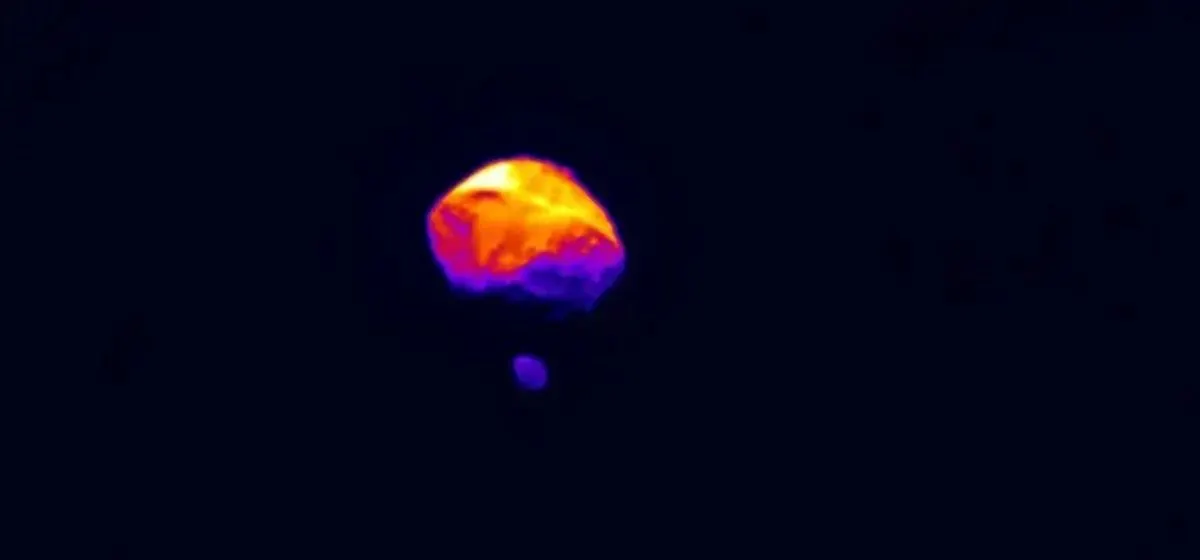
The observatory also targets galaxy evolution, transient objects and neutrinos. Co-director Mark Devlin said the instrument can see small changes in transients in a few days, whereas ACT needed months. Early observations have caught activity around a supermassive black hole, giant flares from a Milky Way star and asteroids crossing the solar system. The LAT has also produced the most comprehensive images of the Milky Way in polarized microwave light. A second phase will add three SATs funded by the United Kingdom and Japan, due to arrive in the coming year.