EPFL theory explains L-H plasma transition in tokamak simulations; ITER threshold put at 43 MW
Simulations of a diverted tokamak reproduce the sudden shift to high energy confinement and yield formulas for the heating power needed to trigger it.

Researchers at the Swiss Federal Institute of Technology in Lausanne (EPFL) have developed a theory of the sudden transition of tokamak plasma to a state of high energy confinement, according to a paper in Physical Review Letters. The work is based on flux-driven two-fluid simulations of a diverted tokamak, in which heating power was increased step by step. aps.org
Physical Review Lettersaps.orgOpen source ↗ The model also explains why plasma density and the direction of the magnetic field affect the process.
Mechanism of the L-H transition
The transition from low to high confinement (L-H) was first observed in 1982: once heating power exceeds a critical value, turbulence in the outer plasma weakens and heat losses fall. No earlier theory explained all observed dependencies at once, including the effect of density and field direction on the required power.
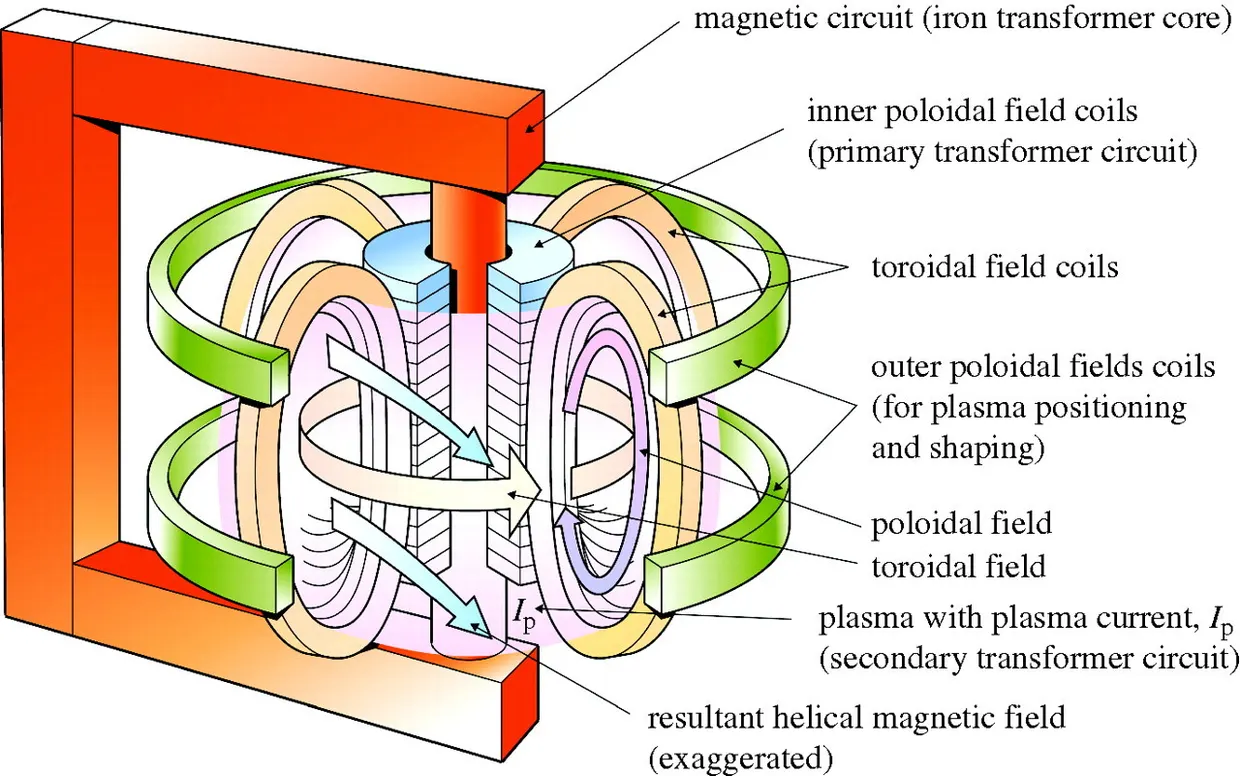
In the simulations, electromagnetic drift-wave turbulence spontaneously generates a sheared E×B flow that suppresses transport in the edge. The asymmetry of the transition with respect to the toroidal field direction was reproduced in simulations for the first time. According to a quasilinear calculation of the turbulent momentum flux, it arises from time-reversal symmetry breaking by finite collisionality. Field configuration, plasma flows and particle collisions interact, so in one magnetic configuration a strong flow is easier to reach than in the other.
Power thresholds for ITER and SPARC
The authors derived analytically scaling laws for the L-H power threshold in the high- and low-density branches, for the density minimum and for the minimum power. All of them match or surpass the accuracy of existing empirical scalings. aps.org
Physical Review Lettersaps.orgOpen source ↗ The required power rises with density in one range and falls in another, so there is a density at which the heating power needed is lowest. The team compared the model's predictions with experiments on existing fusion devices.
Applied to ITER, under construction in France, the model gives a minimum of at least 43 MW of heating power for high confinement; the planned available power is 73 MW. For SPARC, a compact tokamak developed by Commonwealth Fusion Systems (USA), the Swiss team's calculation gives a minimum of about 26 MW against a planned 25 MW.