ICFO builds a strontium-87 quantum-gas microscope that resolves all 10 spin states of single atoms
The setup images single fermionic atoms and reads out the occupation of each spin state in one run, a capability needed for studying SU(N) magnetism at the level of individual sites.
Researchers at ICFO have built a quantum-gas microscope for fermionic strontium-87 and used it to detect single atoms and determine the occupation of each of the 10 spin states in a single experimental realization. The work is published in Physical Review X aps.org
Physical Review Xaps.orgOpen source ↗. The imaging is based on cooling and fluorescence on the narrow intercombination line at 689 nm.
Quantum-gas microscopes give direct access to the phases of the Hubbard model and show how interactions, SU(2) magnetism and doping compete. Alkaline-earth(-like) fermions extend this spin-1/2 picture to higher symmetries and make SU(N) Hubbard models accessible. According to the authors, a microscopic exploration of SU(N) quantum systems had remained elusive until now.
Spin-resolved imaging scheme
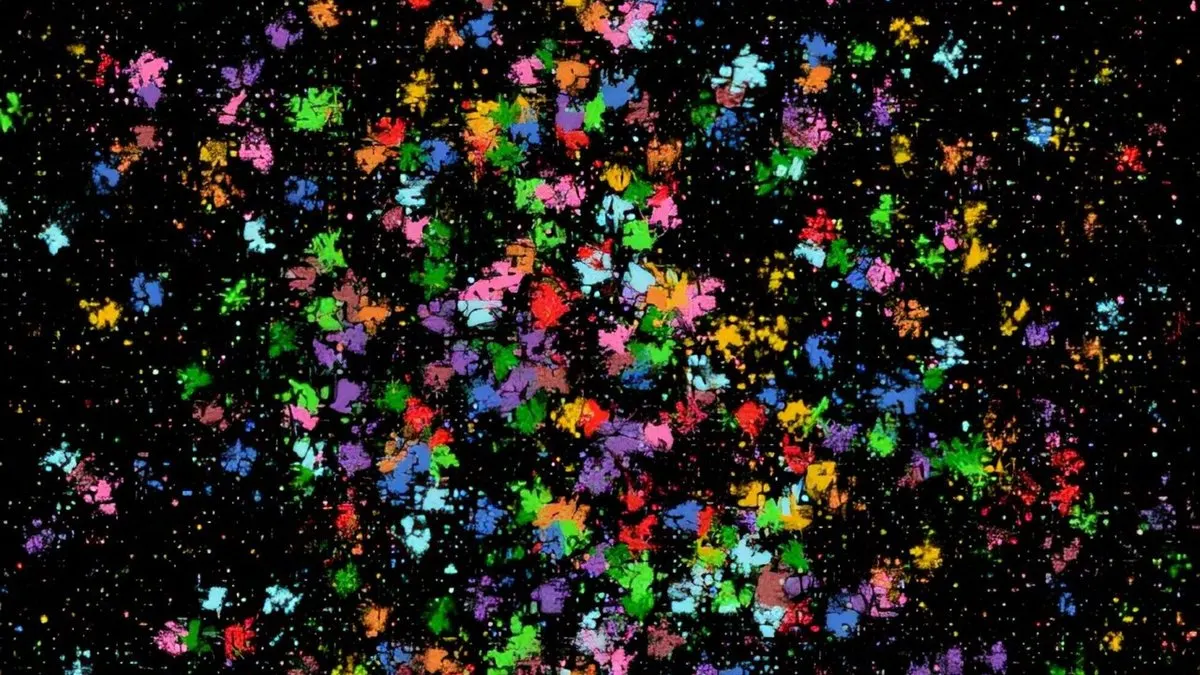
The method uses a spin-selective optical pumping protocol. As described in the publication's summary, the laser is tuned so that only atoms in one chosen spin state fluoresce, while the others stay dark. Atoms from different states are transferred one after another into this addressable state, and one image is collected for each of the 10 states. Overlaying the images gives a picture in which each colour corresponds to one spin state.
The team had previously imaged strontium-84, a boson with no spin. Strontium-87 is a fermion with a nuclear spin of 9/2, so its ground-state manifold contains 10 spin states.
Benchmarks and simulations
To test the method, the authors observed single-particle Larmor precession across the full spin-9/2 ground-state manifold aps.org
Physical Review Xaps.orgOpen source ↗. They also ran numerical simulations of SU(N) Fermi-Hubbard chains that incorporated the measured detection fidelities. According to the authors, these simulations show that the approach can resolve many-body spin correlations. Determining all 10 occupations in a single realization is, in their words, a crucial capability for probing site-resolved magnetic correlations.
The authors state that strontium-87 quantum-gas microscopy can be used to study exotic magnetism in the SU(N) Fermi-Hubbard model and offers a new detection tool for quantum simulation, computation and metrology. The summary of the work also mentions spin liquids and qudits, which can store more information than ordinary qubits, as possible directions. The result is a demonstration of the imaging technique itself; the many-body correlations were evaluated numerically rather than measured.