Laser pulses in Bi-based cuprate show pseudogap competes with superconductivity
Time-resolved photoemission on optimally doped Bi-based cuprates shows that the pseudogap and superconductivity compete, rather than one growing out of the other.
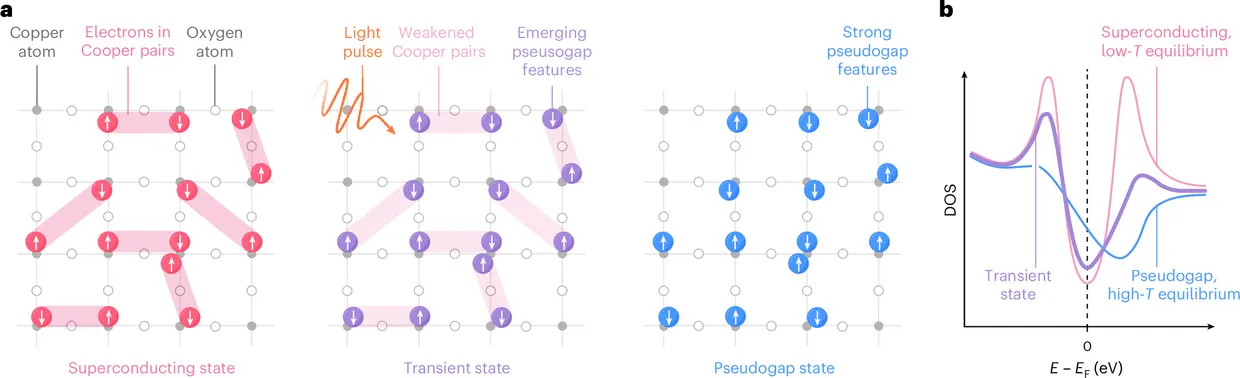
An international team led by Fabio Boschini at the Institut National de la Recherche Scientifique (INRS, Varennes, near Montreal) used time- and angle-resolved photoemission to study how superconductivity and the pseudogap coexist in optimally doped Bi-based cuprates. According to the paper on nature.com, a sufficiently strong laser pulse switches the electronic spectrum from a superconducting-like one to a pseudogap-like one nature.com
nature.comnature.comOpen source ↗. The first author is doctoral student Dario Armanno. The measurements were done at the Advanced Laser Light Source.
What the experiment did
The crystal was cooled to about -263°C, well below the temperature of about -182°C at which it becomes superconducting. An ultrashort infrared pulse broke the electron pairs that carry the supercurrent, switching superconductivity off for about a picosecond without heating the whole lattice above the critical point. A delayed ultraviolet pulse then knocked electrons out of the crystal, and detectors recorded their kinetic energy and emission angle in frames spaced 300 femtoseconds apart. The authors accessed the near-antinodal region of the Brillouin zone directly.
Symmetric and asymmetric gap
The experiment was repeated at two pulse energies. The weaker pulse only partly filled the superconducting gap and kept its symmetry. The pulse with nearly twice the energy produced an asymmetric density of states, the characteristic signature of the pseudogap, which persisted for one to two picoseconds. It faded as superconductivity recovered after about 3.5 picoseconds. When superconductivity was fully restored, the pseudogap was suppressed and the density of states was particle-hole symmetric. At intermediate times or intermediate fluence, the authors observed pseudogap and superconducting features together.
The asymmetry appeared at electronic temperatures well below the equilibrium superconducting critical temperature. A comparison of states with the same electronic temperature after the two pulses showed that the asymmetry arose only after the stronger pulse, so the effect is not purely thermal nature.com
nature.comnature.comOpen source ↗. Simulations by physicists at the Center for Computational Quantum Physics of the Flatiron Institute in New York showed that simply superimposing models of the two states does not reproduce the laboratory data.
The authors say their findings challenge the view that superconductivity emerges from phase coherence within the pseudogap. They report instead that the two states compete, and that the low-temperature ground state of cuprates reflects an interplay between them.
Sources · 2
Found a mistake?Read also