Warwick astronomers: white dwarf WD J1330+6435 would look green, a first for known stars
Researchers at the University of Warwick calculated from spectra that some white dwarfs would appear green, pink, cyan, yellow or purple up close, not only white or blue.

Astronomers at the University of Warwick (UK) have calculated that some white dwarf stars would look green, pink, cyan, yellow or purple to the human eye, according to a study in RAS Techniques and Instruments reported by warwick.ac.uk. The work, led by Dr Mark Hollands, includes the first star the authors know of that would appear green. warwick.ac.uk
warwick.ac.ukwarwick.ac.ukOpen source ↗ The colours are computed, not observed: no white dwarf is close enough to be seen directly.
How the colours were calculated
The team took stellar spectra that astronomers already collect routinely and ran them through a model of human colour vision. For most stars, including most white dwarfs, colour is set almost entirely by temperature, as for a perfect radiator. The exception is the coolest white dwarf atmospheres, where density reaches around 1 gram per cubic centimetre, roughly that of water. There, trace elements such as carbon, calcium and sodium interact with dense helium plasma and absorb light over a wider range of colours, shifting the star away from orange, white and blue.
The colours fall into groups tied to atmospheric composition. Carbon-rich white dwarfs are typically pink or purple. Those enriched with debris from shattered asteroids and comets tend towards yellow. Cooler stars with mixed hydrogen and helium atmospheres often look cyan or pale blue, because hydrogen molecules collide with helium atoms.
Green and salmon-pink stars
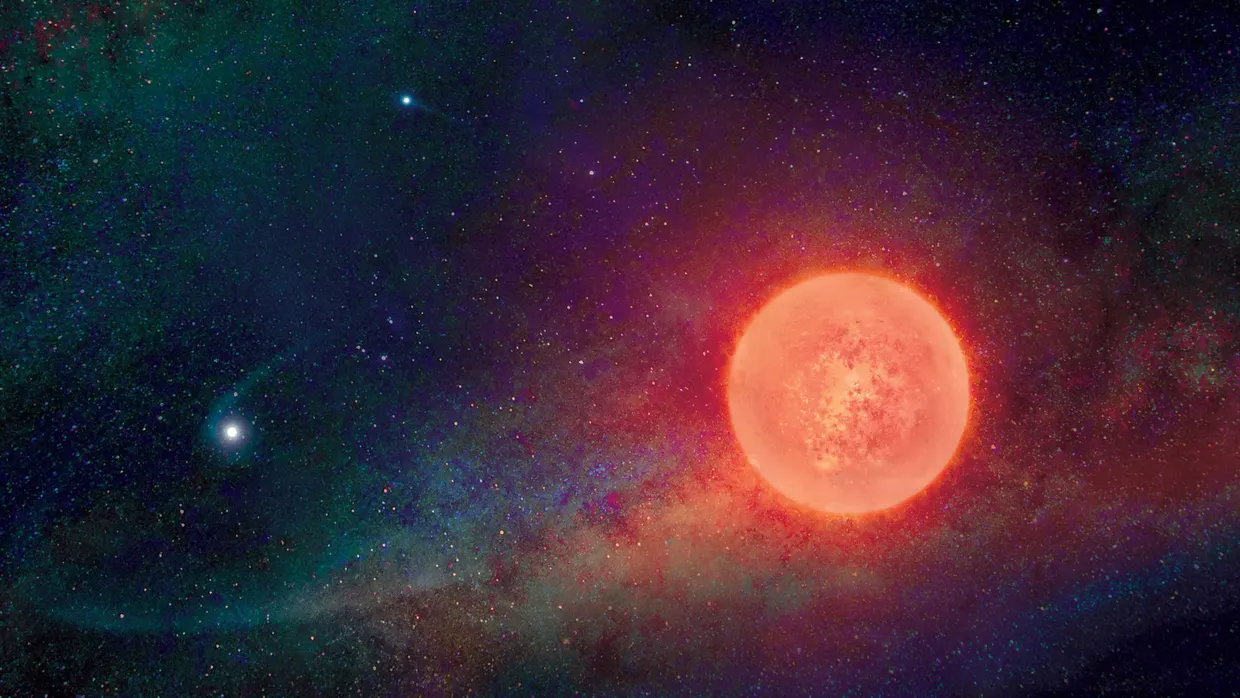
WD J1330+6435, at roughly 4,000 degrees Celsius, has accreted rocky material from its planetary system, which enriched its atmosphere with calcium, lithium and sodium. In the team's models it appears chartreuse green, since sodium absorbs the orange part of the spectrum. warwick.ac.uk
warwick.ac.ukwarwick.ac.ukOpen source ↗ The authors say no other star has been credibly reported as green.
At the other extreme is WD J1011+2845, 48 light years from Earth. Convection has lifted carbon from its core to the surface, and carbon molecules push almost all of its light to wavelengths beyond 600 nanometres, giving a deep salmon-pink glow. The authors say it may be the reddest star recorded.
Of the 151 white dwarfs within 20 parsecs (about 65 light years), five had unusual colours: two yellow and three pink, which suggests roughly one in thirty. For the other 146, the median colour temperature was approximately 6,800 kelvin, which looks white. The authors note that hotter, bluer white dwarfs are brighter and so over-represented in surveys based on brightness alone.