Bogong moths navigate by Earth's magnetic field and stars, a Nature study with a flight simulator shows
A team led by Eric Warrant reports that Agrotis infusa has a second compass sensitive to magnetic field inclination and dependent on blue-violet light, in addition to its stellar compass.
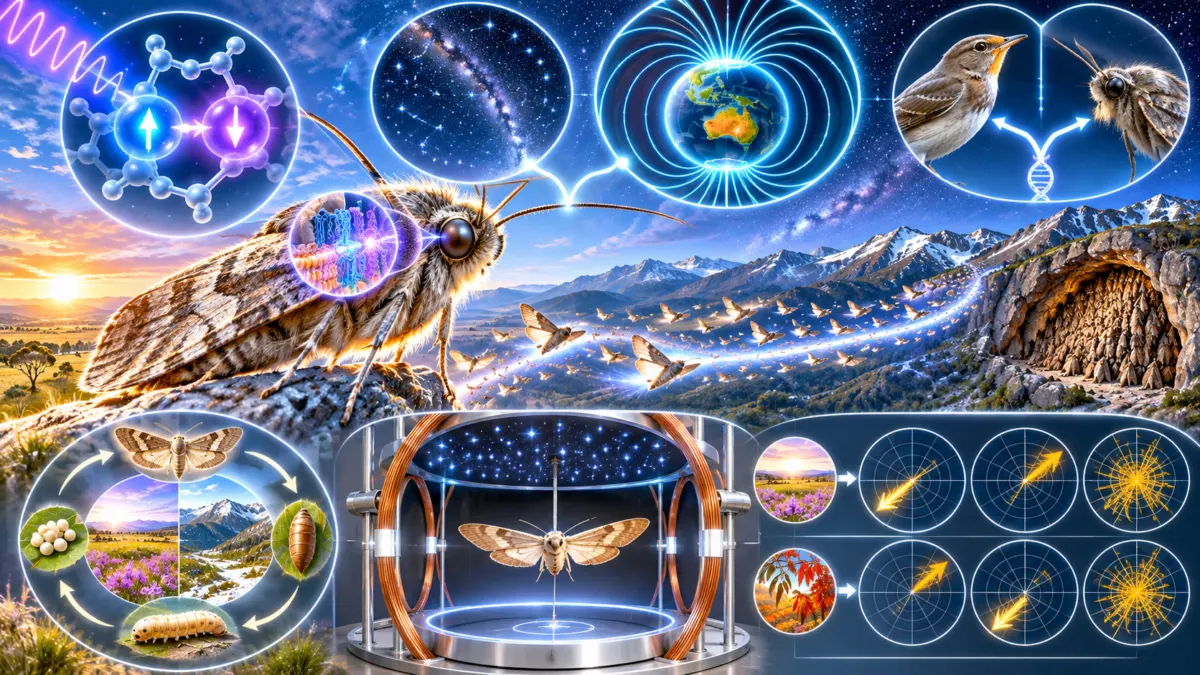
An international team led by Hui Chen, Pauline N. Fleischmann, Eric J. Warrant and Henrik Mouritsen has reported in Nature that Bogong moths (Agrotis infusa) use two complementary internal compasses, according to meteoweb.eu. One reads the stars. The other is a geomagnetic compass based on the inclination of Earth's magnetic field and activated by blue-violet light meteoweb.eu
meteoweb.eumeteoweb.euOpen source ↗. The authors are affiliated with Lund University in Sweden and Carl von Ossietzky University of Oldenburg in Germany.
Migration without a learned route
The moths live about a year. In spring, billions of newly emerged adults leave breeding grounds on the plains of south-eastern Australia and fly up to 1,000 kilometres to a small number of caves and rock crevices in the Australian Alps. They have never been there before and cannot learn the route from older individuals. In the caves they estivate for three to four months, at densities of up to 17,000 individuals per square metre. In autumn the same moths fly back north to mate, lay eggs and die. Earlier work had shown a stellar compass, but it was unclear how the moths keep their heading under thick cloud.
Flight simulator and magnetic coils
The researchers caught migrating moths at Mount Selwyn and Dead Horse Gap in New South Wales over two spring seasons (2023-2024) and two autumn seasons (2024-2025). The insects were tethered by a tungsten pin to an optical flight simulator in an underground laboratory at Adaminaby, free of ferromagnetic materials. Heading was recorded five times per second to build a five-minute virtual trajectory. Helmholtz coils reproduced, rotated or cancelled the local field of 57,600 nanotesla, while a random starry sky removed any usable stellar cues.
With the natural field and no recognisable stars, the moths flew south-west in spring and north-north-east in autumn. Rotating magnetic north by 180 degrees reversed their course by nearly 180 degrees in both seasons, and cancelling the field disoriented them. Inverting both field components left the heading unchanged, while inverting only the vertical component sent the moths north-east. This indicates an inclination compass that distinguishes the direction toward the pole from the direction toward the equator meteoweb.eu
meteoweb.eumeteoweb.euOpen source ↗.
When wavelengths below 500 nanometres were filtered out, the moths could not orient by the magnetic field in either season. With a natural starry sky and no magnetic field they still navigated well without blue or ultraviolet light, so the loss was not a visual deficit. The authors link the mechanism to radical pairs in cryptochrome proteins, the same system found in nocturnal migratory songbirds.