POSTECH and Samsung Research build 1.5 mm metasurface waveguide prototype for AR glasses
The prototype shows white text over a real scene in bright outdoor light and color images indoors. The team cut light loss in the waveguide, a known limit for AR glasses.
On 12 November 2026, South Korea's Ministry of Science and ICT announced that a team led by Professor Noh Jun-seok of POSTECH and Samsung Research developed an optical technique that sharply cuts light loss in a metasurface waveguide for AR glasses, according to yna.co.kr. yna.co.kr
yna.co.kryna.co.krOpen source ↗ The work was published in Nature the same day.
Where the light is lost
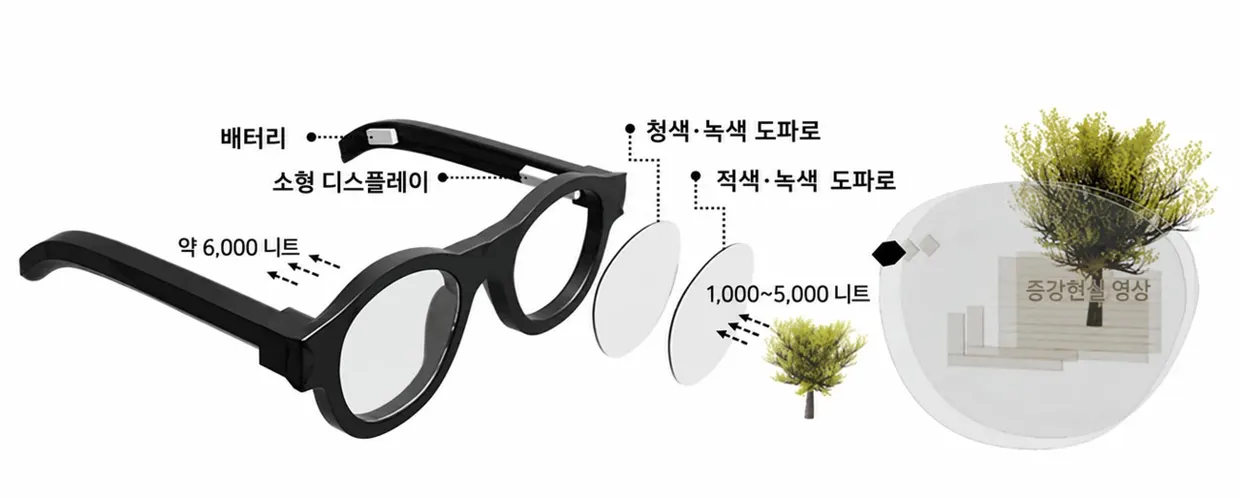
In AR glasses, light from a small display enters a thin waveguide, and surface microstructures redirect it to the eye. Some light escapes in other directions, so the image dims, and losses grow when the eye moves. Red, green and blue light also pass the same microstructure with different efficiency, which distorts colors.
The team showed in theory and experiment that designing the light path across the whole waveguide at the nanometer scale reduces unwanted loss and keeps the image clear as the eye position changes. The metasurface is an array of nanostructures smaller than the wavelength of light.
Two-layer prototype
To even out color efficiency, the team stacked a layer carrying mainly blue and green light with one carrying mainly red and green. The 1.5 mm thick waveguide showed white text in bright outdoor light and color images indoors over the real scene. yna.co.kr
yna.co.kryna.co.krOpen source ↗
The team says practical use requires raising average luminance to the industry brightness standard and matching this performance with one waveguide instead of two. Noh said the next steps are reducing rainbow artifacts and securing mass-production technology.